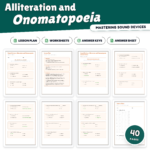
Alliteration and Onomatopoeia Worksheets | Sound Device Practice | Answer Key
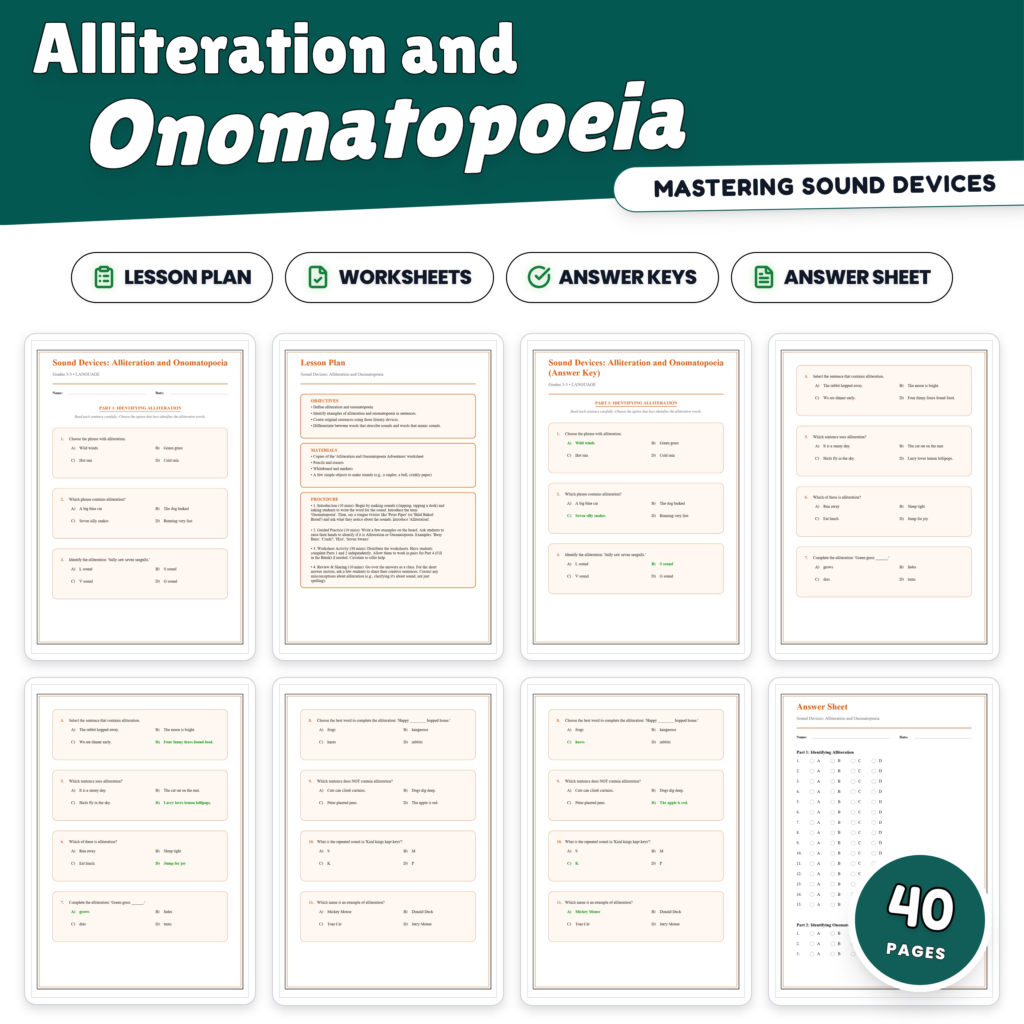
A 40 page alliteration and onomatopoeia worksheet set for grades 3-5, with a lesson plan, student worksheet, answer key and answer sheet.
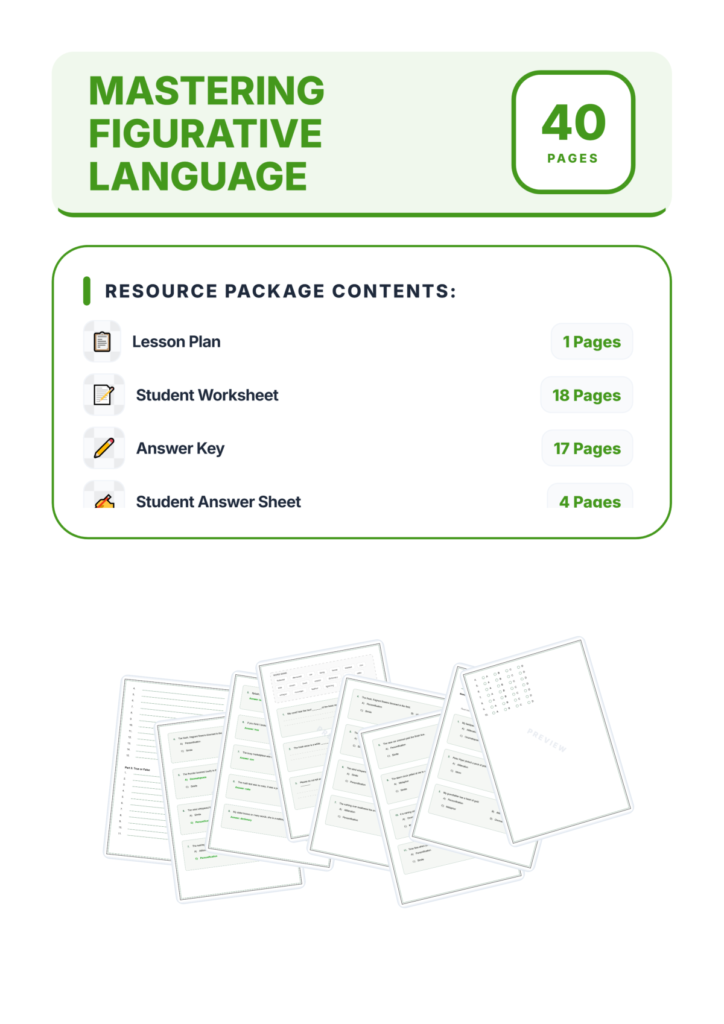
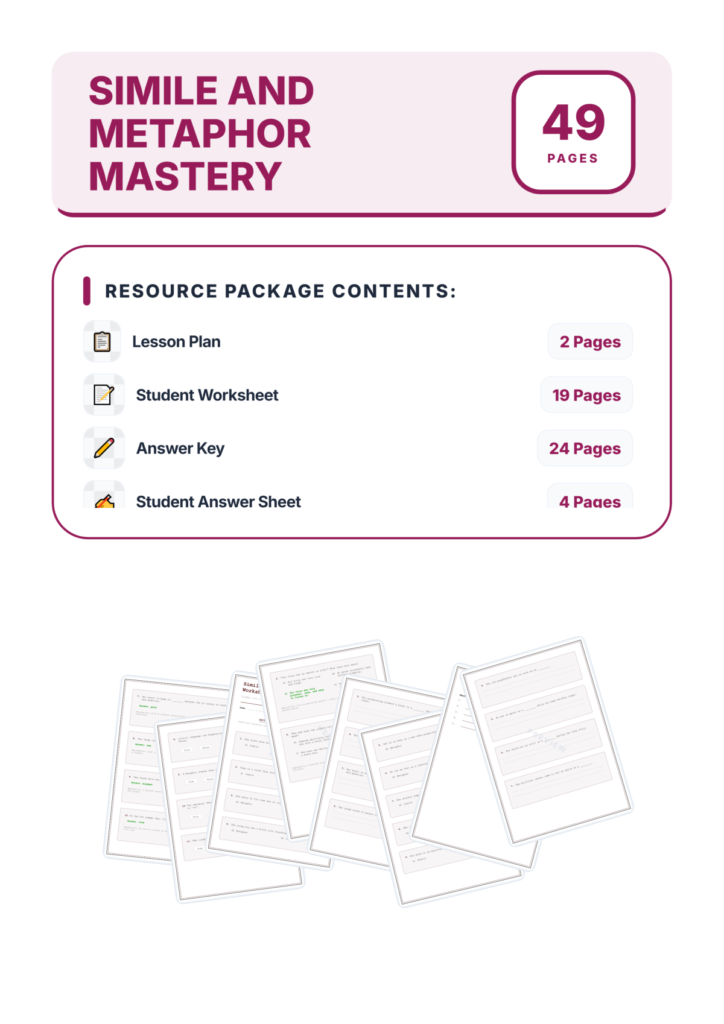
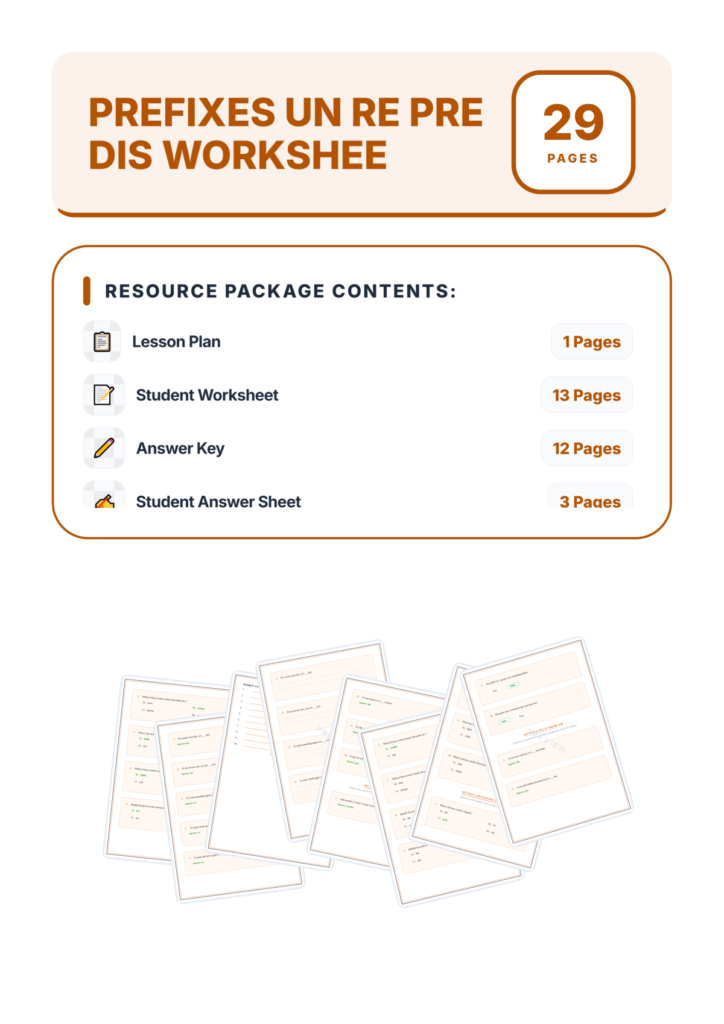
- PDF Sound Devices Alliteration and Onomatopoeia Answer Key 17 pages
- PDF Sound Devices Alliteration and Onomatopoeia Answer Sheet 4 pages
- PDF Sound Devices Alliteration and Onomatopoeia Lesson Plan 1 page
- PDF Sound Devices Alliteration and Onomatopoeia Worksheet 18 pages
- Total number of pages
- 40
- Page size
- A4
Alliteration and Onomatopoeia Worksheets for Sound Devices Practice
These alliteration and onomatopoeia worksheets give upper elementary students a full set of activities for practicing two common sound devices in one resource.
The set is built for grades 3 to 5 and works for a whole class lesson, a small group station, or one student working alone at home.
Alliteration and onomatopoeia are two of the easiest literary devices to teach because students already hear them everywhere: in tongue twisters, comic books and picture books. This resource turns that familiar sound into a structured skill students can name and use on their own.
The lesson plan opens with a simple warm up. The teacher makes a sound, like clapping or tapping a desk, and asks students to write the word for it. That introduces onomatopoeia before the term is ever defined on paper. A tongue twister such as Peter Piper or Bilal Baked Bread does the same job for alliteration.
What Students Practice with These Alliteration and Onomatopoeia Worksheets
Part 1 asks students to pick the phrase or sentence that contains alliteration, such as choosing between four answer choices for a line like Sally saw seven seagulls.
Part 2 switches to onomatopoeia. Students choose the word that names a sound, for example Hiss, Beep, Tinkle, Thud, Splash, Sizzle, Gulp, Buzz or Crunch.
Part 3 is a true or false section that checks whether students understand the definitions, not just the examples.
Part 4 is a fill in the blank page with a word bank, where students choose the word that completes an alliterative or onomatopoeic line, like Seven ______ swans swam silently.
Part 5 asks for short written answers: naming a sound a duck makes, rewriting a sentence to add alliteration, and writing an original alliterative phrase.
Across the five parts, the vocabulary stays grade appropriate: swans, mice, lions, frogs, bears and birds carry the alliteration questions, while a snake, a bell, a car horn and a heavy object falling carry the onomatopoeia questions. Nothing asks students to reach for a word they have not already met.
The short answer page raises the bar slightly. One question asks students to explain why Blue sky is not alliteration, which pushes them past matching letters and toward listening for the actual sound. Another asks for a two word alliterative phrase built around the word Tiger, so students have to invent rather than just select.
What Is in the Download
The zip file holds four PDFs.
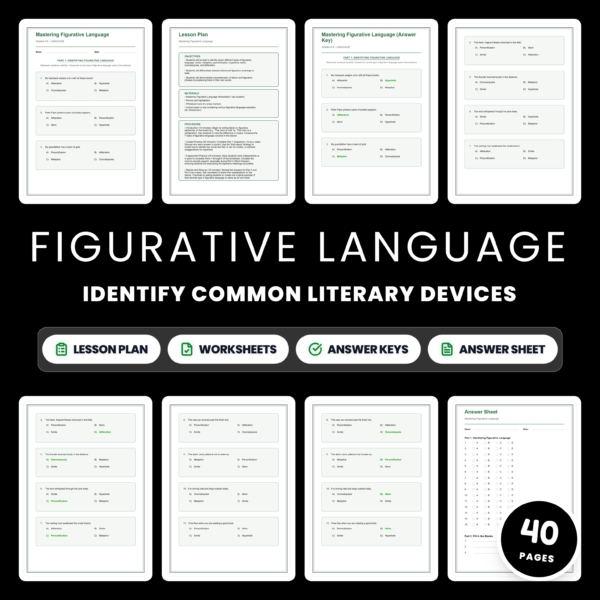
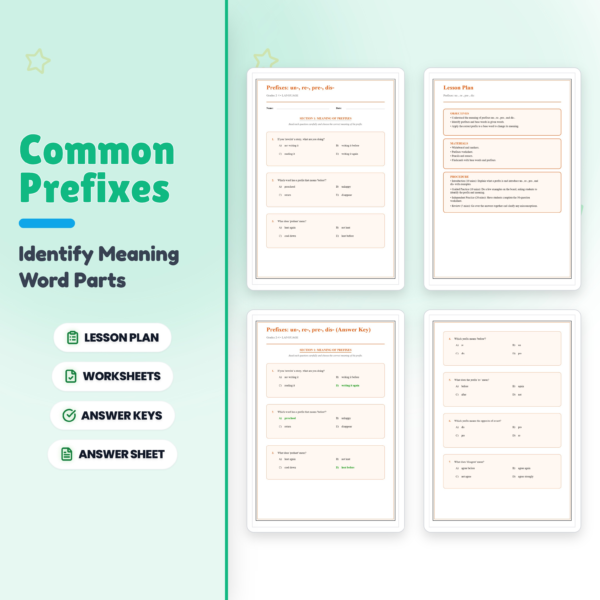
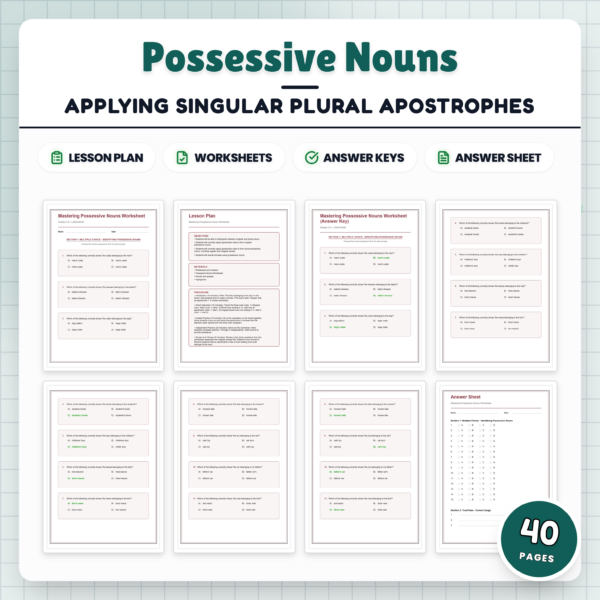
- ✏️ Lesson Plan: 1 page, with objectives, materials and a timed procedure.
- 📄 Student Worksheet: 18 pages, covering all five parts described above.
- ✅ Answer Key: 17 pages, with the correct choice marked for every question.
- 📋 Student Answer Sheet: 4 pages, a bubble sheet for marking A, B, C or D or circling True or False.
That is 40 pages total, counted directly from the files themselves.
How Teachers and Parents Use This Resource
The lesson plan is written for a single class period: an introduction, guided practice on the board, the worksheet itself, then a review.
Beyond the main lesson, the alliteration and onomatopoeia worksheets fit homework, a literacy center, an early finisher task, a sub plan folder or quiet homeschool practice.
Because the answer key and answer sheet are separate files, a teacher can hand out just the worksheet and answer sheet and keep the key for grading.
🏫 The short answer section also works well for partner talk, since a few questions ask students to explain or create their own example.
📁 Every file in this set is a PDF, so it opens on a computer, a tablet or a phone before printing.
🔍 Look through the preview pages first to see the exact question style and layout before you buy.
📚 Because the questions are multiple choice, true or false, fill in the blank and short answer, the set works as a review packet as well as a first lesson. A teacher can assign only Parts 1 and 2 for a quick check, or the full set for a longer unit on figurative language and sound devices.
🧩 The fill in the blank page uses a single word bank for all fifteen blanks, which means students have to test each word in context rather than guessing from a shrinking list. That keeps the activity from turning into a simple process of elimination.
These alliteration and onomatopoeia worksheets pair naturally with other figurative language and grammar resources on the site. Browse more ELA worksheets for related reading and writing skills, or visit the grammar worksheets section for sentence level practice. You can also see the full shop for more printable resources.
Frequently Asked Questions
How many pages are in this alliteration and onomatopoeia worksheets set?
The download is 40 pages total: a 1 page lesson plan, an 18 page student worksheet, a 17 page answer key and a 4 page student answer sheet. Every page count was checked directly against the PDF files before listing.
What grade level is this resource for?
The worksheet and answer key are both labeled Grades 3-5, so the questions and vocabulary are written for upper elementary students who are ready to identify and create examples of alliteration and onomatopoeia on their own.
Is an answer key included?
Yes. A separate 17 page answer key marks the correct multiple choice option for every question and gives sample answers for the short response section, so grading the worksheet does not require working out each answer yourself.
What types of questions are in the worksheet?
The worksheet mixes multiple choice, true or false, fill in the blank with a word bank, and short written response questions across five parts, moving from picking an example to writing an original alliterative or onomatopoeic sentence.
Can this be used for both alliteration and onomatopoeia in one lesson?
Yes. The lesson plan is written to introduce both sound devices in a single class period, and the worksheet keeps them in separate parts so a teacher can also split the alliteration and onomatopoeia worksheets across two shorter lessons instead.
| Format | Digital PDF Document (.pdf) |
|---|---|
| Page size | A4 |
| Pages | 40 |
| Quality | Print-ready PDF |
| License | Single Classroom / Personal Homeschool License |