Space and Planets Reading Comprehension Passages and Solar System Worksheets
This 64 pages packet teaches space and planets reading comprehension through astronomy topics. Students explore the sun, terrestrial planets, gas giants, and distant asteroids.
Instant PDF download after payment, also saved in My Library.
Secure checkout by card or crypto.
Use it at home or in one classroom. Read the license
Details
- File format
- Pages
- 64
- Page size
- A4
- Files
- 3
- Grades
- 3rd–5th
- Answer key
- Included
In this download 3 files
- PDF Space and Planets Reading Comprehension Passages Worksheet 22 pages
- PDF Space and Planets Reading Comprehension Passages Answer Key 41 pages
- PDF Space and Planets Reading Comprehension Passages Lesson Plan 1 page
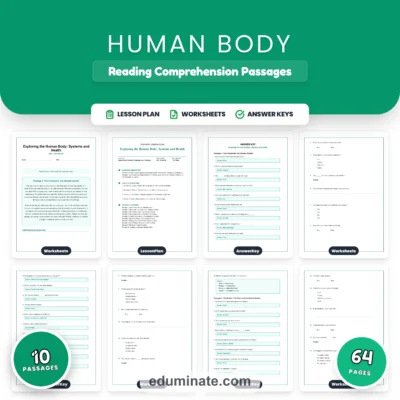
Sample pages
Space and planets reading comprehension for upper elementary classrooms
This unit provides focused space and planets reading comprehension practice for third grade, fourth grade, and fifth grade learners. Through ten informative astronomy articles, students explore the celestial wonders of our solar system, planetary characteristics, atmospheric conditions, and orbital mechanics.
Every selection connects space science with structured literacy instruction, providing teachers with 64 pages of classroom-ready printables. The complete packet features 41 pages of student worksheets, a 22 pages answer key, and a 1 page teacher lesson plan. Learners examine the intense heat of the sun, the cratered terrain of Mercury, thick volcanic clouds on Venus, and distant icy worlds.
Informational astronomy topics covered in this unit
Developing consistent space and planets reading comprehension requires engaging, scientifically grounded non-fiction content. These ten passages introduce core astronomy principles with structured vocabulary and clear informational paragraphs suitable for elementary students.
- Passage 1 explores the sun as our central star, detailing nuclear fusion, immense gravitational pull, solar flares, and its vital light that sustains life on Earth.
- Passage 2 examines Mercury as the swift planet, describing extreme temperature fluctuations, lack of atmosphere, rapid orbital speeds, and impact craters.
- Passage 3 investigates Venus as the cloudy planet, explaining dense carbon dioxide atmospheres, runaway greenhouse effects, and scorching surface heat.
- Passage 4 celebrates Earth as the blue marble, highlighting liquid water oceans, protective magnetic fields, and breathable oxygen-rich air.
- Passage 5 focuses on the moon as Earth’s natural companion, discussing tidal forces, lunar phases, meteorite bombardment, and historic lunar exploration.
- Passage 6 details Mars as the red planet, exploring iron-oxide dust, polar ice caps, dormant volcanoes like Olympus Mons, and robotic rover missions.
- Passage 7 explores Jupiter as the giant planet, describing swirling gas bands, the Great Red Spot storm, and immense planetary mass.
- Passage 8 highlights Saturn as the ringed beauty, examining thousands of ice and rock ringlets, low density, and numerous orbiting moons.
- Passage 9 investigates Uranus and Neptune as the ice giants, detailing methane gas atmospheres, chilling temperatures, and supersonic winds.
- Passage 10 covers dwarf planets and asteroids, explaining the asteroid belt, Kuiper belt objects, and the scientific classification of Pluto.
Structured comprehension questions and assessments
To reinforce space and planets reading comprehension passages and earth and space science reading passages, each text features twenty structured questions. These exercises target vital informational reading standards, requiring students to cite facts, analyze context clues, and demonstrate critical thinking.
- Multiple choice items assess factual recall, passage sequence, and central idea identification across all planetary selections.
- True and false prompts require learners to verify precise statements about planetary sizes, orbits, and atmospheric compositions.
- Fill in the blank sentences reinforce astronomy vocabulary including gravity, orbit, atmosphere, asteroid, and greenhouse effect.
- Matching activities connect celestial bodies with their distinctive physical traits and scientific classifications.
- Short response questions ask learners to summarize astronomical discoveries and explain planetary differences using direct textual evidence.
Classroom implementation and instructional ideas
Teachers seeking planets reading comprehension worksheets can integrate space and planets reading comprehension lessons into various parts of their schedule. These solar system reading comprehension passages support science units, literacy circles, morning warmups, or thematic STEM rotations.
- Use individual passages during weekly reading intervention groups, small group instruction, or close reading rotations.
- Incorporate selections into elementary science units exploring our solar system, gravity, and the universe.
- Assign specific selections as independent morning work, homework assignments, or structured emergency substitute plans.
- Keep printed packets available for early finishers who love astronomy and space exploration.
The estimated lesson plan pacing spans approximately 150 minutes across multiple flexible class periods. Providing structured space and planets reading comprehension helps elementary learners build confidence in reading complex scientific texts while discovering the wonders of our planetary neighborhood.
Discover more resources in our reading comprehension collection, find printable activities in our science worksheets library, or visit the Eduminate shop for elementary curriculum materials.
Frequently Asked Questions
What grade levels is this space and planets reading comprehension packet designed for?
This unit is designed specifically for students in 3rd grade, 4th grade, and 5th grade. The reading passages present fundamental solar system concepts using clear, engaging explanations and structured question sets that allow teachers to differentiate instruction effectively.
Are complete answer keys provided for all ten reading passages?
Yes, a complete 22 pages answer key section provides solutions for all twenty questions per passage. The clear layout allows teachers and substitutes to grade student work quickly or enable students to conduct independent self checking during science stations.
How does this packet support cross-curricular science and literacy standards?
The passages present standards-aligned earth and space science content while developing core reading comprehension skills. Students practice citing text evidence, identifying main ideas, and learning scientific terminology within a structured literacy framework.