Clean Water Technology Reading Comprehension Passages and Questions Gr 3-7
65 pages exploring water purification, filtration methods, and sanitation engineering across 10 reading passages for grades 3-7.
Instant PDF download after payment, also saved in My Library.
Secure checkout by card or crypto.
Use it at home or in one classroom. Read the license
Details
- File format
- Pages
- 65
- Page size
- A4
- Files
- 3
- Grades
- 3rd–7th
- Answer key
- Included
In this download 3 files
- PDF Clean Water Technology Reading Comprehension Passages Lesson Plan 1 page
- PDF Clean Water Technology Reading Comprehension Passages Answer Key 42 pages
- PDF Clean Water Technology Reading Comprehension Passages Worksheet 22 pages
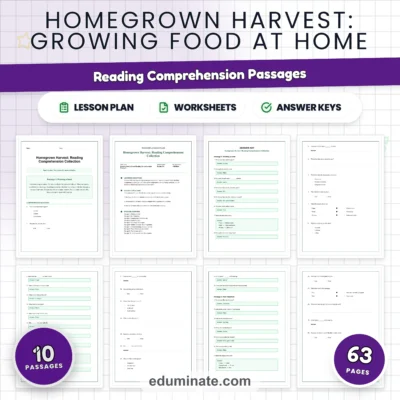
Sample pages
Clean Water Technology Reading Comprehension Passages for Grades 3-7
Turn on a tap and clean water pours right out. Most students take that for granted. This set of clean water technology reading comprehension passages shows them the engineering and environmental science behind every drop. Across 65 pages of printable student materials, your class will examine ten distinct purification methods from ancient history to modern engineering. Each of the 10 informational passages explains a specific method people use to make dirty water safe to drink. Students read the text, answer questions that test detail recall and inference, and build practical science vocabulary along the way.
I designed these clean water technology reading comprehension passages for students in grades 3 through 7. The range works well because the concepts start with familiar ideas like boiling and sand filters before moving to technical topics like reverse osmosis and nanotechnology. You get 22 pages of answer keys to make checking student work fast and reliable. The included 1 page teacher lesson plan gives you a pacing outline for 150 minutes of instruction, complete with discussion starters for each passage.
Water Purification and Filtration Topics Included
The 10 reading passages cover ten distinct methods used around the globe:
Passage 1: Using Sand to Clean Water shows how layers of coarse gravel and fine sand trap suspended dirt like a sieve. Passage 2: Boiling Water to Kill Germs explains heat disinfection, thermal energy, and why high temperatures destroy bacteria. Passage 3: The Water Cycle Filter examines natural evaporation and condensation as Earth’s original purification mechanism. Passage 4: Clay Pot Filters details micro-porous pottery used in rural communities worldwide. That makes these clean water technology reading comprehension worksheets great for connecting environmental science to global citizenship and everyday problem-solving. Passage 5: Chlorine: The Chemical Cleaner explains municipal chemical treatments that neutralize pathogens in city reservoirs. Passage 6: Desalination: Removing the Salt looks at thermal distillation and coastal plants that convert ocean water into freshwater. Passage 7: Reverse Osmosis Explained unpacks semi-permeable membranes and artificial pressure. Students working on these water filtration science reading passages with questions see how modern membranes block microscopic contaminants that regular filters miss. Passage 8: Ultraviolet Light Cleaning explains how light rays scramble microbial DNA without adding chemical tastes. Passage 9: Wastewater Treatment Plants follows sewage through settling tanks and aeration basins. Passage 10: The Future: Nanotechnology wraps up the unit by connecting these water purification technology science reading activities to microscopic carbon tubes that might filter water using minimal energy.
Each passage includes student worksheets with multiple-choice questions, short-answer items, and vocabulary matching exercises. These clean water technology reading comprehension passages give students repeated practice finding textual evidence in technical nonfiction.
Ways to Use This Packet in Your Classroom
Middle grade science teachers use this grades 3-7 clean water reading comprehension packet during units on natural resources, ecology, physical separations, and engineering design. You can assign one passage each day during a two-week environmental unit or place selected sheets in your independent science center. Third and fourth graders can focus on the introductory filtration texts in small guided reading groups. Fifth through seventh graders can read independently and tackle the higher-level questions on reverse osmosis and chemical treatment.
Everything is print-ready. You do not need extra lab equipment or special prep to teach these concepts. Because each passage and question set is self-contained, these clean water technology reading comprehension passages work equally well as planned classwork, homework packets, or quick sub plans.
Find more informational reading units in our complete reading comprehension collection or browse related engineering and earth science topics in the science category. Additional printable materials are available across the worksheets section.
Print on standard paper and start teaching.
Frequently Asked Questions
What grade levels are these clean water technology reading comprehension passages written for?
This packet is written for students in grades 3 through 7. The 10 passages begin with simple physical filtration methods and progress to advanced topics like reverse osmosis and nanotechnology.
How many total pages and reading passages are included?
The resource contains 65 pages in total, including 10 informational reading passages, 42 pages of student worksheets, 22 pages of complete answer keys, and a 1 page teacher lesson plan.
What specific water cleaning technologies do students learn about?
Students learn about sand filtration, boiling, the water cycle, clay pot filters, chlorine disinfection, ocean desalination, reverse osmosis membranes, ultraviolet sanitation, municipal wastewater treatment, and future nanotechnology filters.
Does this resource include complete answer keys for grading?
Yes, 22 pages of answer keys are included. Every multiple-choice question, text-evidence prompt, and vocabulary matching item has complete solutions to help you grade student work quickly and accurately.