Deserts Around the World Reading Comprehension Passages and Questions Gr 3-7
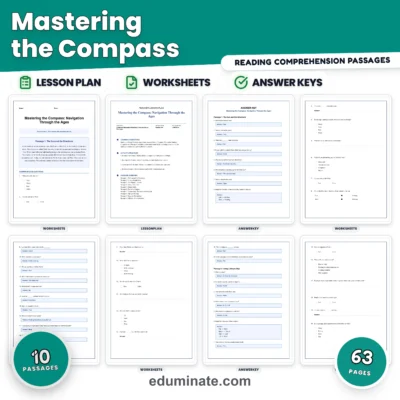
63 pages exploring the Sahara, Gobi, desert adaptations, oases, and cold deserts across 10 reading comprehension passages for grades 3-7.
Instant PDF download after payment, also saved in My Library.
Secure checkout by card or crypto.
Use it at home or in one classroom. Read the license
Details
- File format
- Pages
- 63
- Page size
- A4
- Files
- 3
- Grades
- 3rd–7th
- Answer key
- Included
In this download 3 files
- PDF Deserts Around the World Reading Comprehension Passages Worksheet 22 pages
- PDF Deserts Around the World Reading Comprehension Passages Answer Key 40 pages
- PDF Deserts Around the World Reading Comprehension Passages Lesson Plan 1 page
Sample pages
Deserts Around the World Reading Comprehension Passages for Grades 3-7
Most students think of deserts as endless rolling sand dunes baking under blistering afternoon heat. In reality, dry biomes range from freezing gravel plateaus in central Asia to vast polar ice sheets. This set of deserts around the world reading comprehension passages gives your class ten structured informational texts on global desert biomes. Across 63 pages of classroom materials, students explore rainfall patterns, sand dunes, isolated oases, and extreme survival strategies. Each passage comes with student question sheets that check comprehension, build factual recall, and introduce essential life and earth science vocabulary.
I wrote these deserts around the world reading comprehension passages to support learners in elementary and middle school classrooms. The texts begin with accessible definitions of aridity before examining specific geography like the Sahara and Gobi. You get 22 pages of complete answer keys for quick and stress-free grading. The included 1 page teacher lesson plan provides discussion prompts and a structured schedule across 150 minutes of instructional time.
Global Geography and Desert Ecology Topics Covered
The 10 reading passages guide students through diverse arid landscapes across multiple continents:
Passage 1: What is a Desert? defines aridity based on moisture evaporation rather than daily temperature. Passage 2: The Ship of the Desert examines camel physiology, including wide padded feet and fat storage humps. Passage 3: The Great Sahara explores the largest hot desert on Earth, detailing rock plateaus, dry valleys, and shifting dunes. Passage 4: Plants in the Dry Lands explains waxy leaf coatings, accordion stems, and shallow root networks that soak up sudden rain. Passage 5: Not Just Hot Sand clarifies cold deserts like Antarctica and the Great Basin where freezing winds scour rocky plains. Passage 6: The Windy Gobi examines Asian gravel basins and extreme seasonal temperature swings. Students completing these sahara and gobi desert reading passages with questions learn how mountain rain shadows create arid landlocked basins. Passage 7: Life at the Oasis explains underground aquifers and freshwater springs that support date palms and small desert towns. Passage 8: The Arabian Sands describes wind-sculpted sand seas and ancient nomadic caravan routes. Working through these desert biomes and ecosystems reading comprehension worksheets gives learners a grounded look at global habitats. Passage 9: Spreading Sands explains desertification, soil erosion, and windbreak reforestation efforts along vulnerable borders. Passage 10: Masters of Survival highlights nocturnal habits, underground burrows, and water-conserving behaviors. These desert plant and animal adaptations reading activities show how living organisms thrive in harsh conditions.
Each passage includes student worksheets featuring multiple-choice questions, short-answer prompts, and vocabulary matching. These deserts around the world reading comprehension passages help students practice citing textual evidence while discovering global environmental science. Learners evaluate scientific explanations, track cause and effect relationships, and practice summarizing core takeaways in their own words.
Classroom Application and Differentiation Ideas
Teachers use this grades 3-7 deserts around the world reading packet for science biomes units, social studies geography lessons, or independent reading centers. Third and fourth graders can read the introductory texts in guided reading groups to discuss basic aridity and plant survival. Fifth, sixth, and seventh graders can read independently and evaluate complex issues like desertification and rain shadow mechanics. You can have students work with partners to check answers or use the passages as research sources before creating habitat dioramas or travel brochures. Because every text and worksheet set is self-contained, these deserts around the world reading comprehension passages fit into substitute folders with no fuss.
Find more informational reading units in our complete reading comprehension collection or explore related planetary and habitat resources in the science category. Additional printable materials are available across the worksheets section.
Print on standard paper and you are ready to teach.
Frequently Asked Questions
What grade levels are these deserts around the world reading comprehension passages written for?
This packet is designed for students in grades 3 through 7. The 10 reading passages present world geography, desert ecosystems, and organism survival with clear vocabulary suited to diverse reading abilities.
How many total pages and passages are included in this packet?
The resource contains 63 pages in total. You receive 10 informational reading texts, 40 pages of student worksheets, 22 pages of answer keys, and a 1 page teacher lesson plan.
What desert biomes and scientific topics do students explore?
Students explore aridity definitions, camel anatomical adaptations, the Sahara Desert, cactus water retention, cold polar deserts, the windy Gobi Desert, natural oases, Arabian sand seas, desertification, and nocturnal wildlife.
Are answer keys provided for all student questions?
Yes. The set includes 22 pages of complete answer keys. Every multiple-choice question, vocabulary check, and written response item has clear answers to save you grading time.