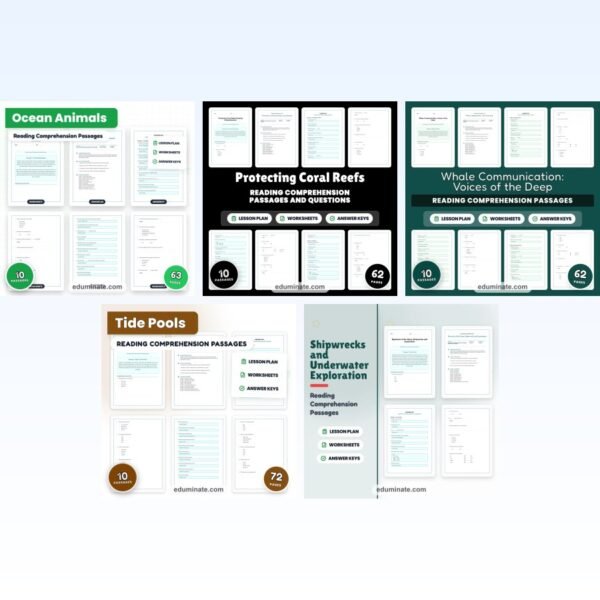
Shipwrecks and Underwater Exploration Reading Passages Worksheets 3rd 7th Grade
Investigate sunken vessels and ocean science with shipwrecks and underwater exploration reading passages. Features 10 texts, tasks, and answer keys across 74 pages for grades 3 to 7.
Instant PDF download after payment, also saved in My Library.
Secure checkout by card or crypto.
Use it at home or in one classroom. Read the license
Details
- File format
- Pages
- 74
- Page size
- A4
- Files
- 3
- Grades
- 3rd–7th
In this download 3 files
- PDF Shipwrecks and Underwater Exploration Reading Comprehension 23 pages
- PDF Shipwrecks and Underwater Exploration Reading Comprehension 2 1 page
- PDF Shipwrecks and Underwater Exploration Reading Comprehension 3 50 pages
Sample pages
Explore Ocean History with Shipwrecks Reading Comprehension Passages
Shipwrecks rest on ocean beds around the globe. They serve as valuable time capsules that preserve historical tools, personal goods, and naval architecture from eras past. Students can study marine science and maritime heritage through our dedicated collection of shipwrecks reading comprehension passages. This classroom resource delivers ten informational reading passages that trace human inquiry from early divers to modern autonomous submersibles across 74 pages.
Every passage connects essential literacy goals with earth science, history, and modern engineering concepts. Students discover why ocean vessels sink, how marine life colonizes artificial reefs, and how acoustic sonar maps ocean floor terrain. In addition, these underwater exploration worksheets help learners analyze informational text structures, build domain-specific scientific vocabulary, and cite clear text evidence accurately during independent practice.
Educational Passages and Maritime Science Topics
The collection provides ten nonfiction passages tailored for learners in grades 3 through 7. Each passage introduces distinct historical and scientific principles:
- The Toy Boat: Introduces buoyancy, water resistance, gravity, and the basic physical forces that keep floating objects upright on water surfaces.
- Scuba Divers: Examines early diving apparatus, compressed gas cylinders, underwater pressure regulation, and essential underwater safety rules.
- Why Ships Sink: Explores hull breaches, cargo shifts, severe storms, ballast adjustments, and maritime structural stability.
- New Homes for Fish: Shows how sunken ships transform into artificial reefs that support thriving marine biomes and coral colonies.
- Navigating the Seas: Outlines navigational instruments across centuries, from magnetic compasses and astrolabes to modern satellite tracking systems.
- Using Sound to See: Details sonar acoustic technology, sound wave reflection, bathymetric mapping, and deep-water depth sounders.
- Underwater Detectives: Highlights the precise field work of marine archaeologists who catalog sunken artifacts without damaging fragile wreck sites.
- Preserving History: Explains chemical treatments and conservation methods that stabilize waterlogged wood, leather goods, and iron relics.
- Robots in the Deep: Examines remotely operated vehicles, tethered submersibles, and autonomous robots that explore extreme abyssal ocean depths.
- The Silent World (Anoxic Preservation): Details cold, low-oxygen benthic environments that protect wooden ship hulls from microbial decay for centuries.
Targeted Literacy Skills and Classroom Implementation
Teachers use these materials for whole-group reading instruction, small-group intervention sessions, and independent science stations. The included ocean archaeology reading comprehension tasks prompt students to identify cause-and-effect relationships, distinguish verifiable facts from inferences, and summarize complex paragraphs. Each passage pairs with multiple-choice questions, vocabulary drills, and short constructed-response writing prompts that demand evidence from the text.
Our printable shipwrecks reading comprehension passages include complete answer keys and a structured lesson plan to support rapid grading. Educators can pair these texts with broader earth science units or use them as focused weekly reading assessments. The predictable structure ensures that students build substantial background knowledge while mastering rigorous comprehension standards across multiple subject areas.
You can integrate these deep sea science worksheets into interdisciplinary units that link physical geography and marine biology. Students examine real-world maritime challenges, such as hydrostatic pressure, metallic corrosion, and legal treaties protecting underwater heritage sites. Engaging shipwreck reading activities encourage critical thinking, classroom discussion, and evidence-based writing across intermediate grade bands.
Assigning these detailed shipwrecks reading comprehension passages helps students build scientific reading fluency during morning warmups or homework assignments. Teachers can easily track student mastery as learners progress through challenging passages on deep-sea robotics and marine ecology. Incorporating our structured shipwrecks reading comprehension passages into your curriculum promotes analytical reading skills and sparks curiosity about deep ocean discoveries.
Each printable sheet gives students room to annotate key details, underline unfamiliar terms, and formulate concise written conclusions. These focused tasks prepare learners for standardized assessments by reinforcing careful textual analysis and cross-curricular reasoning skills throughout the school year.
Frequently Asked Questions
What grade levels work best with these shipwrecks reading comprehension passages?
This set targets grades 3 through 7. The reading levels increase gradually across the ten texts, allowing teachers to differentiate tasks easily. Third graders can explore fundamental ideas like buoyancy, while older middle school students analyze sonar acoustics and anoxic water chemistry.
Are answer keys included with these underwater exploration worksheets?
Yes, complete answer keys accompany every worksheet in the packet. The 23 answer key pages provide clear solutions for multiple-choice questions, vocabulary exercises, and written responses. This clear layout saves preparation time and supports immediate student feedback.
How can teachers integrate these reading passages into existing science units?
Educators can incorporate these shipwrecks reading comprehension passages into lessons on ocean ecosystems, physical forces, sound waves, or archaeological methods. The texts offer direct connections between informational reading standards and stem concepts.
What print formats and file types come with this purchase?
The resource arrives as print-ready PDF files containing 74 pages in total. The files include 50 student worksheet pages, 23 answer key pages, and 1 teacher lesson plan page. Teachers can print complete student packets or select individual passages as needed.