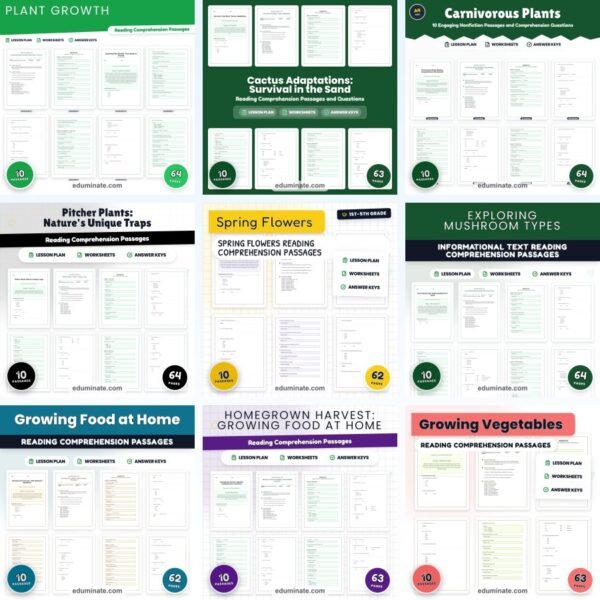
Flowers Worksheets: Reading Comprehension Passages with Answer Keys, Grades 1-5
Investigate plant growth, pollination, and seasonal blooms with spring flowers reading comprehension passages. Features 10 texts, tasks, and answer keys across 62 pages for grades 1 to 5.
Instant PDF download after payment, also saved in My Library.
Secure checkout by card or crypto.
Use it at home or in one classroom. Read the license
Details
- File format
- Pages
- 62
- Page size
- A4
- Files
- 3
- Grades
- 1st–5th
- Answer key
- Included
In this download 3 files
- PDF Spring Flowers Reading Comprehension Passages Worksheet 21 pages
- PDF Spring Flowers Reading Comprehension Passages Lesson Plan 1 page
- PDF Spring Flowers Reading Comprehension Passages Answer Key 40 pages
Sample pages
Explore Seasonal Botany with Flowers Worksheets
Spring arrival signals dramatic botanical changes across gardens, forests, and open meadows. As soil temperatures climb and daylight hours expand, dormant bulbs break through melting snow to unfold colorful blossoms. Our detailed set of flowers worksheets introduces elementary students to plant biology, flower anatomy, pollination relationships, and seasonal growth cycles. This practical resource provides ten informational articles accompanied by rigorous questions across 62 pages.
Every passage connects life science standards with foundational reading skills. Students discover how petals attract pollinating insects, how roots absorb moisture and dissolved minerals, and how seeds scatter to establish new plant colonies. In addition, these spring botany reading worksheets help learners analyze informational text structures, build domain-specific scientific vocabulary, and cite clear text evidence during independent reading practice.
Educational Passages and Plant Science Topics
The collection provides ten nonfiction passages tailored for learners in grades 1 through 5. Each lesson presents distinct plant biology topics through clear, age-appropriate text passages:
- The First Tulip: Follows underground bulb sprouting, early spring emergence, petal color development, and solar orientation.
- Cherry Blossoms in the Wind: Examines deciduous tree flowering, delicate blossom life cycles, wind pollination, and seasonal timing.
- The Golden Daffodil: Explores trumpet petal structures, cup shapes, perennial bulb survival, and early spring hardiness against light frost.
- Violet Hide-and-Seek: Details woodland floor shade adaptations, heart-shaped leaf growth, low-growing stems, and seed dispersal mechanisms.
- The Busy Garden: Highlights ecological plant care, garden soil health, earthworm aeration, and essential watering routines.
- Sunflowers Sprouting: Explores seedling emergence, seed coat separation, root establishment, and phototropism as stalks turn toward sunlight.
- The Bluebell Woods: Investigates ancient woodland carpets, spring canopy sunlight windows, and mutualistic insect pollinator relationships.
- Taking Care of Plants: Outlines photosynthesis essentials, balanced moisture levels, nutrient absorption, and proper stem maintenance.
- Wildflowers in the Meadow: Contrasts native prairie flora against cultivated garden species, focusing on root depth and resilience.
- The Rose Bush: Examines woody perennial stems, protective thorns, compound leaves, rose hip development, and seasonal pruning.
Targeted Literacy Skills and Classroom Implementation
Teachers use these materials for whole-group reading lessons, guided reading stations, and seasonal spring science blocks. The included plant life cycle reading passages prompt students to identify cause-and-effect patterns, compare different floral adaptations, and write evidence-based summaries. Each passage pairs with multiple-choice questions, vocabulary exercises, and short constructed-response questions.
Our printable flowers worksheets include complete answer keys and an organized lesson plan to support fast teacher grading. You can pair these articles with life science units on plant structures, seed germination experiments, or garden observation projects. The consistent format ensures that students gain deep factual knowledge while practicing critical reading standards.
You can integrate these flower science comprehension activities into broader botanical units that link life science and environmental education. Students explore how flowers support honeybees and butterflies while examining real-world agricultural ecosystems. Engaging spring garden reading comprehension tasks spark curiosity, collaborative discussion, and clear explanatory writing across elementary grades.
Assigning these printable flowers worksheets strengthens non-fiction fluency during morning work routines or homework assignments. Students build genuine confidence as they master technical botanical terms and discover fascinating facts about plant growth cycles. Using our flowers worksheets enriches your spring curriculum with dependable, classroom-tested printables.
Each worksheet page provides generous writing space for students to annotate key facts, underline unfamiliar terms, and record complete answers. These repeated reading routines cultivate strong critical thinking habits and independent inquiry throughout the school year. Learners develop lasting enthusiasm for plant biology as they explore how blooming flora revitalizes natural landscapes each spring.
Frequently Asked Questions
What grade levels work best with these flowers worksheets?
This set targets students in grades 1 through 5. The introductory texts on tulips and daffodils provide accessible reading for first and second graders, while subsequent passages exploring phototropism, woodland ecology, and woody stem biology offer appropriate depth for third, fourth, and fifth graders.
Are answer keys included with these spring botany reading worksheets?
Yes, complete answer keys accompany every worksheet in this collection. The 21 answer key pages provide clear solutions for multiple-choice questions, vocabulary tasks, and written explanations, making grading fast and efficient for busy educators and homeschooling parents.
Can teachers use these passages for cross-curricular spring science units?
Yes, these flowers worksheets integrate plant biology concepts directly into reading instruction. Teachers can use them during literacy blocks, science rotations, or dedicated STEM lessons to support standards in both reading comprehension and botany.
What files and total page count are included in this packet?
The download includes print-ready PDF files containing 62 pages in total. This includes 40 student worksheet pages covering ten passages, 21 answer key pages, and 1 teacher lesson plan page with pacing suggestions and objectives.