Multiplication Facts Practice: Strategies and Activities

Multiplication facts practice works best when children understand what a fact means before they try to memorize it. This guide covers the meaning of multiplication, strategies for the 2s through 9s, and card routines, games and daily drills for fluency.
What multiplication facts are
A multiplication fact is a product of two single-digit factors, such as 3 x 4 = 12 or 7 x 6 = 42. Multiplication starts as a quick way to add equal groups, so it helps when a child is already comfortable with addition.
Take 4 x 3. It can mean four groups of three, which is 3 + 3 + 3 + 3 = 12. It can also be shown as an array: four rows with three objects in each row. Counting the objects row by row and adding the rows gives the same total. Seeing the same fact in groups, in an array and as repeated addition helps a child see that these are three views of one idea.
The aim of fact practice is fact fluency: giving the product quickly and correctly without counting from the beginning each time. Fluency frees up attention for harder work later, such as multi-digit multiplication, division and fractions. It grows from understanding first and repetition second.
Start with equal groups and arrays
Before any drill, spend time on the meaning. Lay out small objects such as blocks or buttons and ask a child to build 5 groups of 2. Then ask for the total. Move the same objects into a rectangle of 5 rows and 2 columns and ask for the total again.
This is also the right moment for the commutative property. A 3 by 4 array turned sideways becomes a 4 by 3 array, and the total does not change. So 3 x 4 and 4 x 3 are the same fact. That one idea cuts the work down sharply. With factors from 2 to 9, there are 64 ordered problems, but only 36 different facts once the order is ignored.
A packet such as these repeated addition worksheets gives children a page to connect equal groups to multiplication. The pack has 13 math problems, open challenge tasks and editable presentation slides.
Skip counting and the early facts
Skip counting is the bridge from adding to multiplying. A child who can count 5, 10, 15, 20 already knows that 4 x 5 = 20. If your class needs a refresher on counting in steps, the post on skip counting covers it in detail.
Teach the easy families first, since they give quick wins.
- The 2s: doubles. 2 x 7 is 7 + 7 = 14.
- The 10s: add a zero. 10 x 6 = 60 and 10 x 9 = 90.
- The 5s: the products end in 5 or 0. 5 x 3 = 15, 5 x 4 = 20 and 5 x 8 = 40.
- The 1s and 0s: any number times 1 stays the same, and any number times 0 is 0.
Once these feel solid, the list of facts a child still has to learn is much shorter than it looked at the start.
Multiplication strategies for the middle facts
Next come the 4s, 3s and 9s. Each has a strategy that works because of how the numbers are built.
The 4s: double and double again
Since 4 is 2 + 2, multiplying by 4 means doubling twice. For 4 x 7, double 7 to get 14, then double 14 to get 28. For 4 x 8, double 8 to get 16, then double 16 to get 32.
The 3s: double and add one more group
For 3 x 6, double 6 to get 12, then add one more 6 to get 18. For 3 x 8, double 8 to get 16, then add 8 to get 24.
The 9s: tens minus one group
Nine is one less than ten, so 9 x 7 is 10 x 7 minus one group of 7. That is 70 – 7 = 63. A pattern shows up in the answers as well. In 9 x 7 = 63, the tens digit (6) is one less than the factor 7, and the two digits of the product add up to 9 (6 + 3). The same holds for 9 x 4 = 36, where 3 is one less than 4 and 3 + 6 = 9.
Harder facts: 6s, 7s and 8s
By this stage many of the hard facts are already known from earlier families, because the order of the factors does not matter. For example, 6 x 2, 6 x 3, 6 x 4, 6 x 5 and 6 x 9 come from the 2s, 3s, 4s, 5s and 9s. What remains is a short list.
- 6 x 6 = 36
- 6 x 7 = 42
- 6 x 8 = 48
- 7 x 7 = 49
- 7 x 8 = 56
- 8 x 8 = 64
For these, children can break one factor into parts they already know. To find 7 x 8, split 8 into 5 + 3. Then 7 x 5 = 35 and 7 x 3 = 21, and 35 + 21 = 56. To find 6 x 7, split 6 into 5 + 1. Then 5 x 7 = 35 and 1 x 7 = 7, and 35 + 7 = 42.
Some children like the memory line “5, 6, 7, 8: 56 is 7 times 8”, because the digits 5, 6, 7 and 8 appear in order. If it helps a child, use it, but pair it with the break-apart method so the answer stays connected to meaning.
Multiplication flash cards routines
Cards are a flexible tool for the second stage, once a child understands the facts. These multiplication fact flashcards come as 58 card pages with four multiplication problems on each page, which makes 232 cards in all. The factors run from 2 to 9, and the PDF has 60 pages. Print the pages, cut them apart, and the set is ready for several routines.
Three piles
A child sorts the cards into three piles: “I know it”, “Almost” and “Not yet”. After a week of daily practice, the “Not yet” pile should shrink. Spend most of the practice time on the “Almost” pile, since those facts are close to being secure.
Answer on the back
Write the product on the back of each card, in pencil, so partners can check each other. One child holds the cards and the other answers. A wrong answer goes to the bottom of the stack so it comes around again.
Pairs and matching
Make a second set of blank cards with only products written on them. Lay both sets face up and match each problem to its answer. For a twist, ask the child to find two problems that give the same product, such as 3 x 8 and 4 x 6, which both equal 24.
Beat your own pile
A child works through one small stack and counts how many were correct. The next day the same stack is tried again. The only competition is against yesterday.
Games and times tables activities
Games keep repetition from feeling flat. These need only cards or a notebook.
- Draw and multiply: draw two number cards from a face-down pile, say the product aloud and write the fact in a notebook. Partners check each other.
- Fact of the day: post one fact on the board at the start of the lesson. Children answer on a slip of paper as they come in, and the class reviews it at the end.
- Missing factor: write 6 x __ = 48 on the board. Children find the missing number, which also builds the link to division.
- Array build: give a product such as 24 and ask for every array that makes it: 1 x 24, 2 x 12, 3 x 8 and 4 x 6.
- Fact family cards: pick one multiplication fact and write the two related division facts. The post on fact families shows how the four facts fit together.
The array idea works with other numbers too. Ask for the arrays of 12: 1 x 12, 2 x 6 and 3 x 4. Children begin to see that some numbers have many factor pairs and some have very few.
Times tables chart and daily multiplication facts practice
A multiplication chart helps children spot patterns. Fill it in together and look for rows that follow a rule: the 5s end in 0 or 5, the 10s end in 0, and the squares (1, 4, 9, 16, 25, 36, 49, 64, 81) run along the diagonal. A chart is a support tool. Over time, children should rely on it less.
For daily practice, short and regular beats long and occasional. One way to do it: pick three or four facts, warm up with the ones the child knows, and then add one new fact. Keep the new fact in the stack for the next several days. A child who is rushed at this stage may start guessing, so allow thinking time before asking for speed.
Fluency in addition helps too. If a child hesitates on 7 + 7 or 8 + 8, the doubles in the 7s and 8s will feel slow. These printable addition flashcards include 71 pages that cover math facts up to 20, and the cards can be cut and laminated for daily fluency drills, small group intervention or independent practice. A teacher can use them to warm up before turning to multiplication.
Patterns that connect to multiplication
Number patterns and multiplication are close relatives. When a child sees the sequence 6, 12, 18, 24, 30, they are looking at the 6s facts in order. This number sequence pack has 54 pages, including 13 student activity sheets, a teacher lesson plan, 29 pages of solutions and answer keys. It can sit next to multiplication work for children who like to find the rule behind a list of numbers.
Another idea is a “what comes next” warm-up. Write 8, 16, 24 on the board and ask for the next three numbers. Then ask which multiplication fact each number matches. The third number, 24, is 3 x 8.
Practice material
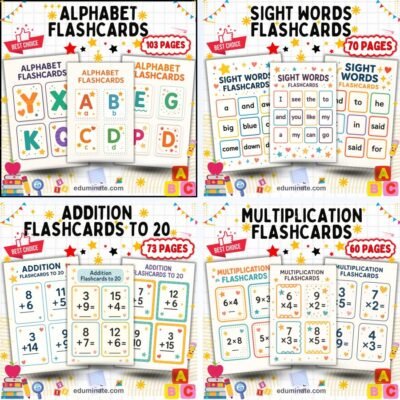
If you want one download that covers more than multiplication, this flashcard bundle brings together four flashcard sets covering alphabet cards, sight words, addition facts and multiplication facts. It has 306 pages and is 25% off the separate prices.
For separate sets, the multiplication fact flashcards, the repeated addition pages, the addition flashcards and the number sequence pack are each listed below.
Frequently asked questions
Which multiplication facts should children learn first?
Start with the 2s, 10s, 5s, 1s and 0s, since each has a simple rule. Then move to the 4s, 3s and 9s, and leave the 6 x 6, 6 x 7, 6 x 8, 7 x 7, 7 x 8 and 8 x 8 facts for last.
How many multiplication facts are there to learn?
With factors from 2 to 9, there are 64 problems. Because 3 x 4 and 4 x 3 are the same fact, there are 36 different facts to learn.
Is it better to use flash cards or games?
Both have a place. Cards are good for quick, focused repetition, and games add variety. A short card routine followed by a game gives children both.
What should I do if a child keeps getting the same fact wrong?
Go back to meaning. Build the fact with objects or draw an array, then connect it to a fact the child knows. For 7 x 8, that might be 7 x 5 plus 7 x 3. After that, return the card to the “Almost” pile for a few days.