Missing Number Worksheet Ideas for Early Math Practice

A missing number worksheet asks a child to fill in the blank, and that small puzzle can be used for counting, patterns, addition and subtraction. This guide shows six types with worked answers, explains how to teach each, and offers ideas for practice at school or home.
Why a missing number worksheet is worth using
A blank space in a problem makes a child think about how numbers relate. In 5 + ___ = 9, a child cannot just add what they see. They have to reason about the gap between 5 and 9. This kind of thinking connects to algebra later on, where a letter stands in for a number that is not yet known.
The format also suits a range of ages. A kindergarten page might ask for a missing number in a counting line from 1 to 10. A second grade page might ask for a missing number in 63 + ___ = 91. The idea is the same, and the numbers grow as children do.
Type one: missing numbers in a counting sequence
This is often the first kind of missing number worksheet. A row of numbers is shown with one or two blanks, and the child writes what comes next or what fits in the middle.
- 1, 2, ___, 4, 5. The missing number is 3.
- 6, 7, 8, ___, 10. The missing number is 9.
- 14, 15, ___, 17. The missing number is 16.
Children can use a number line or a strip of counting cards to check. Our Number Flashcards 1-20 pack has 66 card pages with four big number cards on each page, 264 cards in all. Lay out a row of cards, remove one, and ask which card is gone.
For an early math packet, the Counting Numbers 1-10 set includes 19 student worksheets, a structured lesson plan and complete teacher keys. Children practice counting items, writing digits and comparing quantities from 1 to 10.
Type two: skip counting and number sequence patterns
Here the numbers change by the same amount each time. Children must find the rule and use it. Our post on skip counting explains how to teach the counts by 2, 5 and 10.
- Count by 2: 2, 4, ___, 8. The missing number is 6.
- Count by 5: 5, 10, ___, 20. The missing number is 15.
- Count by 10: 10, 20, 30, ___, 50. The missing number is 40.
- Count by 3: 3, 6, 9, ___, 15. The missing number is 12.
The key question is, “How much is the number changing each time?” If children look at the first two numbers, they find the step. Then they check that the step stays the same through the row.
The Number Sequence Worksheets pack has 54 pages, including 13 student activity sheets, a teacher lesson plan, 29 pages of solutions and answer keys.
Type three: counting backward
Counting backward is harder than counting forward, so it deserves its own practice. A sequence that goes down hides a rule of subtracting the same amount each time.
- 10, 9, ___, 7. The missing number is 8.
- 20, 18, ___, 14. The missing number is 16.
- 50, 40, 30, ___, 10. The missing number is 20.
Some children find it easier to say the sequence aloud first and then write the missing number. A number line with an arrow pointing left shows the direction.
Type four: missing addend
A missing addend problem has a sum and one of the numbers being added. The child finds the other one.
- 5 + ___ = 9. The missing addend is 4, because 5 + 4 = 9.
- ___ + 3 = 11. The missing addend is 8, because 8 + 3 = 11.
- 7 + ___ = 15. The missing addend is 8, because 7 + 8 = 15.
- 6 + ___ = 10. The missing addend is 4, because 6 + 4 = 10.
Three strategies help here:
- Count up. For 5 + ___ = 9, start at 5 and count up to 9: 6, 7, 8, 9. That is 4 steps.
- Use a ten frame or counters. Place 5 counters, then add more until there are 9.
- Think of a fact family. If 9 – 5 = 4, then 5 + 4 = 9.
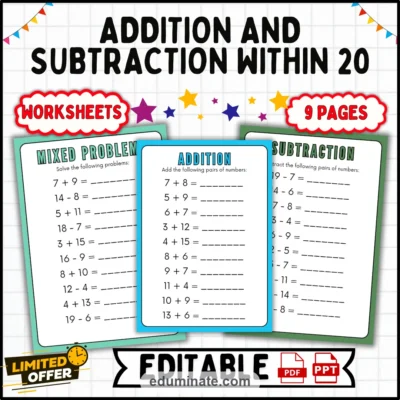
The Addition and Subtraction Within 20 pack has 6 printable worksheets for basic fact fluency, with mixed equations within 20 that can be adapted to leave one number blank. Simply cover a number with a sticky note to make a missing number problem from any equation.
Type five: missing numbers in subtraction
Subtraction can hide any of the three numbers.
- 12 – ___ = 5. The missing number is 7, because 12 – 7 = 5.
- ___ – 4 = 6. The missing number is 10, because 10 – 4 = 6.
- 15 – 6 = ___. The missing number is 9.
The middle type, ___ – 4 = 6, can be the hardest, because the unknown is the starting amount. Ask, “What number do I start with, so that taking away 4 leaves 6?” Then count up from 6 by 4 to get 10. Thinking of addition helps: 6 + 4 = 10.
Type six: balancing the equation
An equals sign means that both sides have the same value. Some children read it as “the answer comes next” instead. Missing number problems with numbers on both sides fix that idea.
- 3 + 4 = ___ + 2. Left side is 7, so the missing number is 5.
- 6 + 2 = 5 + ___. Left side is 8, so the missing number is 3.
- 9 = 4 + ___. The missing number is 5.
A balance picture helps. Draw a simple seesaw bar with the left side and the right side. For the balance to hold, both sides must equal the same total.
Missing numbers in repeated addition
Repeated addition adds the same number several times, and it is the doorway to multiplication. Missing numbers fit well here.
- 4 + 4 + 4 = ___. The missing number is 12.
- 5 + 5 + ___ = 15. The missing number is 5.
- 3 groups of ___ make 12. The missing number is 4.
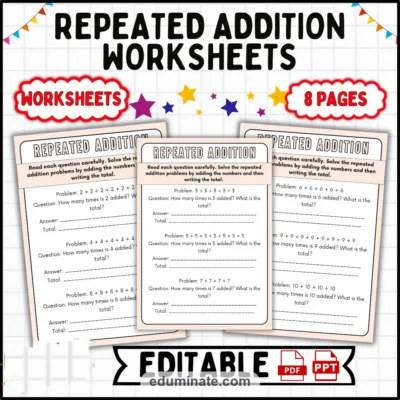
Plain objects such as buttons or cubes, set in equal groups, make the idea concrete. The Repeated Addition Worksheets have 13 math problems connecting equal groups to multiplication, plus open challenge tasks and editable presentation slides.
Using a hundred chart
A hundred chart is a grid of numbers from 1 to 100 with ten in each row. Cover a few squares with sticky notes and ask children to say which numbers are hidden. A hidden number between 41 and 43 must be 42. The square just above 56 holds 46, and the square just below it holds 66. Patterns in the columns become clear: each step down adds ten.
A short missing number lesson plan
Here is one way to use a worksheet in a lesson.
- Show one problem on the board. Think aloud as you find the missing number.
- Do two together. Let children offer ideas and say how they found the answer.
- Children work alone or in pairs. Provide counters, number lines and a hundred chart.
- Check by substituting. Children write their answer in the blank and read the whole sentence. If 5 + 4 = 9, it works.
- Write a puzzle. Early finishers make a missing number problem for a partner.
The substitution check is a habit worth building. It gives children a way to know they are right without asking an adult.
Making your own missing number worksheet
You can also build a page by hand. Pick one type, choose the numbers, and write eight to ten problems with a blank in different places. Keep the numbers small at first. Then change one thing at a time: move the blank, enlarge the numbers, or switch from addition to subtraction.
The Addition and Subtraction Worksheets Bundle brings ten worksheet packets together in one download, covering addition, subtraction, word problems and number patterns, in 152 pages.
Missing number practice by grade
The same six types stretch across several grades when the numbers change. Here is a rough guide, with answers.
Kindergarten
- Counting lines from 1 to 20 with one blank: 11, 12, ___, 14 has the answer 13.
- Simple addends within 5: 2 + ___ = 5 has the answer 3.
First grade
- Missing addends within 20: 9 + ___ = 14 has the answer 5.
- Missing numbers in subtraction: 20 – ___ = 12 has the answer 8.
- Skip counting by 2, 5 and 10 up to 100.
Second grade
- Missing addends within 100: 40 + ___ = 70 has the answer 30, and 63 + ___ = 91 has the answer 28.
- Missing numbers in subtraction within 100: 100 – ___ = 65 has the answer 35.
- Counting by 100: 200, 300, ___, 500 has the answer 400.
Teaching tips for early learners
A few habits help children get the most from a page.
- Read each problem aloud as a sentence: “Five plus what number makes nine?”
- Use a small box or a line for the blank, and keep it large enough to write in.
- Encourage a guess, followed by a check. A wrong guess still teaches, because the check shows which way to go.
- Keep the blank in different places across a page, so that children do not learn only one pattern.
- Let children use counters. They can put them away when they feel ready.
How to balance the equation with objects
Plain objects make the equal sign visible. Use a flat ruler as a seesaw and a few cubes as weights. Place 3 cubes and 4 cubes on the left, which makes 7. On the right, place 2 cubes and ask how many more are needed to level the ruler. The answer is 5. Children feel the balance before they write anything.
Missing number activities with plain objects
Objects give children something to move while they think. These activities need only things found in most classrooms and homes.
- Hidden cubes. Show 9 cubes, then cover some with a cup. Tell the child 5 cubes are still in view. How many are under the cup? The answer is 4, because 5 + 4 = 9.
- Card gap. Lay out number cards in order, take one away and close the gap. Children find where the missing card belongs and say the number.
- Bead strings. Slide beads along an abacus rod. Say there are 10 in all, move 6 across, and ask how many remain on the other side. The answer is 4.
- Skip count steps. Place paper circles on the floor in a line and write the first two counts by 5. Children step along and say the missing counts aloud: 5, 10, 15, 20, 25.
After each activity, ask the child to write the matching number sentence on a page. The move from objects to written numbers is where a worksheet fits in.
Reading the page with a child
Before a child writes, point to each part of the problem and say it in words. For 7 + ___ = 15, say: “Seven and some more make fifteen. How many more?” Then wait. A pause gives the child time to think. If the child is stuck, offer one small hint, such as “Can you count up from seven?”, and wait again.
Frequently asked questions
What grade is a missing number worksheet for?
The format works from kindergarten to second grade and beyond. The numbers and operations change with the level.
What is a missing addend?
It is the unknown number in an addition problem, such as the blank in 5 + ___ = 9.
How can I help a child who is stuck?
Offer counters or a number line. Ask them to say the problem in words, then try counting up from the known number.
Why do children need missing number problems?
They show how numbers relate in both directions, which links addition, subtraction and patterns.