Burger Coloring Pages for Food Units and Play
Burger coloring pages are printable line drawings of burgers, fries and diner favorites, and they suit preschool to 3rd grade for food units, pretend restaurant play and quiet art time. A good set shows the layers of a burger clearly, so children can color each part and talk about what goes inside.
Ideas and page types to look for:
- Single large burgers with thick outlines for the youngest colorers.
- Stacked burgers with buns, patties, cheese, lettuce and tomato to color layer by layer.
- Burger and fries pages, which suit a meal-themed unit.
- Picnic and diner scenes with several foods on one page.
- Smaller details such as sesame seeds, for older children who want a harder task.
Below you will find ways to use the pages in a food unit, a few honest notes about nutrition talk and the real packs we have, from 35 to 100 pages.
In this article (9 sections)
Why children like burger pages
Burgers are a food almost every child knows. That familiarity matters, because a child who knows what a burger looks like can start coloring right away without asking what the picture is. Familiar topics help hesitant colorers feel sure of themselves.
A burger is also a layered object. The bun, the patty, the cheese, the lettuce and the tomato each have a clear shape and an obvious color. That makes it a good first subject for children who are learning to color one area at a time.
Ways to use burger coloring pages
Pretend restaurant
Set up a dramatic play corner as a diner. Children color a burger page to make a menu or an order card, then take turns as customer and server. Writing “1 burger” on a note is a real-world reason to write, even for kindergartners.
Sequencing the layers
Ask children to say what is on the bottom, what is in the middle and what is on top. They can then color the layers in order. For older children, add the words first, next, then and last, and ask them to write the steps to build a burger.
Design your own
Give each child a blank burger outline or let them add to a page. They can draw extra toppings and name their burger. A name written on the page is a good short writing task for 1st and 2nd grade.
Math with the page
Count the seeds on a bun. Count the slices of tomato. Ask “How many more would we need to make ten?” Burger pages have small repeating parts that suit counting and simple addition.
Cooking and community helpers
If your class is studying jobs, a cook or restaurant unit fits well. Color a page, then talk about who prepares food, who serves it and who cleans up. Keep the focus on the jobs, not on the food.
Early finishers and sub plans
Large packs give you plenty of different pages, so children are not doing the same task twice. For a substitute, a page plus a short instruction such as “Color every layer a different color” is enough.
Fine motor skills grow with every layer. A bun is a wide shape, a slice of cheese is a straight-edged one and a tomato is a small circle, so one page covers several kinds of stroke. Teachers who run a short food groups lesson can use the same page: children color the bun for grains, the lettuce and tomato for vegetables, and talk about what else might go on a plate. Keep it short and let the coloring carry the lesson.
A note on nutrition talk
Burgers and fries are a fast food topic, so they sit well beside a nutrition lesson. You do not need to label foods good or bad. A calm, factual approach works better with young children:
- Ask which foods come from plants and which come from animals.
- Talk about adding vegetables, such as lettuce and tomato, to a meal.
- Ask children to name a fruit or vegetable they could eat with a burger.
- Compare a drawn burger with a plate of mixed foods.
Families have different foods and different customs, so keep the conversation open and avoid asking what children eat at home. Our post on healthy eating activities for preschoolers has more ideas that fit a food theme.
Fine motor tips
Burger pages have large round shapes and small details, which makes them good for practice at different levels.
- Preschoolers: use chunky crayons and color the large bun shape first.
- Kindergartners: color each layer a different color, staying inside each band.
- Older children: add shading to the bun and patty with colored pencils.
- Offer a limited palette of tan, brown, red, green and yellow, then let children choose to break the rules.
Taping the page to the table keeps it still for children who press hard.
Burger coloring packs on Eduminate
Each pack is a PDF download, listed for preschool to 2nd or 3rd grade. We read every product page, and the facts below come from those listings. We did not find a free burger pack on the shop, so these are all paid sets.
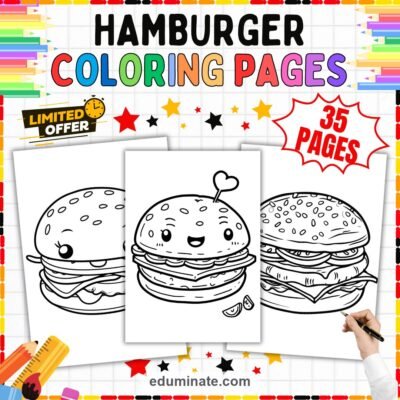
- Hamburger Coloring Pages Fast Food Pack: 35 pages for $4.99, for preschool to 2nd grade. The listing describes stacked burgers, sesame seed buns, lettuce, tomatoes and melted cheese, with cartoon food characters. It prints on US Letter with Fit to page.
- Printable Burger Coloring Pages: 49 pages for $5.99, for preschool to 3rd grade, with grilled patties, cheese, lettuce, tomatoes and friendly food mascots.
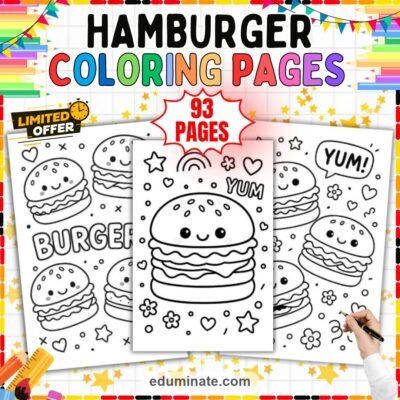
- Burger Coloring Pages Fast Food Nutrition Pack: 93 pages for $10.99, for preschool to 3rd grade, with patties, cheese slices, lettuce, tomatoes and sesame buns.
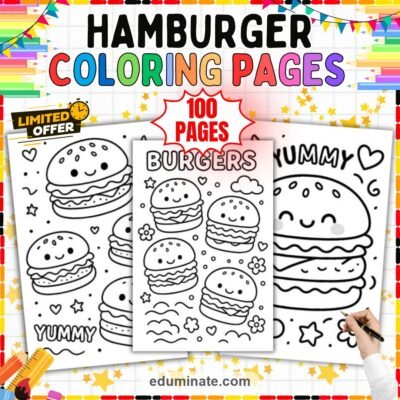
- Burger and Fries Coloring Pages: 100 pages for $11.99, for preschool to 3rd grade, with cheeseburgers, fries in paper cartons and dipping sauce cups.
If you want several of these together, the Fast Food Coloring Pages Bundle includes all four plus two food packs, a 16 page sweet desserts and burger pack and a 50 page snacks and cake pack. That is six PDF files and 343 pages for $30.77. The separate prices add up to $43.95, so the bundle is 30% off.
A new teacher may find the 35 or 49 page pack enough for a first food unit. The larger packs suit a school-wide theme or a long-term early finisher bin. Check the “Look inside” samples on the product pages before you buy. Downloaded files cannot be refunded.
Planning a food week
- Monday: color a single burger and name each layer aloud.
- Tuesday: build a diner menu on a burger page, with prices in play money for older children.
- Wednesday: sequence the steps to build a burger and write them down.
- Thursday: sort foods into plant and animal groups and color matching pages.
- Friday: set up the pretend restaurant and use the finished pages as props.
Keep each session short and let the play corner carry the rest. Children usually remember the role-play more than the coloring.
Printing tips
- Print only the pages you need from large packs to save paper.
- Copy paper works for crayons and pencils. Markers may bleed through, so slip a spare sheet underneath.
- If the edge of the page is cut off on your printer, choose “Fit to page” in the print dialog.
- Laminate a few pages for a dramatic play corner so children can use dry-erase markers.
Use the packs in one classroom or at home, as the license on each product page explains.
Frequently asked questions
What age are burger coloring pages for?
The packs listed here are for preschool to 2nd or 3rd grade. Younger children enjoy the large shapes, and older children can add shading and details.
Are there free burger coloring pages?
We did not find a free burger pack in our shop. The smallest paid pack has 35 pages and costs $4.99.
Do burger pages fit a nutrition unit?
They can. Use them as a starting point to talk about the parts of a meal, where food comes from and how to add vegetables. Keep the tone neutral.
How many pages will a class use?
If each child colors one page per week, a 49 page pack lasts a good part of a term. A pack of 93 or 100 pages gives you enough variety for a whole year of early finishers.