Fire Safety Coloring Pages for School Fire Drills
Fire safety coloring pages are printable sheets with fire trucks, alarm bells, extinguishers and hydrants that children color while they learn what a fire drill looks and sounds like. They suit preschool to second grade, and the best sets use thick outlines so small hands can stay inside the lines. A good set gives a quiet task before or after a drill, so the real alarm feels familiar.
Here are page types that work well in a classroom:
- A fire truck with a ladder and a hose, for children who like vehicles.
- An alarm bell, so the sound and the picture connect.
- A fire extinguisher, to talk about who is allowed to use one (a trained adult).
- A fire hydrant, for a short chat about how firefighters get water.
- A page with a short slogan to color, such as “Practice fire drills.”
- A home escape page, for a family conversation about a meeting place outside.
The rest of this guide covers what to look for, how to use the pages around a drill, and which sets are worth a look. There is a free pack, and it takes an email address, which opens a free account and keeps the file in My Library.

In this article (10 sections)
- Why color before or after a fire drill
- What to look for in a set
- A free fire safety pack to start with
- What the paid packs add
- How to use the pages around a drill
- Other ways to use the pages in class
- Fine motor skills hiding in a coloring page
- Simple talking points for each page
- Frequently asked questions
- Related resources
Why color before or after a fire drill
A fire drill is loud, sudden and a little scary for some young children. Many classrooms already talk about it before the day, but a talk is easy to forget. A coloring sheet gives children something to do with their hands while they think about the drill, and it gives you a natural moment to ask questions.
Many teachers search for a fire drill coloring sheet to hand out on drill day, and that is exactly the use here. The same pages work as preschool fire safety coloring pages for the youngest group.
The pages do not replace your school’s own drill plan. They sit beside it. Your school has set routes, a set meeting spot and its own rules about lining up, and those come first. The pages help children recognize the objects they will hear and see.
Coloring is also quiet. After a drill, children are often wound up. A calm table task with crayons gives them a way to settle before the next lesson.
What to look for in a set
Not every set suits every group. Check these points before you print a stack.
- Thick, clear outlines. Three- and four-year-olds do better with wide lines and big shapes. Older children can handle smaller areas.
- Safety objects that are accurate. A fire extinguisher should look like one, and a smoke alarm should sit on a ceiling. Children copy what they see.
- Calm tone. Pages with smiling trucks and friendly bells help nervous children. Avoid pages that show fire damage or scary scenes for this age group.
- Variety across the set. If every page shows a fire truck, children lose interest by page five. Look for a mix of vehicles, tools and slogans.
- Pages that print alone. You should be able to print one page for a small group without the rest of the file.
A free fire safety pack to start with
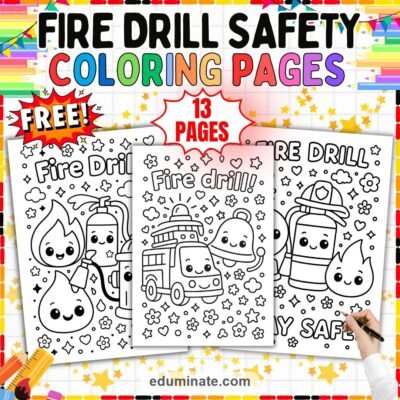
If you only need a few pages, start with the free pack. Free Fire Safety Coloring Pages has 13 pages for Pre-K to 2nd grade, with friendly fire engines, alarm bells and fire extinguishers. The product page also mentions hydrants, coiled hoses and slogans such as “Practice Fire Drills” and “Fire Drill Safety.”
A free pack takes an email address. The address opens a free account, and the file stays in My Library, so you can download it again later. It is a PDF that prints on US Letter with “Fit to page.”
Thirteen pages is enough for one class on one morning. If you want a second round during Fire Prevention Week, or a new page for every child on a different day, you will run out quickly. That is where the paid packs come in.
What the paid packs add
The paid sets cover the same theme with more pages, so you can run a full week or a whole month without repeating a sheet. All of them are PDFs for Pre-K to 2nd grade, and each prints on US Letter with “Fit to page.”
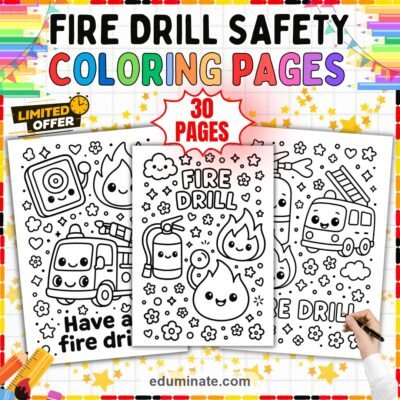
- Fire Drill Coloring Pages has 30 pages and costs $4.99. It centers on fire engines, alarm bells, extinguishers and hydrants for school drill routines.
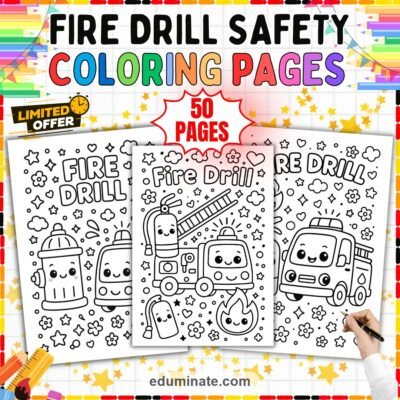
- Fire Truck Coloring Pages has 50 pages and costs $6.99. It leans toward rescue vehicles with ladders and hoses, plus hydrants, bells and extinguishers.
- Fire Safety Coloring Pages has 100 pages and costs $11.99. It is the largest set, with trucks, extinguishers, bells and smoke detectors, plus slogans such as “Fire Drills Are Important.”
The honest difference is page count. The paid packs share the same style as the free one, so none of them is a different kind of activity. You pay for a longer run of pages in one PDF, so you are not hunting for a new sheet each week.
The three paid packs are also part of the Coloring Pages Mega Bundle. That bundle has 28 coloring packs on many themes, from school and sports to beaches and flowers, and the separate prices add up to $226.72 against $136.03 for the bundle. It is a large purchase, so it suits a teacher or a school that wants a full year of coloring themes and not only fire safety.
How to use the pages around a drill
Here is one simple way to build a short routine.
Before the drill
Gather children on the carpet and show one page. Ask what the object is and what sound it makes. Let two or three children answer, then send everyone to color. While they work, walk the room and ask one short question to each table: “What do we do when we hear the bell?” Keep your own wording simple and match your school’s plan.
After the drill
Hand out a different page. Ask who remembers where the class stood outside. A child who colors a truck can tell you what the firefighters do. A child who colors a bell can tell you what it sounded like. The talk matters more than the finished picture.
Fire Prevention Week
The product pages mention Fire Prevention Week in October, which is a natural time to run a themed week. Give each day one job:
- Monday: color a fire truck and name its parts.
- Tuesday: color an alarm bell and talk about the sound.
- Wednesday: color an extinguisher and talk about who may use it.
- Thursday: color a slogan page and read it aloud together.
- Friday: choose a favorite page and show it to a partner.
Other ways to use the pages in class
- Morning work. Put a page on each table before children arrive. It gives a calm start and a reason to talk when you take attendance.
- Early finishers. Keep a folder of pages near the supply shelf. Children who finish a task early can pick one without asking.
- Counselor or small-group time. A school counselor can use a page as a gentle opener for children who worry about loud alarms.
- Sub plans. Leave a stack and a note. Coloring needs no setup, and the substitute can run a short talk from the page.
- Hallway display. Finished pages on a wall remind the school community about drill routines.
- Home connection. Send one page home and ask the family to pick a meeting place outside their home. That small conversation can matter more than the coloring.
Fine motor skills hiding in a coloring page
Coloring builds finger strength and pencil control. A truck with big wheels and a long ladder gives children plenty of space to practice staying inside the lines, and small stars or borders add a finer challenge for those who are ready. If you want more ideas for hand strength, our guide to fine motor activities has quick tasks that pair well with coloring.
A few tips for the youngest group:
- Offer chunky crayons or short pieces of regular crayons, which encourage a good grip.
- Tape the page to the table so it does not slide.
- Let children choose their own colors. A blue truck is fine, since the goal is the conversation.
- Praise effort and care, not neatness.
Simple talking points for each page
Have a short question ready for each object. Children remember a question they answered themselves better than a fact you told them.
- Fire truck: Who rides on it? Where does it go? What does it carry?
- Alarm bell: What does it sound like? What do we do when we hear it?
- Extinguisher: Is this a toy? (No. Only trained adults use it.)
- Hydrant: What does a firefighter get from it?
- Smoke detector: Where is the one at home? Who checks it?
Keep the tone matter of fact. Children pick up on worry from adults, and a calm voice tells them the drill is just something we practice.
Frequently asked questions
What age are fire safety coloring pages for?
The sets listed above are made for Pre-K to 2nd grade. Younger children color the large shapes and talk about them. Older ones can add labels or write a sentence about what they would do during a drill.
Is there a free fire safety coloring pack?
Yes. The free pack has 13 pages. It takes an email address, which opens a free account and keeps the file in My Library. You can print as many copies as you need for one classroom.
Can I print the pages on US Letter paper?
The files are made on A4 pages, and the product pages say they print on US Letter with “Fit to page.” Choose that option in the print dialog.
Which set should I buy first?
Try the free pack, then decide. If you want a week of pages, the 30-page Fire Drill set is the smallest paid option. If you teach several classes or want a fresh page for months, the 100-page set gives the most pages for the price.