Number Recognition Worksheets and Cards for Ages 3 to 6

Number recognition worksheets and cards help a young child look at a written numeral and say which number it is. This guide covers what recognition really means, how to teach numbers 1 to 10 and then the teen numbers, and simple activities that need only cards, counters and a pencil.
What number recognition means
Number recognition is the skill of seeing a numeral, such as 7, and knowing its name. It is a different skill from counting aloud. A child can say “one, two, three, four, five” in order and still not be able to point to the numeral 5 on a page.
It also helps to separate three ideas that adults often blend together:
- Reciting: saying the number words in order.
- Recognizing: looking at a written numeral and naming it.
- Understanding quantity: knowing that the numeral 5 stands for five objects.
Good practice touches all three. A child names the card, counts out that many objects, and then writes the numeral. Each step supports the next one, so it pays to move between them rather than drill only one.
Number recognition worksheets: what to look for
Before you print anything, check a few details. They decide whether a page is easy to use with a three-year-old or a six-year-old.
Size of the numeral
Large numerals are easier for small eyes. A single big numeral on a card gives the child one thing to look at, which suits a first look at a new number.
One clear task per page
A page that asks the child to color, trace and count all at once can be too much for a beginner. Start with pages that ask for one thing, then combine tasks later.
The range of numbers
Many children begin with 1 to 5, move on to 1 to 10, and then reach 11 to 20. A set that covers numbers 1 to 20 can stay in use for a long time, because you can pick the range that fits the child today.
Room to reuse
Cards can be laminated or slipped into plastic sleeves and used again and again. Cards also work in more kinds of activities than a worksheet that is written on once.
Teaching numbers 1 to 10 first
Numbers 1 to 10 are the base for everything that follows, so give them time. Here is one way to introduce them.
- Show one numeral card at a time and say its name clearly.
- Let the child count out that many buttons, blocks or crayons and set them under the card.
- Trace the numeral in the air with a finger, then on paper with a pencil.
- Mix in a numeral the child already knows, so each new number sits beside a familiar one.
Do not rush to add all ten at once. Two or three new numerals at a time is a sensible pace, and you can always go back. If a child hesitates on a numeral, put the objects out and count them together, then show the card again.
Numbers that look alike
Some pairs cause trouble. The numerals 6 and 9 look the same when one is turned upside down. The numeral 2 can be written backward, and so can 3, 5 and 7. When a child mixes up a pair, place the two cards side by side and talk about what makes them different, such as where the curve sits or which way the numeral faces.
Teen numbers 11 to 20
The teen numbers are often the next hurdle. The words eleven and twelve do not follow a pattern. The numbers 13 to 19 end with the sound “teen”, which points to ten and some more: thirteen is ten and three, fourteen is ten and four, and nineteen is ten and nine.
Here is a simple way to show it with objects.
- Put out ten buttons in a row and keep them together.
- Add three more buttons beside the row.
- Count all of them: thirteen. Place the numeral 13 next to the buttons.
Repeat with 14, 15 and so on. Each of these numerals has two digits, and the first digit, 1, tells the child there is one group of ten. This is a gentle first look at place value, long before a child is asked to write it down formally.
Written numerals above 9 also need careful reading. The numeral 12 is read from left to right as twelve, and 21 is a different number that uses the same two digits. Show a child 12 and 21 side by side and say each name. The difference in order is easy to see when the cards sit next to each other.
Teen numbers are also a place where reversals happen. A child may write 12 as 21 or read 16 as 61. If that happens, slow down, line up the objects, and name the tens first.
Number recognition activities with cards
These number recognition activities need only a set of printed cards and a few small objects. They suit a table at home, a math center or a small group.
Match the card to the objects
Set out a few numeral cards. Place small piles of buttons or blocks in a separate row. The child counts a pile and puts it under the matching card. Start with three or four cards and add more as the child grows confident.
Put the cards in order
Lay out the numerals 1 to 10 mixed up. Ask the child to line them up from smallest to largest. For a greater challenge, use 11 to 20, or take a card away and ask which number is missing.
The missing number
Place the cards 1 to 10 in a row, then turn one face down. Ask the child which numeral is hiding. Check by turning it over. You can also ask for the number that comes just before or just after a card you point to.
Number hunt around the room
Tape a few cards in easy places, such as a shelf, a door or a window. Call out a number and let the child find the matching card. Keep the hunt calm and short, so every child can take part at a walking pace.
Trace and build
Fill a shallow tray with a thin layer of sand or salt. Show a numeral card and ask the child to trace the numeral in the tray with a finger. Then they can build the same numeral from play dough rolled into thin ropes. The hands learn the shape while the eyes learn the name.
Sort the numerals
Use two sheets of paper with simple headings, such as numbers I know and numbers I am learning. The child places each card in a group. The sorting gives you a quick picture of where to focus next.
Number formation practice
Once a child knows a numeral by sight, ask for number formation on paper. Say a short phrase as the pencil moves, such as “start at the top, go across, then slide down” for a 7. Keep the phrase the same each time so the movement becomes familiar. Short practice sessions work better than a long page of repeated numerals.
Number flashcards for preschool and kindergarten
Number flashcards are the most flexible tool for this skill. A page with four big cards can be cut apart and used for matching, ordering, hunts and quick checks. They suit preschool and kindergarten alike, since you choose the range of numbers. Here are the sets we offer, so you can match the size of the set to your plans.
- The Number Flashcards Bundle brings five flashcard sets into one download, with number cards from 1 to 20 across 346 pages.
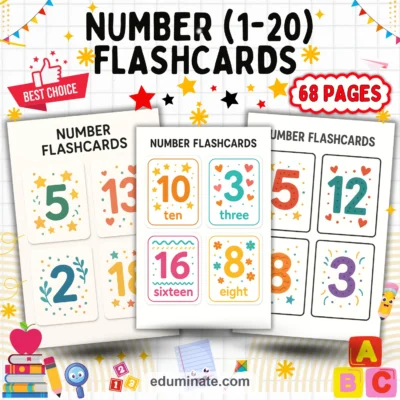
- The Number Flashcards 1-20 set has 66 card pages with four big number cards on each page, 264 cards in all, using the numbers 1 to 20. The PDF has 68 pages.
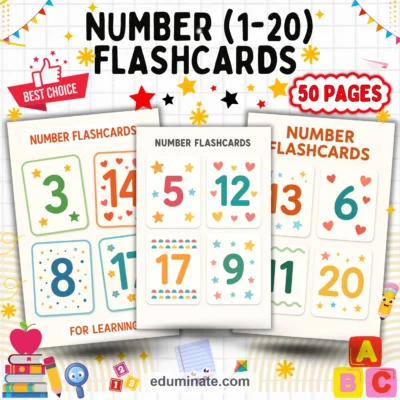
- The Number Flashcards 1-20 Printable PDF has 48 card pages with four big cards on each page, 192 cards in all, with numbers up to 20. The PDF has 50 pages.
- The Printable Number Flashcards 1-20 has 66 card pages, with four big number cards on each page and 264 cards in all, with numbers up to 20. The PDF has 68 pages.
- The Counting Flashcards 1-20 has 49 card pages with four big number cards on each page, 196 cards in all, with numbers up to 20. The PDF has 51 pages.
- The Number Flashcards Printable set has 107 card pages with four big cards on each page, 428 cards in all, mostly with numbers from 1 to 10. The PDF has 109 pages.
With so many cards in a set, you can keep a master copy and print fresh pages when a card gets worn. You can also print only the numbers a child is working on this week and put the rest away.
Using cards at home, in centers and in small groups
At home
Keep a small stack of cards in a bag and pull out a few at a calm moment, such as before a meal. Ask the child to name the cards and then count out the same number of spoons or napkins. Everyday objects turn a card into a real task.
In a math center
Put a set of cards in a tray with a cup of counters and a recording sheet. Children match, order or build numerals on their own while you work with another group. Rotate the cards every week or two so the center stays fresh.
In a small group
With three or four children, give each a few cards and ask them to take turns naming the numeral and showing the matching quantity. Listening to a classmate say the name of a numeral is a quiet form of practice for everyone at the table.
Moving from recognizing to counting and writing
Once a child can name the numerals with confidence, link them to counting and writing. A child can roll small balls of play dough into counters, place that many on a card, and then write the numeral on a small whiteboard. This gives three views of the same number: the symbol, the quantity and the written form.
Our guide to counting worksheets for kindergarten has more ideas for counting objects and linking each count to a numeral. Pair it with the cards when a child is ready to count past ten.
A simple week of number recognition practice
Here is one plan you can adapt. It uses a few numbers at a time and returns to them often.
- Day one: introduce three new numerals. Name them, count out objects for each, and trace the numerals in the air.
- Day two: play the missing number activity with the numerals from day one and a few known ones.
- Day three: match cards to piles of objects, and then do the number hunt.
- Day four: trace and build the numerals in a sand or salt tray.
- Day five: review all the numerals learned so far by sorting them into numbers I know and numbers I am learning.
Next week, move the numerals that feel solid into the known pile and add two or three new ones. The plan can be slow or quick. Follow the child, not the calendar.
Frequently asked questions
What is the difference between number recognition and counting?
Recognition means reading a written numeral and naming it. Counting means saying the number words in order or counting objects one by one. A child needs both, and they grow side by side.
Which numbers should a child learn first?
Many children start with 1 to 5 and then move to 1 to 10. After that, the teen numbers from 11 to 20 come next. Follow the pace of the child and return to earlier numerals whenever they feel shaky.
Why does my child mix up 6 and 9?
The two numerals are the same shape turned upside down, so they are easy to confuse. Place the cards side by side, count out six objects and nine objects, and talk about which numeral matches which quantity.
Can I print the cards more than once?
Within the license that comes with the product, yes. Many parents and teachers keep a master set and print new pages when cards wear out.