Plural Nouns Examples: Rules, Irregular Plurals and Lists

A plural noun names more than one person, place, thing or idea, and most plurals follow a short set of spelling patterns. This page gives plural nouns examples for each pattern, then a list of irregular plurals, collective nouns and a plural nouns list you can copy onto a chart.
Plural nouns examples
A singular noun names one thing. A plural noun names more than one. Most of the time the plural is made by changing the end of the word.
| Singular | Plural |
|---|---|
| book | books |
| box | boxes |
| city | cities |
| leaf | leaves |
| child | children |
| foot | feet |
| sheep | sheep |
| day | days |
Sheep does not change at all, and child does not follow the usual pattern. The rest of this page sorts the pairs into groups so students can see which pattern a word belongs to.
A few clues help a reader spot a plural in a sentence. The noun often ends in -s. A number or a word like many, few, these or those may come before it. The verb also changes: The books are on the table uses are, while The book is on the table uses is.
How to make nouns plural
Regular plural nouns follow a spelling pattern that depends on the last letters of the word. To pick the pattern, a student can ask three questions:
- What is the last letter, or the last two letters?
- If the word ends in y, is the letter before the y a vowel (a, e, i, o, u) or a consonant?
- Does the word end in s, x, z, ch or sh, where an extra -s would be hard to say?
The table covers the patterns students meet most.
| Ending | Rule | Examples |
|---|---|---|
| Most nouns | Add -s | book/books, cat/cats, pencil/pencils |
| s, x, z, ch, sh | Add -es | bus/buses, box/boxes, buzz/buzzes, church/churches, dish/dishes |
| Consonant + y | Change y to i, add -es | city/cities, baby/babies, story/stories |
| Vowel + y | Add -s | day/days, key/keys, toy/toys |
| f or fe | Often change to -ves | leaf/leaves, knife/knives, wolf/wolves |
| f (exceptions) | Some only add -s | roof/roofs, chief/chiefs |
| o | Some add -es, some add -s | potato/potatoes, tomato/tomatoes, photo/photos, studio/studios |
A few of these patterns have exceptions. Some nouns ending in z double the letter first (quiz/quizzes), and nouns ending in o have to be learned one at a time. Teach the pattern, and tell students that some words break it.
Irregular plural nouns
Irregular plural nouns do not follow the add-s or add-es patterns. They fall into three groups.
- The word changes inside: man/men, woman/women, foot/feet, tooth/teeth, goose/geese, mouse/mice.
- The word adds -en: child/children, ox/oxen.
- The singular and plural are the same: sheep, deer, fish, moose, series.
There is no rule that predicts these forms, so each one is learned as its own word. Sorting them into the three groups gives students a way to keep them straight. Short sentences also help: One mouse ran under the chair. Two mice ran under the chair. The deer is near the fence. The deer are near the fence.
Irregular plurals list
Here is an irregular plurals list of twenty pairs.
| Singular | Plural | Singular | Plural |
|---|---|---|---|
| man | men | ox | oxen |
| woman | women | sheep | sheep |
| child | children | deer | deer |
| person | people | fish | fish |
| foot | feet | moose | moose |
| tooth | teeth | series | series |
| goose | geese | species | species |
| mouse | mice | bison | bison |
| cactus | cacti | fungus | fungi |
| crisis | crises | phenomenon | phenomena |
Some of these have a second accepted plural. Cactus can also be cactuses, and fungus can also be funguses.
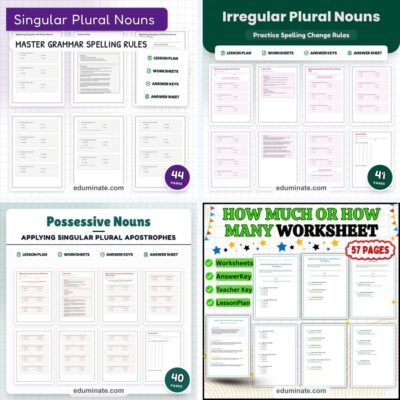
For a full set of practice questions on these words, the irregular plural nouns packet has 41 pages for grades 3 to 5, with 70 questions across 6 sections, a lesson plan and an answer key.
Collective nouns examples
A collective noun names a group. The group is a single thing, so in American English it usually takes a singular verb: The team is ready. If you name the members instead, the verb is plural: The players are ready.
Collective nouns examples: team, class, family, flock, herd, bunch, pack. This list of collective nouns pairs a group word with what it names.
| Collective noun | What it names |
|---|---|
| a flock of | birds |
| a herd of | cattle |
| a bunch of | grapes |
| a pack of | wolves |
| a team of | players |
| a swarm of | bees |
| a school of | fish |
| a pride of | lions |
| a bouquet of | flowers |
| a crowd of | people |
Collective nouns can be made plural like any other noun when you mean more than one group: two teams, three flocks, four families. In Two teams are on the field, the verb is plural because the subject is teams.
Matching the verb to the subject is covered in our post on subject verb agreement rules. For nouns that cannot be counted at all, such as water or sand, see the how much or how many pack, a set for grades 3 to 5 with multiple choice and fill in the blank questions on countable and uncountable nouns.
Singular and plural nouns in sentences
The verb has to match the noun. Singular and plural nouns examples in sentences show the match clearly:
| Singular | Plural |
|---|---|
| The dog barks. | The dogs bark. |
| The child plays outside. | The children play outside. |
| The mouse is small. | The mice are small. |
| This box is heavy. | These boxes are heavy. |
| The woman walks to work. | The women walk to work. |
In each pair, the plural noun goes with the plural form of the verb. The singular verb ends in -s (barks, plays, walks) and the plural verb does not.
Plural nouns anchor chart
For a plural nouns anchor chart, let the class build it together, one pattern at a time. Draw three columns on a large sheet:
| Ending | Rule | Examples |
|---|---|---|
| Most nouns | Add -s | desk/desks |
| x | Add -es | fox/foxes |
| Consonant + y | Change y to i, add -es | party/parties |
Students suggest the examples, and you add a row each time a new pattern comes up in reading. Keep a separate section on the side of the chart for irregular plurals, since they have no rule to write in the middle column.
Plural nouns list
This plural nouns list has twenty-four words, grouped by rule. Students can read each pair aloud, cover the plural with a strip of paper and try to say it from memory, then slide the paper away to check. They can also copy the list into a notebook as a spelling reference.
| Rule | Words |
|---|---|
| Add -s | desk/desks, tree/trees, cup/cups, pen/pens |
| Add -es | dish/dishes, brush/brushes, glass/glasses, fox/foxes |
| Consonant + y: change to -ies | lady/ladies, berry/berries, family/families, party/parties |
| Vowel + y: add -s | way/ways, boy/boys, play/plays, monkey/monkeys |
| f or fe: change to -ves, or add -s | wolf/wolves, shelf/shelves, life/lives, chief/chiefs |
| o: add -es or -s | tomato/tomatoes, hero/heroes, studio/studios, video/videos |
Ways to practice
Sort cards by rule
Write singular nouns on cards. Students sort them into piles by ending (add -s, add -es, change y to i) and then check the plural by writing it on the back.
Plural hunt in a read-aloud
While you read, students listen for plural nouns and add a tally mark or a word to a list. Afterward they sort what they found into regular and irregular.
Fix the sentence
Write sentences with one wrong plural, such as The two boxs are on the shelf. Students rewrite them correctly (boxes) and say which rule they used.
Plural bingo
Give students a grid of plural words. Call out singular nouns, and they cover the matching plural. Include a few irregular ones, such as feet and mice.
Practice material
For students who need structured practice, the singular and plural nouns packet covers regular and irregular plural rules, with a 70-question worksheet, an answer key, an answer sheet and a lesson plan, for grades 2 to 4.
The nouns bundle puts four noun packets in one download: regular and irregular plurals, possessive apostrophes, and how much or how many with countable and uncountable nouns. It runs 182 pages, for grades 2 to 5.
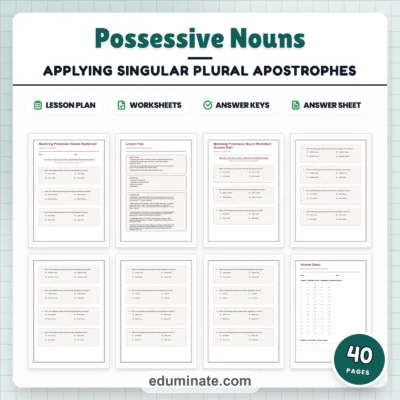
Once students are confident with plurals, the next step is showing ownership. The possessive nouns packet has 70 questions across five ownership sections, plus a recording sheet and a 17-page answer key, for grades 3 to 5. For more grammar by grade, see our post on grammar for 3rd graders.
Frequently asked questions
Why is it children, not childs?
Child is one of a few nouns that form the plural with -en instead of -s. Ox/oxen works the same way. These words do not follow the usual pattern, so students learn them as exceptions.
Is it fish or fishes?
For more than one of the same kind, fish is the usual plural: There are three fish in the tank. Fishes is used for different kinds: The aquarium has many fishes from the Pacific. Usage varies, and both forms appear in dictionaries.
Is a collective noun singular or plural?
In American English a collective noun usually takes a singular verb, because the group is treated as one thing: The class is quiet. If the sentence is about the members acting separately, a plural verb is possible, but the singular is the safer choice for students.
What grade learns plurals?
Schools differ, so check your own curriculum. For reference, our plural packs are listed for grades 2 to 4 (singular and plural nouns), grades 3 to 5 (irregular plurals) and grades 2 to 5 (the nouns bundle).
Related resources
- Singular and Plural Nouns Worksheets, Plural Rules, Grammar Practice Activity
- Irregular Plural Nouns Worksheet Packet, Spelling Rules and Plural Practice
- Nouns Worksheets Bundle, Plurals, Possessives and Countable Nouns Practice
- Possessive Nouns Worksheet Packet With Singular and Plural Apostrophe Work
- How Much or How Many Worksheet, Countable and Uncountable Nouns Practice Pack