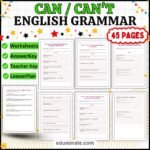

Can vs Can’t Worksheets | English Grammar Practice | Ability Permission Set
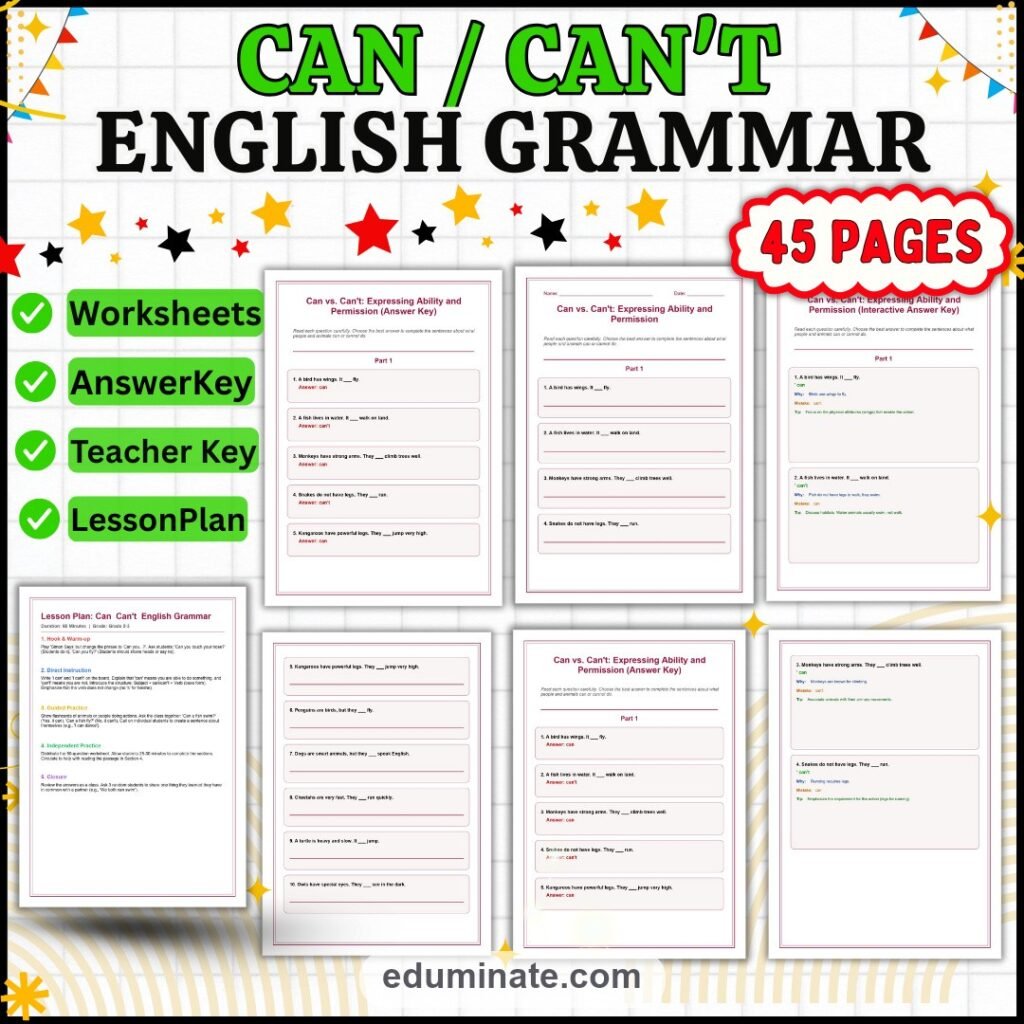
Can vs can’t worksheets covering fill in the blank sentences, questions, a reading passage, and word order practice, with a teacher key, answer key, and lesson plan.
- PDF Answer Key 9 pages
- PDF Lesson Plan 1 page
- PDF Student Worksheet 10 pages
- PDF Teacher Key 25 pages
- Total number of pages
- 45
- Page size
- A4
Can vs can’t worksheets for practicing ability and permission
These can vs can’t worksheets give students a full set of practice with one of the trickiest modal verbs in English. Kids read short sentences about people and animals, then decide whether can or can’t fits.
The set was built for a teacher who wanted one resource that covers the rule, the questions, and a short story, instead of piecing together separate handouts. It moves from simple statements to questions, a reading passage, and sentence building. Anyone searching for modal verbs worksheets or can’t worksheets for kids will find a complete unit here, and these can and can’t worksheets pair well with any review of ability and permission.
What students actually do
Part 1 asks students to fill in the blank for statements like “A bird has wings. It ___ fly” or “A turtle is heavy and slow. It ___ jump.” They look at the clue in the first sentence and pick the matching word.
Part 2 moves from animals to people, with lines such as “I have a broken leg. I ___ play soccer right now” and “Sarah is a great singer. She ___ sing beautifully.” Each sentence gives a reason that points to the right answer.
Part 3 flips the pattern into questions and short answers, for example “___ you swim?” and “Can we eat ice cream for breakfast? No, we ___.” Students practice both forming questions with can and giving short answers.
Part 4 is a short reading passage about a superhero named Sam and his friend Tina. Sam can fly and lift heavy cars but can’t swim, while Tina can’t fly but can run very fast. Students answer questions using details from the story, such as what Sam is afraid of and what Tina can do quickly.
Part 5 gives scrambled words such as “play / guitar / can / He” and asks students to put them into the correct sentence order. A blank space at the end invites students to draw something they learned that day.
What is included in the download
The download has four documents. The student worksheet runs 10 pages and covers all five parts described above, with space for a name and date on the first page.
A plain answer key is 9 pages long and lists the correct word for every question, so grading takes just a few minutes.
A teacher key adds 25 pages of support. For each question it repeats the answer, then explains why that answer is correct, names a common mistake students make, and offers a short tip for teaching that item.
A one page lesson plan rounds out the set, with a warm up game, direct instruction on the can/can’t structure, guided practice with flashcards, independent work time, and a closing discussion. It is written for a 60 minute class.
How to use it in class or at home
Hand out the student worksheet during a grammar lesson and use the lesson plan as your script for the day. The teacher key works well for small group instruction, since it gives you the reasoning to share out loud, not just the answer.
These can vs can’t worksheets also fit into early finisher folders, homeschool grammar practice, or a quiet independent activity once the rule has been introduced. The reading passage gives strong readers something extra to think about while others finish the fill in the blank sections.
Because the reading passage and word order questions are self contained, a student can work through the whole packet without extra materials or teacher explanation once the basic rule is understood.
Many teachers use the lesson plan for whole class instruction on a Monday, then send the plain worksheet home later in the week as review or homework practice.
The files are PDFs, so they print cleanly at home or at school. Take a look at the preview pages before you buy to see the exact layout and wording of every section.
If you like this can and can’t practice, you may want to browse more grammar worksheets or the wider worksheets collection, and the ELA category has related reading and language resources for the same age group.
Frequently Asked Questions
What is included in these can vs can't worksheets?
These can vs can't worksheets include a 10 page student worksheet, a 9 page plain answer key, a 25 page teacher key with explanations and tips, and a 1 page lesson plan. Together they cover fill in the blank sentences, questions, a reading passage, and word order practice.
What grade level are these can vs can't worksheets for?
The lesson plan lists this set for grade 2 to grade 3. The sentences use short, clear vocabulary about everyday actions and animals, which suits early elementary students who are learning the modal verb can.
Can I print the pages in black and white?
Yes. The pages use simple text boxes and lines rather than colored images, so they photocopy or print in black and white without losing any of the questions or instructions.
What does the reading passage in the worksheet cover?
Part 4 is a short story about a superhero named Sam and his friend Tina. Students read what each character can and can't do, then answer questions using details straight from the passage.
How is the teacher key different from the plain answer key?
The plain answer key just lists the correct word for each item. The teacher key repeats every answer, then adds a short reason it is correct, a common student mistake, and a tip for teaching that specific question.
| Format | Digital PDF Document (.pdf) |
|---|---|
| Page size | A4 |
| Pages | 45 |
| Quality | Print-ready PDF |
| License | Single Classroom / Personal Homeschool License |