Honey Production Reading Comprehension Passages and Questions for Grades 2-6
64 pages exploring honeybees, hive roles, beekeeping gear, hexagonal comb architecture, and nectar chemistry across 10 science reading passages for grades 2-6.
Instant PDF download after payment, also saved in My Library.
Secure checkout by card or crypto.
Use it at home or in one classroom. Read the license
Details
- File format
- Pages
- 64
- Page size
- A4
- Files
- 3
- Grades
- 2nd–6th
- Answer key
- Included
In this download 3 files
- PDF Honey Production Reading Comprehension Passages Grades26 Answer Key 22 pages
- PDF Honey Production Reading Comprehension Passages Grades26 Lesson Plan 1 page
- PDF Honey Production Reading Comprehension Passages Grades26 Worksheet 41 pages
Sample pages
Honey Production Reading Comprehension Passages for Grades 2-6
Honeybees are among the most industrious and ecologically significant insects on Earth. Beyond producing sweet golden honey, these small creatures pollinate billions of agricultural crops that supply our global food system. This structured unit of honey production reading comprehension passages introduces upper elementary and middle school students to the biology, social hierarchy, and chemistry of apiaries. Across 64 pages of printable instructional materials, learners explore how foraging bees gather flower nectar, how hive enzymes transform liquids into honey, and how beekeepers harvest frames safely.
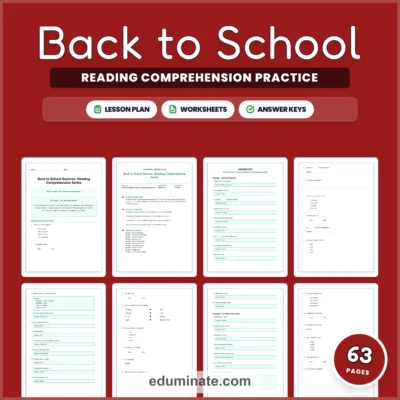
Teachers integrate these honey production reading comprehension passages into life science, insect biology, and non-fiction literacy blocks. The selections bridge entomological concepts with practical agriculture and food science. Each text features student question sheets containing multiple-choice items, True or False checks, and context vocabulary matching exercises. Educators benefit from 22 pages of thorough answer keys that make verifying student answers swift and straightforward. The download also includes a 1 page teacher lesson plan with pacing schedules, introductory questions, and review strategies across 150 minutes of instructional time.
Entomology and Hive Engineering Across Ten Passages
The ten informational reading selections in this collection guide students through bee biology, hive roles, and agricultural stewardship:
Passage 1: Busy Little Bees introduces worker bees gathering floral nectar, carrying yellow pollen grains on their hind legs, and returning to the colony. Passage 2: The Family in the Hive examines the social caste system, comparing the egg-laying queen bee, male drones, and hardworking female worker bees. Passage 3: Tools for the Job investigates anatomical adaptations including the flexible proboscis, pollen baskets, and compound eyes. Passage 4: Making the Honey details the dehydration process, where worker bees fan their wings rapidly to evaporate moisture from nectar. Completing these beekeeping life cycles and honeybee hive reading worksheets assists students in connecting insect physiology with food processing. Passage 5: The Beekeeper’s Gear explores protective bee suits, mesh veils, hive smokers, and stainless steel hive tools. Passage 6: Engineering the Honeycomb examines the geometric strength of beeswax hexagons that maximize storage volume while using minimal wax. Working through these pollination chemistry and honeycomb structure reading activities enables students to analyze natural geometry and insect architecture. Passage 7: A World of Flavors explains how honey color and floral aroma depend on specific nectar sources, such as clover, orange blossom, and wildflower. Passage 8: Pollination Partners explores how bees transfer pollen between plant blossoms to produce apples, almonds, and berries. Solving these queen bees worker drones and nectar harvest comprehension questions reinforces agricultural vocabulary and reading recall. Passage 9: The Chemistry of Honey discusses supersaturated natural sugars, hydrogen peroxide enzymes, and low moisture levels that prevent bacterial growth for centuries. Passage 10: Protecting Our Pollinators examines modern threats like habitat loss and pesticide exposure, while suggesting pollinator-friendly wildflowers for home gardens. Practicing with these honey production reading comprehension passages connects insect biology with environmental conservation.
Every passage inside this grades 2-6 entomology and honeybees reading comprehension packet directs learners to locate explicit text evidence. Students practice identifying core themes, defining scientific vocabulary, and analyzing cause and effect relationships in ecosystems.
Classroom Application and Differentiation Ideas
Educators use these honey production reading comprehension passages across a variety of instructional frameworks. Assign the basic bee role and honey making selections for second and third grade guided reading groups. Use the chemical preservation and comb geometry passages for fifth and sixth grade science research units. The materials function smoothly for whole-class science reading, collaborative partner work, independent science centers, or substitute folders. The clean worksheet formatting prints smoothly on standard paper without decorative ink waste.
Find additional animal and Earth science resources in our reading comprehension collection or explore insect printables in the worksheets section. You can also view our full catalog of educational resources across the school shop catalog.
Print on standard paper and you are ready to teach.
Frequently Asked Questions
What grade levels does this honey production resource target?
This unit targets students in grades 2 through 6. The ten passages begin with accessible descriptions of worker bees and honey making, then progress into social caste hierarchies, honeycomb geometry, and honey preservation chemistry.
How many total pages and passages are included in the download?
You receive 64 pages in total. The resource contains 10 informational science passages, 41 pages of student worksheets, 22 pages of complete answer keys, and a 1 page teacher lesson plan.
Which specific science concepts do students study in these worksheets?
Students explore honeybee anatomy, queen and worker roles, nectar evaporation, beekeeping tools, beeswax honeycomb geometry, floral flavor variations, agricultural pollination, and antibacterial honey chemistry throughout these science worksheets.
Are full answer keys included with these honey production reading comprehension passages?
Yes. The download includes 22 pages of complete answer keys covering every multiple-choice item, True or False statement, and vocabulary matching exercise for fast, accurate grading.