
Run-On Sentences Worksheets – Comma Splices and Fused Sentence Practice Set
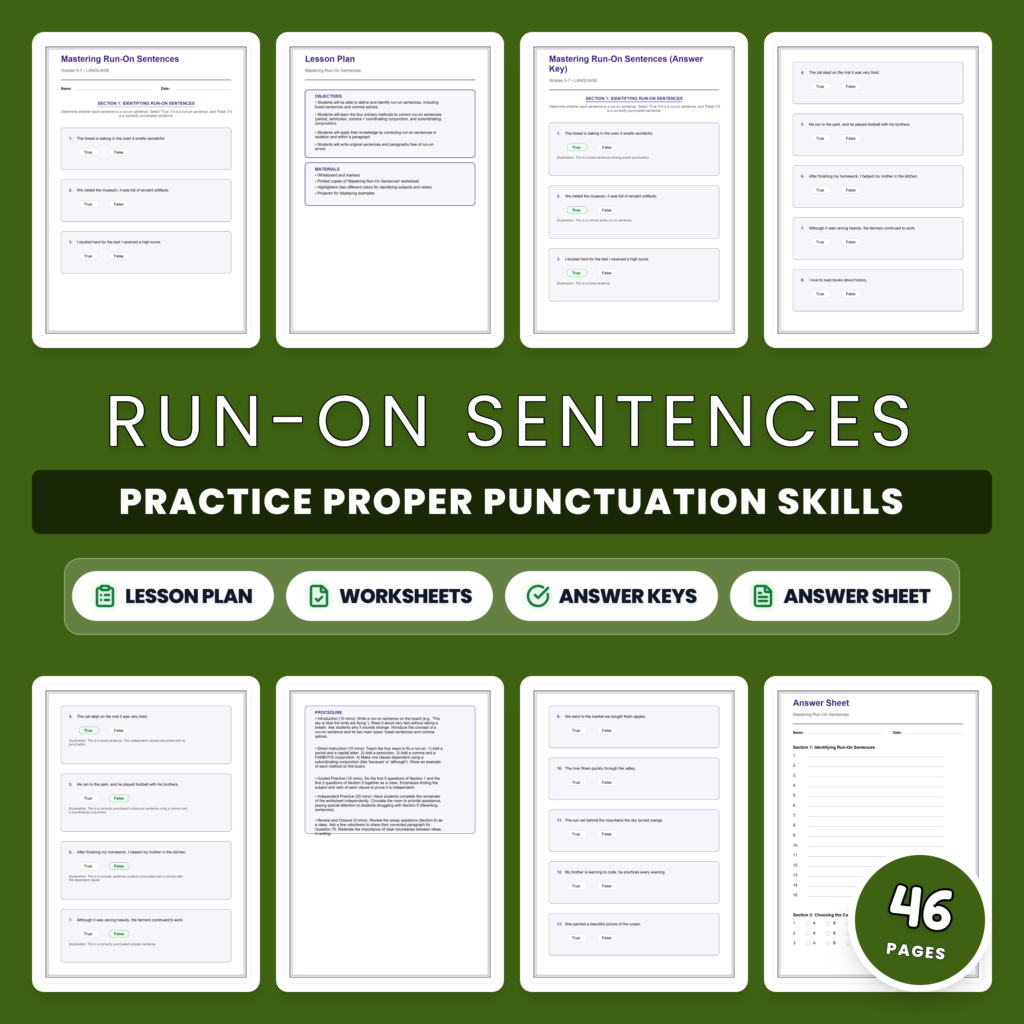
A run-on sentences worksheets packet of 46 pages for grades 5 to 7, with a lesson plan and answer key. Students work through 70 questions across 6 sections.
- PDF Mastering RunOn Sentences Answer Key 21 pages
- PDF Mastering RunOn Sentences Answer Sheet 4 pages
- PDF Mastering RunOn Sentences Lesson Plan 2 pages
- PDF Mastering RunOn Sentences Worksheet 19 pages
- Total number of pages
- 46
- Page size
- A4
A run-on sentences worksheets packet of 46 pages for grades 5 to 7, built for helping upper elementary and middle school writers spot and repair clause boundary errors. Students learn how to tell fused sentences and comma splices apart from complete sentences, and they practice four reliable ways to fix them.
In fifth, sixth, and seventh grade, students often assume a sentence is a run-on simply because it is long, or they try to fix two fused clauses by dropping a lone comma between them. Once they learn to find the subject-verb pair in each independent clause, they can see why a comma by itself is too weak to hold two main clauses together. Practicing periods, semicolons, coordinating conjunctions, and subordinating conjunctions one method at a time gives writers clear choices when revising their own drafts.
What is inside this run-on sentences worksheets packet
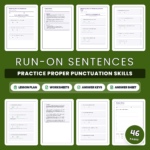
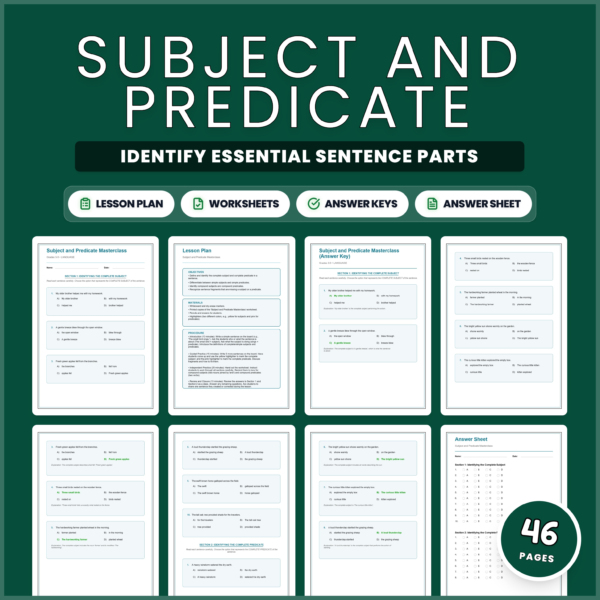
This printable set includes four classroom documents that add up to 46 pages:
- A teacher lesson plan of 2 pages for a class period of 60 minutes, covering objectives, materials, a fast breath-test read-aloud hook, direct instruction on the four correction methods, guided practice, and closure.
- A student worksheet of 19 pages containing 70 numbered questions organized into 6 sections.
- A student answer sheet of 4 pages with bubble grids and numbered lines for quick grading or reusable packets.
- An answer key of 21 pages that shows every correct answer and a brief grammatical explanation for all 70 items.
How students work through the six sections
The student pages start with identifying run-on errors in isolated sentences and progress toward targeted sentence rewriting and paragraph editing.
- Section 1 has 15 True or False questions on identifying run-on errors. Students read sentences such as “The bread is baking in the oven it smells wonderful” and “We visited the museum, it was full of ancient artifacts” and decide whether each line is a run-on or a properly punctuated sentence.
- Section 2 has 15 multiple-choice questions on fixing run-on sentences. Learners choose the option that eliminates the error using a semicolon, a relative pronoun (who or that), a subordinating conjunction (because), or a comma with coordinating conjunctions fanboys.
- Section 3 has 10 multiple-choice classification questions where students label each item as a Comma Splice, a Fused Sentence, a Correct Sentence, or a Fragment, sharpening their understanding of comma splices and fused sentences.
- Section 4 has 10 fill-in-the-blank vocabulary items with a word bank of 13 words. Students complete definitions using terms like independent, dependent, semicolon, and splice while skipping three distractor words to review independent and dependent clauses.
- Section 5 has 15 guided rewriting tasks. Each sentence includes an explicit direction in parentheses, such as rewriting with a semicolon, breaking into two separate sentences with a period, starting with Because, or joining with a comma and and, but, or so.
- Section 6 has 5 short writing prompts where students explain why comma splices are incorrect, rewrite a fused morning-routine paragraph, compose an original meal paragraph free of run-ons, and combine two clauses in three ways.
Ways to use these run-on sentences worksheets in class
The lesson plan of 2 pages walks you through a session of 60 minutes. You start by writing “The sky is blue the birds are flying” on the board and reading it aloud without taking a breath so students hear how two independent clauses collide. After modeling all four repair methods on the board, you guide the class through the first items of Section 1 and Section 5 using two highlighter colors for subjects and verbs.
You can also assign these run-on sentences worksheets during writing workshop editing days, use the separate answer sheet for a sentence-structure quiz, or place the answer key at a self-checking station.
Look over the preview pages before you buy to see the lesson plan, sample worksheet questions, and the explained answer key.
For more sentence structure and punctuation lessons, browse our grammar worksheets and English language arts resources, or check out the full catalog of printable classroom worksheets.
Frequently Asked Questions
How many pages are in these run-on sentences worksheets?
The download has 46 pages in total. You receive a teacher lesson plan of 2 pages, a student worksheet of 19 pages with 70 questions across 6 sections, a student answer sheet of 4 pages, and an answer key of 21 pages.
Which four methods do students practice to fix run-on sentences?
Students practice separating two independent clauses with a period and capital letter, joining related clauses with a semicolon, linking clauses with a comma and a FANBOYS coordinating conjunction, and turning one clause into a dependent clause with a subordinating conjunction.
Do these run-on sentences worksheets explain comma splices versus fused sentences?
Yes. Sections 1, 3, and 4 teach students to distinguish a fused sentence (two independent clauses joined with no punctuation at all) from a comma splice (two independent clauses joined by only a comma).
What grade levels fit this run-on sentences packet?
The packet is marked for grades 5, 6, and 7. It supports upper elementary and middle school language standards for recognizing and correcting inappropriate sentence fragments and run-ons.
| Format | Digital PDF Document (.pdf) |
|---|---|
| Page size | A4 |
| Pages | 46 |
| Quality | Print-ready PDF |
| License | Single Classroom / Personal Homeschool License |