Smart Glasses Reading Comprehension Passages and Technology Worksheets Set
This 48 pages packet teaches smart glasses reading comprehension through STEM topics. Students explore augmented vision, voice controls, navigation, and wearable technology advances.
Instant PDF download after payment, also saved in My Library.
Secure checkout by card or crypto.
Use it at home or in one classroom. Read the license
Details
- File format
- Pages
- 48
- Page size
- A4
- Files
- 3
- Grades
- 5th
- Answer key
- Included
In this download 3 files
- PDF Visions of the Future Understanding Smart Glasses Answer Key 16 pages
- PDF Visions of the Future Understanding Smart Glasses Lesson Plan 1 page
- PDF Visions of the Future Understanding Smart Glasses Worksheet 31 pages
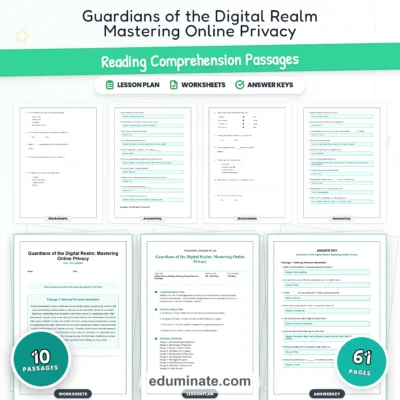
Sample pages
Smart glasses reading comprehension for fifth grade students
This unit provides focused smart glasses reading comprehension practice for fifth grade students. Through ten informational passages, learners explore the mechanics of head-mounted displays, heads-up navigation, voice interfaces, and practical wearable electronics.
Every selection connects modern engineering principles with focused literacy practice, delivering 48 pages of ready-to-print materials. The complete set includes 31 pages of student worksheets, a 16 pages answer key, and a 1 page teacher lesson plan. Students discover how tiny microprocessors fit inside spectacle frames, how visual sensors aid people with vision challenges, and how engineers solve battery limitations.
Informational topics covered in this unit
Building thorough smart glasses reading comprehension requires varied, engaging non-fiction content. These ten passages present contemporary computing concepts in clear, student-friendly prose designed for upper elementary classrooms.
- Passage 1 introduces what smart glasses are, explaining how tiny microprocessors and optical lenses project digital information directly into a user’s field of view.
- Passage 2 explains augmented reality technology, distinguishing between complete virtual worlds and computer graphics overlaid onto physical surroundings.
- Passage 3 covers voice control systems and audio speakers, describing bone-conduction transducers and directional microphones that capture spoken commands.
- Passage 4 explores breaking language barriers, showing how real-time translation displays live foreign subtitles during international conversations.
- Passage 5 focuses on hands-free navigation, explaining how internal compasses and satellite positioning display directional arrows over city streets.
- Passage 6 highlights accessibility features that assist visually impaired users by reading printed street signs and describing nearby obstacles.
- Passage 7 investigates battery life challenges, discussing the trade-offs engineers make between lightweight frames and battery storage capacity.
- Passage 8 examines personal privacy concerns, addressing public questions about built-in cameras, data security, and recording etiquette in public spaces.
- Passage 9 outlines commercial workplace uses, showing how warehouse order pickers, aircraft mechanics, and surgeons use smart eyewear to work efficiently.
- Passage 10 discusses the future of wearable tech, anticipating lightweight contact lenses, extended battery performance, and flexible neural sensors.
Structured comprehension questions and assessments
To reinforce smart glasses reading comprehension passages and emerging technology reading comprehension, each passage includes a structured twenty-question assessment. These exercises evaluate essential informational reading standards, requiring students to cite evidence and analyze technical terminology accurately.
- Multiple choice items assess factual recall, passage sequence, and central idea identification across scientific topics.
- True and false prompts require learners to verify precise statements about optical hardware and digital features.
- Fill in the blank sentences reinforce academic terminology including augmented reality, microprocessor, sensor, and optical display.
- Matching activities connect digital components with their specific roles in wearable devices.
- Short response questions ask learners to summarize technical challenges and synthesize engineering solutions using textual evidence.
Classroom implementation and instructional ideas
Educators seeking smart glasses worksheets for students can integrate smart glasses reading comprehension lessons into various parts of their schedule. This unit supports wearable technology reading comprehension during STEM lessons, digital literacy units, or informational reading blocks.
- Use individual passages during weekly reading intervention groups, small group instruction, or close reading rotations.
- Incorporate selections into upper elementary science units exploring computer science, light optics, and modern inventions.
- Assign specific selections as independent morning work, homework assignments, or structured emergency substitute plans.
- Keep printed packets available for early finishers who want to read about current technology trends and future inventions.
The estimated lesson plan pacing spans approximately 150 minutes across multiple flexible class periods. Providing structured smart glasses reading comprehension helps fifth graders build confidence in reading complex informational texts while exploring exciting real-world innovations.
Discover more resources in our reading comprehension collection, find printable activities in our science worksheets library, or visit the Eduminate shop for elementary and middle school materials.
Frequently Asked Questions
What grade levels is this smart glasses reading comprehension resource designed for?
This resource is designed specifically for 5th grade students, but it also works well with 4th grade advanced readers and 6th grade introductory STEM students. The passages explain modern engineering ideas using clear vocabulary and accessible paragraph structures.
Are answer keys provided for all ten reading passages?
Yes, a complete 16 pages answer key section provides solutions for all twenty questions per passage. The clear layout allows teachers and substitutes to grade student work quickly or enable students to conduct independent self checking during science stations.
How can this resource support STEM and technology curriculum standards?
The passages introduce real-world applications of optics, microcomputing, battery physics, and software design. Students practice close reading of informational texts while learning how engineers solve technical problems and evaluate social impacts like privacy and safety.