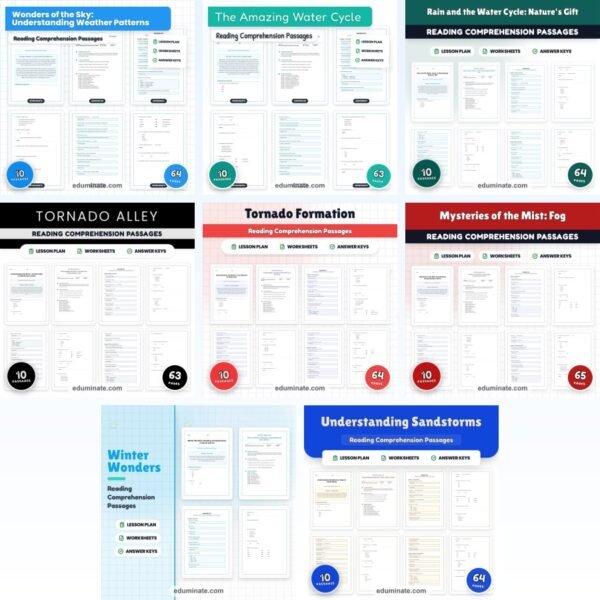
Tornado Formation Reading Comprehension Passages Worksheets 3rd-7th Grade
Examine how storms develop with 10 tornado formation reading comprehension passages across 64 pages. Features informative texts, text dependent questions, a structured lesson plan, and answer keys for grades 3 to 7.
Instant PDF download after payment, also saved in My Library.
Secure checkout by card or crypto.
Use it at home or in one classroom. Read the license
Details
- File format
- Pages
- 64
- Page size
- A4
- Files
- 3
- Grades
- 3rd–7th
- Answer key
- Included
In this download 3 files
- PDF Tornado Formation Reading Comprehension Passages Grades37 Answer Key 23 pages
- PDF Tornado Formation Reading Comprehension Passages Grades37 Lesson Plan 1 page
- PDF Tornado Formation Reading Comprehension Passages Grades37 Worksheet 40 pages
Sample pages
Understand Severe Meteorology with Tornadoes Worksheets
When atmospheric conditions turn volatile, gentle breezes transform into rotating supercells that generate intense tornadoes. This 64 pages printable packet offers ten high interest informational articles that trace storm physics from initial cloud buildup to touchdown and dissipation. Each passage pairs with targeted comprehension questions that challenge students to cite textual evidence, expand scientific vocabulary, and understand complex atmospheric cycles. Upper elementary and middle school educators can integrate these materials into weather units or daily literacy blocks.
Our classroom collection provides structured materials tailored for learners in third grade through seventh grade. Educators rely on these tornadoes worksheets for whole class earth science lessons, small group guided reading, station rotations, and substitute lesson plans. These reading comprehension packets save valuable preparation time while teaching students important physical science mechanisms.
These tornadoes worksheets present complex meteorology concepts through straightforward explanations. Students explore how warm, buoyant air masses meet dense, cold air boundaries along weather fronts. By analyzing wind shear, rising thermals, and rotating mesocyclones, young scientists gain a clear understanding of severe storm dynamics.
Informational Storm Physics Passage Topics
The unit covers fundamental meteorological steps across ten structured reading selections:
- The Spinning Wind: Introduces rotating air currents and explains how breezes develop into rapid vortexes.
- Storm Clouds: Explores cumulonimbus clouds, towering anvil heads, and the atmospheric moisture feeding big storms.
- Warm and Cold Meet: Details the collision of humid southern air masses with crisp northern cold fronts.
- Tornado Alley: Reviews the central geography of North America where dry lines and moist currents frequently intersect.
- The Funnel Cloud: Explains how condensing moisture and rotating drafts make spinning air columns visible.
- Measuring the Strength: Introduces the Enhanced Fujita Scale and how meteorologists classify storms by observed damage.
- Inside the Storm: Mesocyclones: Examines deep, continuously rotating updrafts located inside supercell thunderstorms.
- Forecasting and Warning: Details modern radar alerts, meteorologist tracking procedures, and community siren alerts.
- Wind Shear and Lift: Demonstrates how differences in wind speed and direction at varying altitudes create rolling horizontal tubes of air.
- The Life Cycle of a Tornado: Follows funnel formation from organizing dust whirls to mature stages and final rope dissipation.
Each selection includes targeted question sets featuring multiple choice items, true or false statements, matching tasks, and short written responses. Completing these skill building worksheets strengthens factual recall while building reading endurance.
Versatile Teaching Tools and Complete Answer Keys
Each topic in this packet comes with detailed question pages paired with clear answer keys. Teachers can quickly evaluate student progress or establish self checking science stations during morning work. Because these how tornadoes form science reading passages include an organized teacher lesson plan, educators can introduce domain specific vocabulary before assigning independent reading.
Integrate these tornado formation reading comprehension printables into spring weather studies, physical science units, or end of year reviews. They function smoothly as homework assignments, science station tasks, or independent practice packets. To view additional science and literacy resources, explore our full catalog at the Eduminate shop.
Educators seeking supercell thunderstorms reading worksheets appreciate the accurate meteorological explanations presented in student friendly language. The clean page layout reduces distractions and supports developing readers. Incorporating these weather science reading activities elementary into your weekly science routine equips students with the analytical skills needed to understand severe natural phenomena.
Reading these tornadoes worksheets gives students consistent practice with complex informational texts. Learners practice identifying main ideas, distinguishing causes from effects, and extracting domain specific vocabulary. Working with these tornadoes worksheets throughout the school year strengthens scientific literacy and reading confidence across multiple grade levels.
Frequently Asked Questions
What grade levels are best suited for these tornadoes worksheets?
This resource is designed for students in third grade through seventh grade. The informational texts and varied question formats allow teachers to differentiate reading tasks for elementary and middle school classrooms.
How many total pages are included in this download?
The resource contains 64 pages in total. It features ten informative reading articles, multiple format question worksheets, a structured teacher lesson plan, and complete answer keys for rapid grading.
Are full answer keys included for every passage?
Yes. Each reading selection includes a complete answer key covering multiple choice questions, true or false statements, matching drills, and short response prompts to ensure fast checking.
Can I use these tornadoes worksheets during severe weather units?
Yes. These worksheets fit smoothly into severe weather science units, atmospheric physics lessons, independent literacy rotations, morning work, and emergency substitute teacher lesson plans throughout the school year.