Quotation Marks Rules for Kids and Students, With Examples

Quotation marks show the exact words someone said or wrote. This guide to quotation marks rules covers the six rules students need most, how commas and end punctuation work with the marks, how to lay out a conversation between two speakers, the difference between direct and indirect speech, and when to use quotation marks for titles. It uses American style, where periods and commas go inside the closing mark.
What quotation marks do
Quotation marks wrap around the exact words a person says: Maya said, “I am ready.” They are also used around the titles of short works, such as a poem or a short story. Anything outside the marks is the writer’s own words.
Quotation marks rules
These are the grammar rules for quotation marks that come up in almost every piece of student writing.
1. Put the marks around the exact spoken words only
- Right: Maya said, “I am ready.”
- Wrong: “Maya said, I am ready.”
2. Begin the quote with a capital letter when it starts a sentence
- Right: Tom said, “We are late.”
- Wrong: Tom said, “we are late.”
3. Periods and commas go inside the closing mark
In American English, a period or comma that ends a quote goes inside the closing quotation mark.
- Right: She said, “Let’s go.”
- Wrong: She said, “Let’s go”.
4. Use a comma to introduce a quote after the speaker tag
A speaker tag is a phrase like she said. When it comes first, follow it with a comma. When it comes after the quote, the comma goes inside the marks.
Right: Dad said, “Dinner is ready.” and “Dinner is ready,” said Dad.
5. Start a new paragraph for each new speaker
When the speaker changes, the writing starts on a new line. We show this in the dialogue section below.
6. Keep a question mark or exclamation mark inside the marks when it belongs to the quote
- Right: She asked, “Where are you going?”
- Right: He shouted, “Watch out!”
Quotation marks and punctuation rules in detail
Commas and quotation marks
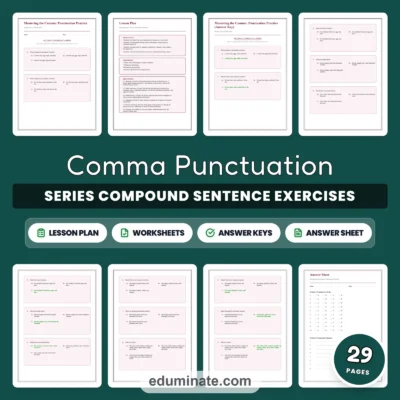
The rules for quotation marks and commas come down to two points. In short, quotation marks and comma rules work together like this: A comma separates the speaker tag from the quote, and a comma at the end of a quote sits inside the marks. Our guide to comma rules explains the other places commas are used, and the Comma Usage Worksheet Packet is a 29-page packet for grades 3 to 6 with a lesson plan, answer key and 40 comma questions across 4 sections.
Question marks and exclamation points
If the quote is a question or an exclamation, the mark goes inside. If the whole sentence is a question but the quote is not, the question mark goes outside.
- She asked, “Where are you going?” (the quote is a question)
- Who said, “I’ll be there”? (the whole sentence is a question)
When a quote ending in a question mark comes before the tag, do not add a comma: “Where are you going?” she asked. The tag starts with a lowercase letter. Our post on the types of sentences explains which end mark goes with which sentence.
Splitting a quote with a speaker tag
When the tag comes in the middle of one sentence, the second half starts with a lowercase letter: “I know,” said Ben, “that it is late.” If the second half is a new sentence, it starts with a capital: “It is late,” said Ben. “We should go.”
Semicolons and colons
In American style, semicolons and colons go outside the closing quotation mark: She said, “I’ll call you”; then she left.
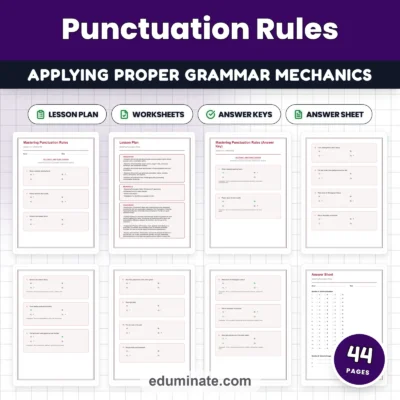
For all of these, the Punctuation Rules Worksheets give extra practice with end marks, commas, colons and semicolons in a 44-page packet for grades 4 to 6, with a lesson plan, answer key and 70 questions across 6 sections.
Rules for quotation marks in dialogue
The rules for quotation marks in dialogue are the same ones as above, plus the new-paragraph rule. Each speaker gets a new paragraph, and a speaker’s action stays in that speaker’s paragraph. Here is a two-speaker example:
“Are you coming to the library?” asked Mia.
“Yes,” said Leo. “I just need my book.”
“Good,” Mia replied. “We can walk together.”
Notice the tags. After “Yes,” the tag said Leo starts with a lowercase letter, and a new sentence follows with a capital: “I just need my book.” The Quotation Marks Practice Worksheets are a 45-page packet for grades 3 to 5 for dialogue punctuation and short titles, with a lesson plan, answer key and 70 questions across 6 sections.
Direct quotes vs indirect quotes
A direct quote gives the exact words, so it needs quotation marks. An indirect quote reports what was said in the writer’s words, so it does not. Indirect speech is also called reported speech. The pronouns and verb tenses often change.
| Direct | Indirect | Marks needed? |
|---|---|---|
| Mia said, “I am hungry.” | Mia said that she was hungry. | Direct: yes. Indirect: no. |
| Leo asked, “Where is my book?” | Leo asked where his book was. | Direct: yes. Indirect: no. |
| Dad said, “Close the door.” | Dad told me to close the door. | Direct: yes. Indirect: no. |
For students ready to practice the change from direct to indirect, the Direct and Indirect Speech Worksheets are a 32-page packet for grades 5 to 8 with a lesson plan, answer key and 50 questions across 5 sections. The Active and Passive Voice and Reported Speech Worksheets Bundle has four packets (two active and passive voice sets and two direct and indirect speech sets), 208 pages in total, listed for grades 5 to 8.
Quotation marks for titles
Titles of short works go in quotation marks: poems, articles, short stories and chapters. Titles of longer works, such as books, go in italics (or are underlined when handwritten).
- We read “The Little Red Hen” in class.
- Read the chapter called “Getting Ready” for homework.
- Our class is reading Charlotte’s Web.
Common mistakes
| Wrong | Right | Why |
|---|---|---|
| Mia said “I am ready”. | Mia said, “I am ready.” | Add a comma after the tag, and put the period inside the marks. |
| “I am ready”, said Mia. | “I am ready,” said Mia. | The comma goes inside the closing mark. |
| Mia said, “we are ready.” | Mia said, “We are ready.” | A quote that starts a sentence begins with a capital letter. |
| “Where are you going?”, she asked. | “Where are you going?” she asked. | No comma after a question mark. |
| Mia said that “she was ready.” | Mia said that she was ready. | Indirect speech needs no quotation marks. |
| “I like this,” said Leo. “It is fun”. | “I like this,” said Leo. “It is fun.” | The period goes inside the closing mark. |
Practice material
Quotation marks need a lot of repetition, and written practice with an answer key makes it easy to check. The Quotation Marks Practice Worksheets cover dialogue punctuation and short titles. The Direct and Indirect Speech Worksheets and the Punctuation Rules Worksheets extend the same skills into reported speech and other punctuation.
Frequently asked questions
Do I use single or double quotation marks?
American English uses double marks for a quote. Single marks are for a quote inside a quote: Mia said, “Leo told me, ‘I’ll be late.'”
Do I use quotation marks for thoughts?
Thoughts are not spoken, so quotation marks are not required. Writers often use italics or a phrase like she thought. Check what your teacher expects for school writing.
Where does the period go?
Inside the closing quotation mark in American English: She said, “Let’s go.” Some other countries put it outside.
Do I start a new paragraph every time someone speaks?
Yes. Each new speaker begins a new paragraph, and any action by that speaker stays in the same paragraph as their words.