Shapes Worksheets for Kindergarten: Ideas and Activities
Shapes worksheets for kindergarten help children name, trace, sort and describe the shapes they see every day. This guide covers which shapes to teach, how to talk about sides and corners, and hands-on activities to pair with printable pages.
Which shapes to teach first
Start with shapes that appear all around a child and are easy to tell apart. A short list is enough for a first unit:
- Circle: round, with no corners and no straight sides.
- Square: four equal sides and four corners.
- Triangle: three sides and three corners.
- Rectangle: four sides and four corners, with two long sides and two short sides.
Once those four feel familiar, add more shapes one or two at a time:
- Oval: a stretched circle.
- Diamond: a shape with four equal sides that stands on a point.
- Pentagon: five sides and five corners.
- Hexagon: six sides and six corners.
Introduce one new shape at a time and let children handle a real example before they see the page.
Sides and corners
Naming a shape is the start. The next step is describing it. Children can learn two words that do most of the work: sides and corners. A side is a straight line on the edge of a shape. A corner is where two sides meet.
Counting sides and corners makes a good worksheet task:
- A triangle has 3 sides and 3 corners.
- A square has 4 sides and 4 corners.
- A rectangle has 4 sides and 4 corners.
- A pentagon has 5 sides and 5 corners.
- A hexagon has 6 sides and 6 corners.
- A circle has 0 sides and 0 corners.
Ask children to run a finger along each side while they count, and to touch each corner. The movement keeps count and shape tied together.
What to look for in shapes worksheets for kindergarten
When you choose a page, think about what the child will do with a pencil or crayon.
Clear, large shapes
Large shapes with thick outlines are easier for small hands to trace and color. Crowded pages can frustrate a child who is still building control.
One task per page
A page that asks a child to trace, circle and count all at once can be too much. Pages with one clear job work better at this age.
Variety of tasks
Tracing, matching, coloring, sorting and counting all use shapes in different ways. A mix keeps interest high across a week.
Room for talk
A worksheet is a starting point for conversation. Ask, “Which shape is this? How do you know?” and let the child answer in a full sentence.
Here are some Eduminate sets that fit these points:
- The Math Worksheets Coloring Pages pack has 78 printable pages that blend foundational operations, geometry and relaxing coloring fun.
- The Math Coloring Sheets Bundle gathers nine coloring packs in one download, covering numbers, shapes, addition and subtraction practice in coloring form, in 535 pages.
Shape flashcards for quick practice
Flashcards add a different kind of practice from worksheets. A child sees a shape and says its name, and the cycle repeats quickly. They work well in small groups, at a center or at home.
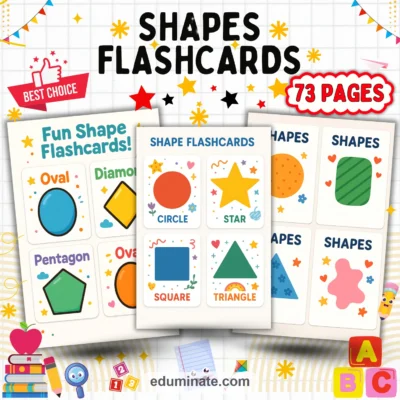
- The Shapes Flashcards set has 71 card pages with four shape cards on each page, 284 cards in all. Each card shows a colored shape and its name.
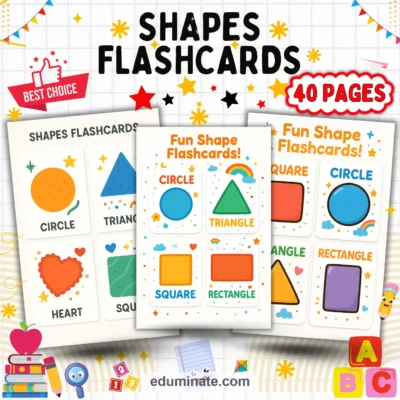
- The Printable Shapes Flashcards set has 38 card pages with four shape cards on each page, 152 cards in all. Each card shows a colored shape, and most print its name.
- The Colors and Shapes Flashcards Bundle puts four flashcard sets in one download, covering color cards and shape cards, in 262 pages.
Ways to use the cards:
- Show and say. Hold up a card, and the child names the shape.
- Sort. Spread the cards out and ask children to group the ones with the same number of sides.
- Match to objects. Place the cards in a row, and ask children to bring a classroom object that matches each one.
- Find the one that is missing. Turn one card face down and ask which shape has gone.
Shape posters for the classroom wall
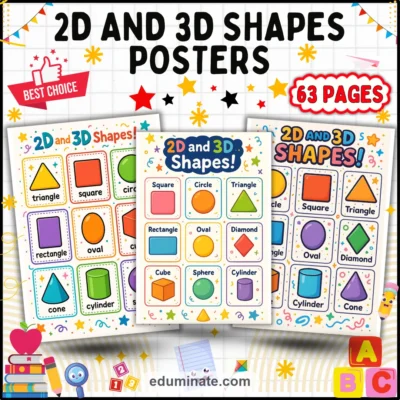
A poster keeps a shape in view all week. The Shapes Posters set holds 60 visual charts of two-dimensional and three-dimensional geometric figures. Teachers can hang each reference chart on a bulletin board or hand out mini versions for student math folders.
Point to the poster during circle time, and ask children to name a shape and tell one thing about it. Over a week, the poster becomes a shared reference.
Hands-on activities for 2D shapes
Pair a printable page with something children can touch and move.
Shape hunt
Walk around the room or home and look for shapes in everyday objects. A plate is a circle. A window or a book is a rectangle. A napkin folded flat is a square. A slice of sandwich cut corner to corner is a triangle. Children can tick off shapes on a recording page as they go.
Sorting shapes
Give children a handful of paper shapes cut in different sizes and colors. Ask them to sort by shape first, then by color. Then ask them to sort in a new way, such as big and small.
Tracing shapes
Tracing gives practice with pencil control. Start with dotted outlines, then solid ones, and later ask children to draw a shape on their own.
Build with craft sticks
Lay craft sticks end to end to make a triangle with three sticks, a square with four, or a hexagon with six. The number of sticks matches the number of sides, which is a physical way to learn the idea.
Color by shape
A page with mixed shapes and a key, such as every triangle blue and every circle green, asks children to identify shapes before they pick up a crayon.
Shape pictures
Cut out a set of paper shapes and let children glue them together to make a house, a boat or a rocket. A square, a triangle and a rectangle can form a house with a roof and a door. Talk about which shapes they used and how many of each.
Moving on to 3D shapes
Flat shapes are only part of the picture. Children also meet solid shapes: a ball is a sphere, a box is a cube or a rectangular prism, a can is a cylinder, and a funnel is a cone. A simple first step is to hand children a solid object and ask what flat shape they see on its face. Our post on the 3D shapes worksheet goes into detail for that stage.
A week of shapes
Here is one way to plan a week for a small group:
- Day one: circle and square. Handle real objects, then trace each shape.
- Day two: triangle and rectangle. Count the sides and corners on a worksheet.
- Day three: a shape hunt around the room, with a recording page.
- Day four: sort shape cards and build shapes with craft sticks.
- Day five: color by shape and make a shape picture.
If the group needs more time, stay on a day as long as it helps. There is no need to hurry through the list.
Questions children often ask about shapes
Young learners notice details, and some of their questions are good chances to talk.
Is a tilted square still a square?
Yes. A square turned on its corner is the same shape, and some children call it a diamond. Turn a paper square in your hands to show that the sides are still equal and the corners are still the same.
How is a rectangle different from a square?
A square has four equal sides. A rectangle has two long sides and two short sides. Lay craft sticks along the edges to compare.
Are all triangles the same?
No. Triangles can be tall, wide, small or large, but each has three sides and three corners. Show a few different paper triangles side by side.
What is the difference between a circle and an oval?
A circle is perfectly round. An oval is stretched, like an egg shape. Both have curved edges and no corners.
Everyday objects that match each shape
A list of real objects helps children see shapes beyond the worksheet.
- Circle: a plate, a coin, a wheel on a toy truck, the top of a jar.
- Square: a floor tile, a sticky note, a cracker, a window pane.
- Triangle: a pennant flag, a slice of watermelon, a roof gable, a yield sign.
- Rectangle: a door, a book, a whiteboard, a phone screen.
- Oval: an egg, a mirror, a leaf, a serving tray.
Ask children to add to each list. Every new example is a small piece of evidence that shapes are everywhere.
Shapes at home for parents
Learning shapes does not need a classroom. A kitchen, a living room and a short walk can serve as a shape lesson.
- At mealtime, ask the child to name the shape of the plate, the napkin and a slice of toast.
- On a walk, look for a circle, a rectangle and a triangle on signs, buildings and gates.
- At the kitchen table, cut sheets of paper into squares, rectangles and triangles, then sort them into piles.
- Build a shape picture with the paper pieces and glue it on a sheet to keep.
- Print a few pages and keep them in a folder, so the child can pick one when there is spare time.
Keep each session short. Naming three or four shapes with real interest is better than rushing through a long list.
Checking what a child knows
A quick, friendly check tells you where to go next. Ask a child to do these tasks one at a time, and note which are easy:
- Point to the circle among a handful of paper shapes.
- Name a shape you hold up.
- Count the sides of a triangle and of a square.
- Find something in the room that is shaped like a rectangle.
- Say how a square and a triangle are different.
If steps one and two are easy but step three is hard, spend more time on counting sides and corners. If step five is hard, return to sorting with real shapes and have the child describe each pile in words.
Frequently asked questions
Which shapes should kindergarten children learn?
Circle, square, triangle and rectangle are a good start. Oval, diamond, pentagon and hexagon can follow.
How can I teach sides and corners?
Count them aloud while tracing each shape with a finger. A triangle has 3 of each, and a square has 4 of each.
Do children need worksheets for shapes?
Worksheets are one tool. Real objects, flashcards, posters and building activities give the topic different angles.
Can I use the same printables at home?
Yes. Many of the activities above need only paper, a pencil and a few objects from around the house.