Summer Reading Comprehension Worksheets by Grade
Summer reading comprehension worksheets are short passages with questions that children read in the warm months, either in summer school, at home or in the last weeks of the school year. A good set uses topics children know, such as picnics, gardens and the beach, and it comes with answer keys so a parent or teacher can check the work fast. The packs below cover grades 1 to 6, and a few cover the days around the summer break.
Here are the kinds of summer reading pages you can find:
- Ten passages on everyday summer topics such as sunny days, picnics, shells and gardens, for grades 1 to 5.
- Ten longer passages for grades 4 to 6 on camping, hiking, kites and stargazing.
- End of year stories about field day, the class picnic and memory books.
- A thank you letter page set for the last day of school.
- Back to school passages for the first weeks after the break.
In this article (9 sections)
How to pick a summer reading pack
Start with the grade, then look at the page count and what is included. Most of the packs here are PDFs of 63 or 64 pages with ten passages, worksheet pages, a one page lesson plan and answer keys. That means one download gives you a full unit, and the teacher or parent does not have to write questions. All the packs on this page list A4 files that print on US Letter with Fit to page.
Think about the setting too. A summer school class that meets every morning can use one passage a day for two weeks. A family that wants light practice can read one story every few days. A teacher closing the school year may want something shorter, and the end of year packs are built for that.
Summer passages for grades 1 to 5
These three packs have the same shape: ten passages, worksheet pages with multiple choice, true or false, matching and short written answers, a lesson plan and answer keys. They differ in topics, so you can buy more than one and not repeat a story.
| Pack | Grades | Pages | Price |
|---|---|---|---|
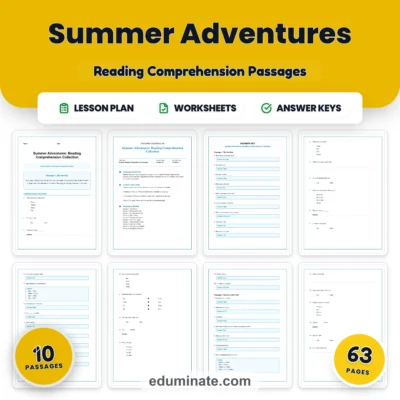
| Summer Reading Comprehension Passages Worksheets 1st to 5th Grade Activities | 1 to 5 | 63 | $7.99 |
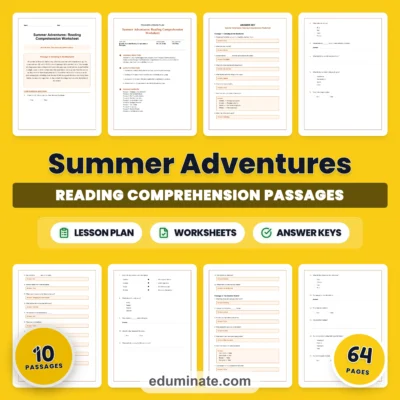
| Summer Vacation Reading Comprehension Passages Worksheets 1st to 5th Grade | 1 to 5 | 63 | $7.99 |
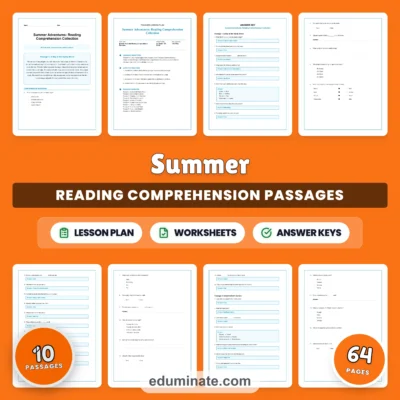
| Summer Reading Comprehension Passages with Questions and Answer Keys, Grades 1-5 | 1 to 5 | 64 | $7.99 |
The first pack has passages such as The Hot Sun, Cold Treats, Shells on the Sand, The Family Picnic, Growing Tomatoes and The Buzzing Bees. Its page also lists a passage on why the days are longest in summer. The second pack moves through stories that range from building a treehouse to tending backyard garden vegetables. The third has stories that go from building castles on the beach to planting seeds in a garden.
Because the grade range is wide, teachers can use the same pack for a mixed group. Younger readers can read the passage aloud with a partner and answer the multiple choice questions, while older readers write the short answers in full sentences.
Summer passages for grades 4 to 6
Older readers need longer texts and questions that ask for evidence. The pack below has ten narratives about backyard camping, the seashell hunter, the vegetable garden, a mountain hike, a day at the library, making lemonade, kite flying and stargazing.
| Pack | Grades | Pages | Price |
|---|---|---|---|
| Summer Worksheets: Reading Comprehension Passages with Answer Keys, Grades 4-6 | 4 to 6 | 64 | $7.99 |
Its page says the questions build text evidence citation, inferential thinking and key vocabulary. That makes it a fit for a student who is reading well but needs practice proving an answer from the page.
End of the school year
The last weeks of school are hard to plan. Children are tired, schedules change, and a full unit feels like too much. These three items are smaller or lighter.
| Pack | Grades | Pages | Price |
|---|---|---|---|
| End of Year Reading Comprehension Passages and Questions for 2nd to 5th Grade | 2 to 5 | 11 | $3.00 |
| End of Year Worksheets, Reading Passages with Questions and Answer Key | 2 to 5 | 51 | $6.99 |
| Thank You Letter to Teacher for the Last Day of School | All grades | 12 | $3.00 |
The 11-page pack has four narrative stories with full sentence questions. It comes as a PDF and a PowerPoint file, so the slides are editable. The 51-page pack has ten school stories, among them The Great Classroom Cleanup, Field Day Fun, Summer Reading Goals, The Class Picnic and Creating a Memory Book. It holds 31 worksheet pages and 20 pages of answer keys. The letter pack is a writing activity. It has sample appreciation letters and stationery pages where students write their own thank you notes.
A simple last-week plan
- Read one end of year story together on Monday.
- Let students answer the questions in pairs and check them against the key on Tuesday.
- Use the Summer Reading Goals story on Wednesday to ask each child to name one book they want to read over the break.
- Finish the week with the thank you letter pages.
Back to school after the break
Some teachers send these home in the final week as a preview, and others use them in the first days of the new year. They are not summer topics, but they fit the weeks on either side of the break.
| Pack | Grades | Pages | Price |
|---|---|---|---|
| Back to School Reading Passages K-5 Passages with Answer Keys | K to 5 | 64 | $7.99 |
| Back to School Reading Passages: Reading Passages with Answer Keys, Grades 2-4 | 2 to 4 | 63 | $7.99 |
| First Day of School Reading Comprehension Passages and Questions Grades 1-10 | 1 to 10 | 63 | $7.99 |
The K to 5 pack covers waking up early, the school bus, pencil cases, recess and library books. The grades 2 to 4 pack has packing a backpack, meeting teachers, cafeteria lunches and art class. The first day pack follows school life from backpacks and bus rides to lockers and study habits, so it spans grades 1 to 10.
Skills practice for summer school and library visits
Two more packs are not about summer at all, but they suit a summer program that wants life skills or research practice in the mix.
- Time Management Worksheets: Reading Passages with Answer Keys, Grades 2-6 has 63 pages and costs $7.99. Its ten texts cover morning routines, task priorities, calendars and study habits.
- Library Worksheets: Reading Comprehension Passages with Answer Keys, Grades 2-6 has 63 pages and costs $7.99. It covers book care, the Dewey Decimal System and research skills, which pairs well with a summer library visit.
All of it in one download
The Seasonal Worksheets Bundle holds 14 reading packets in one download: summer, fall, autumn, spring, end of year and back to school passages. It has 862 pages, covers kindergarten to 10th grade, and costs $71.41. The separate prices add up to $109.86, so the bundle saves $38.45, or 35 percent. It makes sense for a school or a homeschool family that will use several seasons across the year.
Ways to use summer reading passages
Fight summer learning loss with a small routine
Many teachers worry about summer learning loss, the slide in reading skill that can happen when children go weeks without practice. A small routine helps more than a big one. Fifteen minutes with one passage, three or four days a week, keeps reading stamina up without turning the break into school. Send a few pages home in a folder, and tell families to read the passage aloud first and answer the questions afterward.
Teach text evidence with a pencil
Ask children to underline the sentence that proves each answer. For a multiple choice question, they underline first and choose second. This habit is the core of the text evidence skill, and it works at any grade. After a few passages, children start to do it without being asked. For more on this, see our guide to reading comprehension strategies.
Use the passages as a read and talk
Summer topics give children plenty to say. After The Family Picnic or Making Lemonade, ask what they would pack, or who they would invite. Short talk before the questions improves answers, because children have already put the story in their own words.
Mix with hands-on work
- After a garden passage, plant a seed in a cup and keep a short growth log.
- After a shell or beach passage, sort a handful of shells by shape and write three sentences about them.
- After a kite or stargazing passage, draw a labeled diagram of the main idea.
Frequently asked questions
Which summer pack is best for grade 3?
Any of the three grades 1 to 5 packs fits grade 3. Pick by topic: the first has sunny weather and bees, the second has a treehouse and garden vegetables, and the third has beach castles and planting seeds.
Do the packs include answer keys?
Yes. The 63 and 64 page packs each include answer keys of 22 pages and a one page lesson plan. The 11 page end of year pack and the 51 page end of year pack also list answer keys.
Can I print them on US Letter paper?
Every pack on this page lists an A4 file that prints on US Letter with Fit to page.
Is there a pack for the whole year?
The Seasonal Worksheets Bundle gathers summer, fall, autumn, spring, end of year and back to school passages in one download, with 862 pages for kindergarten to 10th grade.