Sun Moon Earth Worksheet Ideas for Grades 1 to 5 Science

A sun moon earth worksheet is most useful when students can also see the idea with a lamp and a ball. This guide explains day and night, the year, moon phases and eclipses in simple terms, with models you can build on a desk and printable packs to go with them.
The big picture: three bodies in space
Start with what each body is.
- The Sun is a star. It gives off light and heat, and it is much larger than Earth.
- Earth is a planet. It travels around the Sun.
- The Moon is a natural satellite of Earth. It travels around Earth, and it is smaller than Earth.
One idea to stress early: the Sun makes its own light, but Earth and the Moon do not. We see the Moon because it reflects sunlight. This single fact explains many things students notice in the sky.
Day and night
Earth spins like a top, turning once about every 24 hours. The spinning is called rotation. At any moment, half of Earth faces the Sun and has daytime, and the other half faces away and has night. As Earth turns, each place moves from day to night and back again.
A lamp and ball model
- Dim the room and place a lamp on a table to stand for the Sun.
- Hold a ball at arm’s length to stand for Earth. Mark a small spot on the ball with a sticker to stand for your town.
- Turn the ball slowly. The spot moves into the light and then out of it.
- Ask: when is the spot in daytime? When is it in night?
Note that the Sun does not move around Earth each day. It looks that way because Earth turns. This is one of the most common mix-ups, so give it a moment of its own.
Shadows through the day
For a simple outdoor study, stand a stick or ruler upright in a sunny spot and mark the end of its shadow with chalk at a few times during the school day. Shadows are long in the early morning and late afternoon and short near the middle of the day. Students can record their findings in a table and then explain what changed.
A word on safety: remind students never to look straight at the Sun. Shadows give a safe way to study it.
A sun moon earth worksheet for the year and the seasons
Earth also travels in a big path around the Sun, which is called an orbit. One trip takes about a year, or about 365 days. Earth’s axis, the imaginary line it spins around, is tilted. That tilt causes the seasons.
A common mix-up is the idea that Earth is closer to the Sun in summer. The tilt matters more. When a part of Earth is tilted toward the Sun, it gets more direct light and has summer. When it is tilted away, it gets less direct light and has winter.
A good worksheet for this topic includes a simple diagram with the Sun in the center and four positions of Earth around it. Ask students to label which part is tilted toward the Sun in each position and to write the matching season for it. Keep the tilt consistent in every position, with the axis pointing the same way, since that is the key to the idea.
Moon phases
The Moon orbits Earth, taking about a month to go around. As it moves, we see different amounts of its lit half. These are the moon phases.
The eight phases, in order, are:
- New moon: we cannot see the lit side.
- Waxing crescent: a thin sliver grows.
- First quarter: half of the Moon’s face is lit.
- Waxing gibbous: more than half is lit and growing.
- Full moon: the whole face is lit.
- Waning gibbous: more than half is lit and shrinking.
- Last quarter: half is lit, on the other side.
- Waning crescent: a thin sliver shrinks away.
The word waxing means growing, and waning means shrinking. Half of the Moon is always lit by the Sun. The phase we see depends on how much of that lit half faces Earth.
A moon phase model
Use the same lamp as before. Place the lamp on one side of the room. Hold a ball at arm’s length and turn slowly in a circle, keeping your eyes on the ball. The lit part of the ball changes as you turn: a crescent, then half, then full, and so on. Ask students to sketch each shape they see on a record sheet.
Phase journal
For a longer project, ask students to look at the Moon each evening for a few weeks (with a parent when possible) and to draw its shape on a calendar page. Clouds will hide it on some nights, and that is fine. Blank squares tell their own story.
Eclipses
An eclipse happens when the Sun, Moon and Earth line up so that one casts a shadow on another. There are two kinds.
- A solar eclipse: the Moon passes between the Sun and Earth, and blocks some or all of the Sun’s light from a part of Earth.
- A lunar eclipse: Earth passes between the Sun and the Moon, and Earth’s shadow falls on the Moon.
Eclipses are rare compared with moon phases, because the Moon’s path is slightly tilted compared with Earth’s path. Most months, the Moon passes above or below the line.
Safety matters here. Never look straight at the Sun, even when part of it is covered. Looking at a solar eclipse needs special eclipse glasses made for the purpose. A model on a desk, using a lamp and two balls, shows the idea without any risk.
Putting the three together
Once students know each piece, ask them to explain the whole system in a short paragraph. A frame can help:
- The Sun is a star, and it gives light and heat.
- Earth spins, which gives us day and night.
- Earth orbits the Sun, which takes a year.
- The Moon orbits Earth, which gives us moon phases.
Ask students to add one sentence of their own that connects two of these ideas. Strong answers often tie the tilt to seasons or the reflected light to the Moon’s glow.
Printable packs for the unit
Reading and coloring both have a place in a space unit. The packs below give you both.
Reading passages
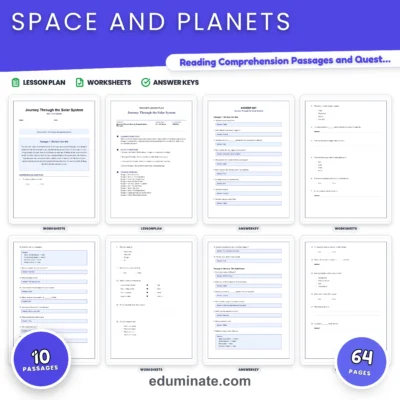
The Space and Planets Reading Comprehension packet has 64 pages and teaches space and planets reading comprehension through astronomy topics. Students explore the Sun, terrestrial planets, gas giants and distant asteroids. If your class is ready to move beyond the three bodies, our guide to the solar system for kids is a natural next step.
For one download that covers several elementary science topics, the Science Worksheets Bundle has nine reading packets with elementary science passages and questions, 553 pages in all.
Space coloring pages
Coloring gives students a calm way to review shapes and names. A few options:
- The Sun and Moon Coloring Pages pack has 74 printable pages featuring solar rays, moon crescents, stars and eclipses.
- The Sun Moon and Stars Coloring Pages set has 39 pages for day and night sky science.
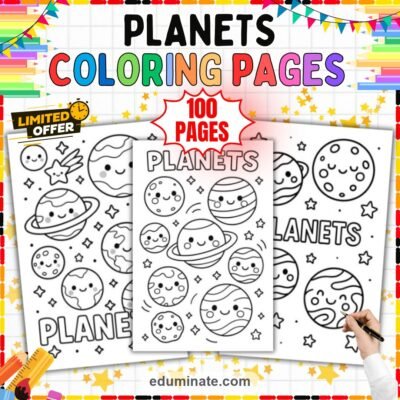
- The Planets Coloring Pages pack has 100 printable pages featuring all of the solar system planets and asteroid belts.
- The Space Coloring Sheets Bundle gathers seven coloring packs in one download, covering planets, the solar system, stars, the sun, moon and spacecraft, in 380 pages.
One way to use the moon pages: after the phase model, give students a page with a row of moon shapes and ask them to color only the lit part of each shape, then number the shapes in order.
A simple week for a sun moon earth unit
- Day one: name the three bodies and talk about what each one is. Read a short passage.
- Day two: use the lamp and ball to model day and night.
- Day three: study shadows and talk about the year and seasons.
- Day four: model moon phases and sketch them.
- Day five: talk about eclipses, then write a paragraph that connects the Sun, Earth and Moon.
Take your time. Phases and seasons both take a few tries before the idea clicks, and a model in the hand helps more than another explanation.
Common mix-ups to watch for
Some ideas in this unit are easy to get backward. Knowing them ahead of time helps you spot them in student work.
- The Sun moves around Earth. It looks that way, but Earth is the one that turns.
- Seasons come from distance. The tilt of Earth’s axis is the cause.
- Earth’s shadow makes moon phases. Phases come from how much of the Moon’s lit half we can see. Earth’s shadow only matters in a lunar eclipse.
- The Moon makes its own light. It reflects sunlight.
- The Moon only comes out at night. The Moon is in the sky for part of each day, and sometimes it is visible in daylight.
When a student shares one of these, do not just correct it. Ask them to show you with the lamp and the ball. Most mix-ups fix themselves once the model is in front of them.
Vocabulary to teach
Start a word list on the board: star, planet, moon, rotate, orbit, axis, phase, eclipse, season, reflect. Ask students to write each word with a short meaning and a sentence of their own. Return to the list at the end of the unit and ask them to use at least five words in a paragraph about the three bodies.
Writing prompts for the unit
Short writing tasks show whether students can explain an idea, not just repeat it. Here are some prompts:
- Explain why Earth has day and night. Use the words rotate and Sun.
- Describe what you see when you hold a ball in front of a lamp and turn in a slow circle.
- Explain the difference between a solar eclipse and a lunar eclipse.
- Explain why the Moon seems to change shape.
Ask students to include a labeled diagram where it helps. A diagram of the Sun, Earth and Moon in a line is a good way to show an eclipse.
Frequently asked questions
Why do we have day and night?
Earth spins once about every 24 hours. The half facing the Sun has day, and the half facing away has night.
Why does the Moon change shape?
The Moon does not change. As it orbits Earth, we see different amounts of its lit half, which gives us the moon phases.
Does the Moon make its own light?
No. The Moon reflects light from the Sun.
What causes the seasons?
The tilt of Earth’s axis. A part of Earth tilted toward the Sun gets more direct light and has summer, and a part tilted away has winter.