Two Step Word Problems: How to Teach and Solve Them

Two step word problems ask a child to do two calculations in order before reaching one final answer. This guide explains the idea, offers a routine children can follow, shows worked examples for each type, and suggests ways to practice.
What are two step word problems?
A one-step problem needs a single operation. “Sam has 7 apples and picks 5 more” is solved with 7 + 5 = 12. A two step problem needs two operations, and the first answer becomes a number in the second step.
Here is a simple one. Sam picks 14 tomatoes on Monday and 9 on Tuesday. He gives away 6. How many tomatoes does he have left?
- Step 1: 14 + 9 = 23 tomatoes picked in all.
- Step 2: 23 – 6 = 17 tomatoes left.
The question asks only for the last number, but the problem never says “find the total first”. Children have to figure out the first step for themselves. That hidden step is the new challenge, and it is why these problems feel harder than they look.
Why children find multi-step word problems hard
Several things pile up at once:
- The reader has to hold a story in mind while picking out numbers.
- The question may come after extra information.
- The first calculation is not named, so a hidden question must be found.
- A wrong choice in step one carries through to step two.
A calm routine takes some weight off. When children know what to do first, they have more attention left for the math.
A routine for solving two step word problems
Teach the same steps every time, and post them where children can see them.
- Read the problem twice. The first time is for the story. The second time is for the numbers.
- Underline the question. Find the sentence that asks “how many” or “how much”.
- Find the hidden question. Ask: what do I need to know first, before I can answer this?
- Solve step one. Write a number sentence and the answer, with a label such as “tomatoes”.
- Solve step two. Use the answer from step one and write a second number sentence.
- Check. Does the final answer fit the story? Is it bigger or smaller than it should be?
A page with a boxed area for each step helps children keep the work tidy. The Multi Step Word Problems Worksheets have fifteen multi step addition and subtraction problems, real-world scenarios, student workspace and editable presentation slides.
Four types of two step addition and subtraction problems
Looking at the types one by one helps children recognize patterns.
Add, then add
Lena has 8 books. Her brother has 5 more than she does. How many books do they have together?
- Hidden question: how many does her brother have? 8 + 5 = 13.
- Together: 8 + 13 = 21 books.
Add, then subtract
A soccer club has 26 players in the morning group and 31 in the afternoon group. Then 15 players are away for a trip. How many players are left?
- Total first: 26 + 31 = 57.
- Then subtract: 57 – 15 = 42 players.
Subtract, then add
A shelf holds 35 books. On Monday, 18 are borrowed. On Tuesday, 12 are returned. How many books are on the shelf now?
- After Monday: 35 – 18 = 17.
- After Tuesday: 17 + 12 = 29 books.
Subtract, then subtract
A supply box has 50 pencils. On Monday, 17 are handed out. On Tuesday, 20 more are handed out. How many pencils are left?
- After Monday: 50 – 17 = 33.
- After Tuesday: 33 – 20 = 13 pencils.
Two step word problems within 20
Younger children can start with smaller numbers, so that the structure is the focus and not the arithmetic.
Example: A gardener plants 7 seeds in one row and 6 in another. Four seeds do not sprout. How many seeds sprout? Step one is 7 + 6 = 13. Step two is 13 – 4 = 9. Nine seeds sprout.
Example: There are 12 crayons in a tub. Three are taken out and then 5 are put back. How many are in the tub now? Step one is 12 – 3 = 9. Step two is 9 + 5 = 14.
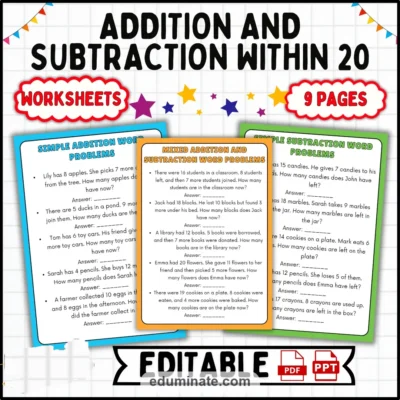
The Word Problems Within 20 pack has twenty-four word problems within 20, covering addition, subtraction and mixed multi-step story problems, with editable slides. Our post on addition and subtraction word problems covers the one-step stage that comes first.
Two step word problems within 100
Once children handle small numbers, larger ones add the challenge of two digit arithmetic. The routine stays the same.
Example: A class collects 45 cans in the morning and 38 in the afternoon. They sort out 20 cans that are damaged. How many cans are good? Step one is 45 + 38 = 83. Step two is 83 – 20 = 63.
Check with an estimate: 45 + 38 is close to 50 + 40 = 90, and 90 – 20 = 70. The answer 63 is in the right range.
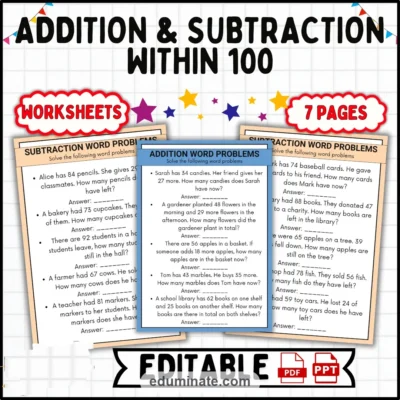
The Word Problems Within 100 pack has 4 printable worksheets of real-world story problems for second graders, with dedicated answer blanks. When the arithmetic is the sticking point, the Mixed Addition and Subtraction Within 100 Worksheets give 200 problems of two-digit practice. If a child is not yet ready for regrouping, the Addition and Subtraction Without Regrouping pack is a gentler place to build skill.
Using a bar model
A bar model is a simple drawing of rectangles that shows how the parts and the whole relate. For the books problem above, draw one bar for Lena’s 8 and a longer bar for her brother’s 13. Then draw a bracket across both and label it with a question mark.
Bar models help because they turn a story into a picture of numbers. They are drawn with plain boxes, so children focus on quantity and not on art. Start with bars on paper, then let children draw their own.
Watch out for key words
Some children learn to circle “more” and always add, or to circle “left” and always subtract. This works sometimes and fails at other times. In the problem “Lena’s brother has 5 more than she does”, “more” does mean add. In “Maya has 4 more than Omar, and Maya has 9. How many does Omar have?”, “more” leads to subtraction: 9 – 4 = 5.
Teach children to picture the story and ask what is happening to the quantities. Key words are clues, not rules.
Check your answer
A short check at the end catches many errors. Ask children to:
- Reread the question and confirm the answer responds to it.
- Add a label such as “players” or “pencils”.
- Decide if the answer is bigger or smaller than the starting number, and whether that matches the story.
- Estimate with round numbers.
- Undo the last step. If 23 – 6 = 17, then 17 + 6 should equal 23.
Ways to practice at school or at home
Write the story first
Give children a number sentence pair, such as 12 + 8 and then minus 5, and ask them to write a story that fits. Making up a problem shows how the parts fit together.
Sort problems by type
Mix a handful of solved problems and ask children to sort them into the four types above.
Find the mistake
Show a worked problem with an error. A child might subtract in step one when the story called for addition. Ask the group to find it and fix it.
One problem a day
A single problem on the board each morning, solved together, builds the routine without a full worksheet. The Addition and Subtraction Worksheets Bundle brings ten packets together in one download, covering addition, subtraction, word problems and number patterns, in 152 pages.
A full worked example
Let us walk through the routine with one problem. A cook slices 16 carrots and 19 potatoes. She uses 25 of the vegetables in a soup. How many vegetables are left?
- Read twice. The first time, picture the kitchen. The second time, note the numbers: 16, 19 and 25.
- Underline the question. “How many vegetables are left?”
- Find the hidden question. Before we can say how many are left, we need to know how many vegetables there were in all.
- Step one. 16 + 19 = 35 vegetables in all.
- Step two. 35 – 25 = 10 vegetables left.
- Check. 10 + 25 = 35, so the answer fits the story.
Notice that the checking step used addition to confirm a subtraction. Children who get into this habit gain a tool that works for every problem type.
More examples from everyday topics
Stories from science, reading and the garden keep problems close to what children know.
- Science: A class plants 12 bean seeds in one tray and 15 in another. Nine seeds do not sprout. How many sprout? Step one: 12 + 15 = 27. Step two: 27 – 9 = 18 seeds.
- Reading: A student reads 24 pages on Monday and 31 pages on Tuesday. Her goal is 70 pages by Wednesday. How many more pages does she need? Step one: 24 + 31 = 55. Step two: 70 – 55 = 15 pages.
- Garden: A gardener picks 20 beans, then picks 13 more, then gives away 8. How many are left? Step one: 20 + 13 = 33. Step two: 33 – 8 = 25 beans.
Sentence frames that support thinking
Some children find it hard to put their thinking into words. Sentence frames give them a start:
- “First I need to find ___.”
- “Then I will ___.”
- “My answer is ___ because ___.”
Used aloud with a partner, these frames turn solving into a small conversation. Over time, children stop needing them.
Frequently asked questions
What is a two step word problem?
It is a story problem that needs two calculations. The answer from the first calculation is used in the second.
What grade level are two step word problems?
They fit second and third grade well. Smaller numbers can be used for younger children, and larger numbers for older ones.
How do I find the hidden question?
Ask: what do I need to know before I can answer the main question? The answer to that is step one.
Should children always draw a picture?
A bar model or a quick sketch of boxes helps many children. Others prefer a number line or a written list. Offer choices and let children use what works.