Weather Coloring Pages: Rain, Clouds, Storms and Seasons
Weather coloring pages turn the sky outside the window into a quiet classroom task. The sets below cover rain, clouds, sunshine, storms, rainbows and the four seasons for children from preschool to 5th grade. A good weather set has bold outlines and a clear subject on each page, so a child can name what they are coloring and match it to the day’s forecast.
Here is what weather coloring pages usually show:
- Rain showers, puddles and umbrellas, easy shapes for the youngest colorers.
- Puffy clouds, sunshine and breezy days for a daily weather chart.
- Thunderclouds, lightning bolts and double rainbows for a storm lesson.
- Seasonal scenes, such as drifting autumn leaves, frost on windows and spring puddles.
- Science tools, such as thermometers and wind speed gauges, for older children.

In this article (11 sections)
Free weather coloring pages
At the time of writing, we do not have a free weather coloring pack. If you need a page today, ask children to draw the weather outside in a box on blank paper, then color it and add a label. We do have free packs on other topics, and a free pack takes an email address, which opens a free account and keeps the file in My Library. The paid weather packs below add a large number of pages in one PDF, so you can color a new page each day of the year.
Weather sets compared
All of these are PDFs, and each product page states that the A4 file prints on US Letter with Fit to page. Page counts, grades and prices come from the product pages.
- The 100 Types of Weather Coloring Pages pack is the widest set. It has 100 pages for Pre-K to 2nd grade, at $11.99. It covers rain showers, sunshine, clouds, thunder and breezes, with outdoor scenes from every season.
- The 88 Complete Weather Coloring Pages Four Seasons pack is for kindergarten to 5th grade, at $9.99. It includes outdoor thermometers, wind speed gauges, tornadoes, tall storm clouds, lightning bolts and snowdrifts.
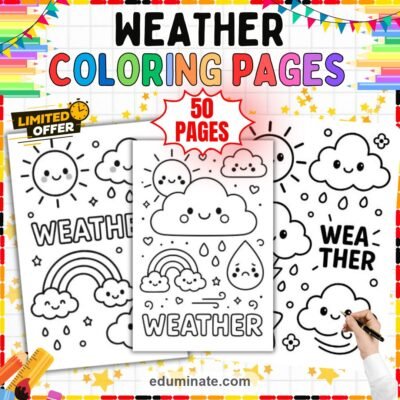
- The 50 Ready Weather Coloring Sheets pack is for Pre-K to 3rd grade, at $6.99. It has dark thunderclouds, lightning, sun breaks, double rainbows and umbrellas turning in the wind.
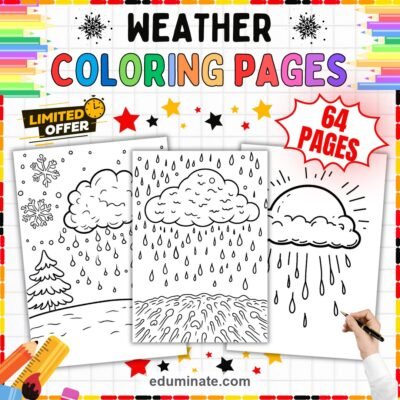
- The 64 Practical Weather Seasons Coloring Pages pack is for kindergarten to 4th grade, at $7.99. It follows the year through autumn leaf drifts, frost patterns on windows, spring rain puddles and summer shorelines.
- The 40 Handy Printable Weather Coloring Pages pack is for Pre-K to 2nd grade, at $5.99. It is built for daily weather tracking, with sunshine icons, clouds, raindrops, snowflakes, weather wheels and morning forecast charts.
- The 50 Ready Rainy Day Coloring Pages pack is for Pre-K to 3rd grade, at $6.99, and the 25 Simple Rain Coloring Pages pack is for Pre-K to 1st grade, at $3.99. Both are for classes that want a rain-only theme.
The weather bundle
The Weather Coloring Pages Bundle puts seven packs in one download: the 100, 88, 40, 64, 50 storms, 50 rainy day and 25 rain sets. That is 417 pages in seven PDF files for $37.75, which is 30% off the $53.93 the packs cost separately. It suits a teacher who wants to use weather pages all year, or a school that wants a shared set for several grades. A teacher who wants just a few pages can buy one single pack.
Which set for which age
Preschool and kindergarten
Start with the 40-page forecast pack or the 25-page rain pack. The subjects are simple and the page count is small enough to feel finishable. Ask a child to point to the weather outside, find the matching page and color it.
First and second grade
The 100-page types of weather pack and the 50-page storms pack give children a choice. Ask them to pick the page that matches today, color it and write one sentence under it, such as “Today it is cloudy and cool.”
Third to fifth grade
The 88-page pack is listed up to 5th grade and includes science tools, such as the thermometer and the wind speed gauge. Older children can label the parts they know, add a title and write two facts about the weather the page shows. For worksheets that go further into weather science, see our guide to weather worksheets.
Using weather pages with a daily routine
The easiest way to use these pages is to attach them to a routine you already have.
- Morning calendar time. Ask a helper to look out the window and say what the sky looks like. The class picks a matching page.
- A weather journal. Staple one colored page a week into a small booklet. By the end of term, children have a record of how the weather changed.
- A weather chart. Color a page for each weather type, cut out the picture and glue it to a wall chart.
- A season sort. Give children a mixed pile of colored pages and ask them to sort them into four groups: autumn, winter, spring and summer.
Weather words to teach
Each page is a chance to teach a word. Write the word on the board, say it together and ask children to use it in a sentence while they color.
- Rain and clouds: shower, drizzle, puddle, overcast.
- Wind: breeze, gust, windy, calm.
- Temperature: warm, cool, freezing, thermometer.
- Storms: thunder, lightning, rainbow, forecast.
For a short extension, ask older children to write a two sentence forecast for tomorrow and color a page to match. Younger children can dictate their forecast to you. These rain and clouds pages work well for this, since the pictures are simple and children can read them at a glance.
Easy discussion prompts
Weather pages open short talks that need no prep. Keep each one to two minutes.
- What do we wear when it rains?
- Which season has the coldest days where we live?
- What does the sky look like before a storm?
- Why do people use umbrellas, and what do they use on a sunny day?
With storm pages, keep the tone calm and factual. Children who are nervous about thunder can color the umbrella and the rainbow first. Starting with a comforting picture can make the topic easier to talk about.
Fine motor tips
Clouds and raindrops are curved shapes, and rainbows are long arcs. These shapes are useful practice for wrist control.
- Ask children to color a rainbow one band at a time, starting at the outer edge and turning the paper as they work.
- Use a light touch for clouds, and ask for short strokes in one direction.
- For lightning bolts, a zigzag stroke is a good warm up for handwriting.
- Give young children a chunky crayon and older children a sharpened pencil for the small details on the science pages.
- Print on slightly thicker paper if you plan to use watercolor markers.
A 20 minute weather art plan
- Ask the class to look outside and describe the sky in one word each. Write four or five words on the board.
- Hand out pages that match those words. Children color for twelve minutes.
- Ask each child to add one detail the page did not have, such as a ray of sun, a puddle or a scarf on a hook.
- Finish by lining the pages up on a table and asking children to sort them from coldest to warmest.
More ways to use weather pages
- Early finishers. Keep a folder of single pages at a center. A child who finishes a task picks one that matches the weather outside.
- Indoor recess. A rainy day is the perfect time for a rainy day page, and children enjoy the match.
- Sub plans. A stack of pages and a short question, such as “What is your favorite season and why?”, makes an easy quiet task.
- Display. Hang the colored pages in a row to make a classroom sky.
Frequently asked questions
What grades do weather coloring pages suit?
The packs here run from Pre-K to 5th grade. Younger children enjoy the simple rain and sunshine pages, and older children can use the science tools in the 88-page pack.
Is there a free weather coloring pack?
Not at the time of writing. Free packs on our shop take an email address, which opens a free account and keeps the file in My Library.
Which pack should I try first?
The 100-page types of weather pack gives the widest range of weather types, with scenes from every season. For a smaller start, the 40-page forecast pack is built for a daily weather chart.
Can I print these on US Letter paper?
Yes. The product pages for the packs above state that the A4 files print on US Letter with Fit to page.