Skip Counting by 2s, 5s and 10s: Charts, Games and Tips
Skip counting means counting forward in equal jumps instead of one number at a time, such as 5, 10, 15, 20. This page covers counting by 2s, 5s, 10s and 3s, with a chart, a number line, and the link to repeated addition and equal groups. It finishes with games for grades 1 to 3.
What is skip counting
When a child counts 1, 2, 3, 4, every number is spoken. In skip counting, some numbers are skipped over and the size of the jump stays the same. Counting by 5s goes 5, 10, 15, 20. Each jump is 5.
Skip counting is a first step toward multiplication. Counting by 3s four times lands on 12, which is the same as 4 groups of 3. Children who can skip count have a way to find multiplication facts before they have memorized them.
Everyday objects make a good starting point. Five pairs of mittens hold ten mittens in all, and counting the pairs by 2s gives 2, 4, 6, 8, 10. Ask children to find other things that come in equal sets, like a row of cups with the same number of beads in each, and count them by the size of the set.
Counting by 2s
Counting by 2s is an easy first sequence, because the numbers sound familiar.
- To 20: 2, 4, 6, 8, 10, 12, 14, 16, 18, 20
- To 50: 22, 24, 26, 28, 30, 32, 34, 36, 38, 40, 42, 44, 46, 48, 50
Every number is even. The ones digit repeats in the order 2, 4, 6, 8, 0.
Counting by 2s can also start at 1, which gives the odd numbers: 1, 3, 5, 7, 9, 11. Try both starts on the same number line and ask what is different about the numbers you land on.
Counting by 5s
- To 50: 5, 10, 15, 20, 25, 30, 35, 40, 45, 50
- To 100: 55, 60, 65, 70, 75, 80, 85, 90, 95, 100
Counting by 5s has an easy pattern. Every number ends in 5 or 0, and the two take turns.
Counting by 10s
The sequence is 10, 20, 30, 40, 50, 60, 70, 80, 90, 100. The tens digit goes up by one each time, and the ones digit stays 0. Counting by 10s also shows place value at work, since each jump adds one more ten.
Children can also start from a number other than 0. Counting by 10s from 7 gives 7, 17, 27, 37. The ones digit stays 7 and only the tens digit changes.
Counting by 3s
Counting by 3s is harder because the ones digit does not follow a short pattern: 3, 6, 9, 12, 15, 18, 21, 24, 27, 30, 33, 36. Take it slowly and use a number line or a chart so children can see where they are.
Skip counting chart
A skip counting chart puts the first ten numbers of each sequence side by side.
| Counting by | First ten numbers |
|---|---|
| 2s | 2, 4, 6, 8, 10, 12, 14, 16, 18, 20 |
| 3s | 3, 6, 9, 12, 15, 18, 21, 24, 27, 30 |
| 5s | 5, 10, 15, 20, 25, 30, 35, 40, 45, 50 |
| 10s | 10, 20, 30, 40, 50, 60, 70, 80, 90, 100 |
You can also make the chart on a hundred chart. Give children a crayon and ask them to color every second square, then every fifth, then every tenth, each on its own copy. The colored squares show the pattern at a glance.
Skip counting on a number line
Skip counting on a number line shows the jumps. Start at 0 and hop 5 each time. Children draw a curved arrow for each hop and say the number they land on.
A plain-text number line for counting by 5s looks like this: 0 – 5 – 10 – 15 – 20.
The same line works backward. Start at 20 and hop back by 5: 20, 15, 10, 5, 0. Counting back is a good way to introduce subtraction by equal jumps.
Four hops of 5 land on 20. Counting the hops tells you how many groups there are, and the number where the last hop ends tells you the total.
Skip counting and repeated addition
Repeated addition means adding the same number again and again. Skip counting is repeated addition said out loud.
- Counting by 3s four times: 3, 6, 9, 12. As repeated addition: 3 + 3 + 3 + 3 = 12. That is 4 equal jumps of 3.
- Counting by 5s three times: 5, 10, 15. As repeated addition: 5 + 5 + 5 = 15.
Our printable repeated addition pack has 13 math problems that connect equal groups to multiplication, along with open challenge tasks and editable presentation slides, for grades 1 to 3.
Equal groups and multiplication
Equal groups are sets that all have the same number of items. Imagine 4 cups with 3 counters in each. There are 4 groups of 3, and counting them by 3s gives 3, 6, 9, 12. Written as equal groups multiplication: 4 x 3 = 12.
Multiplication is a short way to write repeated addition, so repeated addition and multiplication say the same thing:
- 3 + 3 + 3 + 3 = 12 is the same as 4 x 3 = 12.
- 5 groups of 2 is 2 + 2 + 2 + 2 + 2 = 10, which is 5 x 2 = 10. Swapping the numbers gives 2 x 5 = 10, the same answer.
One more example: 6 cups with 5 counters in each cup. Counting by 5s six times gives 5, 10, 15, 20, 25, 30, so 6 x 5 = 30. The answer is the last number they say.
Number patterns
Number patterns follow a rule, and skip counting is one such rule. Look at this sequence: 4, 8, 12, 16, ?, 24. Each number is 4 more than the one before, so the missing number is 20.
To find a rule, subtract each number from the one after it. If the answer is the same every time, that is the size of the jump.
| Sequence | Rule | Next three numbers |
|---|---|---|
| 3, 6, 9, 12 | Add 3 | 15, 18, 21 |
| 10, 20, 30, 40 | Add 10 | 50, 60, 70 |
| 4, 8, 12, 16 | Add 4 | 20, 24, 28 |
| 50, 45, 40, 35 | Subtract 5 | 30, 25, 20 |
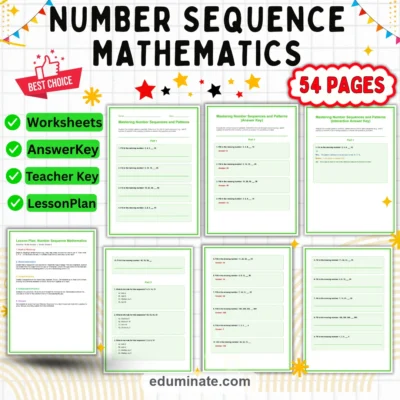
For children ready to work with longer sequences, the number sequence pack has 54 pages, including 13 student activity sheets, a lesson plan, solutions and answer keys, for grades 2 to 4.
Skip counting games
These skip counting games are short and active.
Hop and count on a floor number line
Lay a strip of tape or paper squares on the floor and mark the numbers. A child starts at 0 and hops by 2s, 5s or 10s while the group counts aloud.
Roll and skip
Roll a die. Count by that number five times and write down what you land on. A roll of 4 gives 4, 8, 12, 16, 20. Counting by 3s or 6s takes more care, so start with the smaller numbers if needed.
Mystery number
Write a skip counting sequence and leave one number out, like 15, 20, ?, 30, 35. The child names the missing number and says the rule.
Counters in cups
Put the same number of counters in each of several cups. Children skip count to find the total, then check by counting one by one.
Practice material
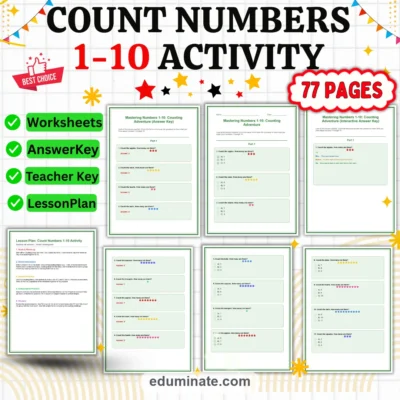
The youngest learners may need to start with the numbers 1 to 10 first. Counting numbers 1-10 includes 19 student worksheets, a lesson plan and teacher keys, and children practice counting items, writing digits and comparing quantities, for preschool to kindergarten. For children who also need addition practice, the addition and subtraction within 20 pack has 6 printable pages, for kindergarten to grade 2.
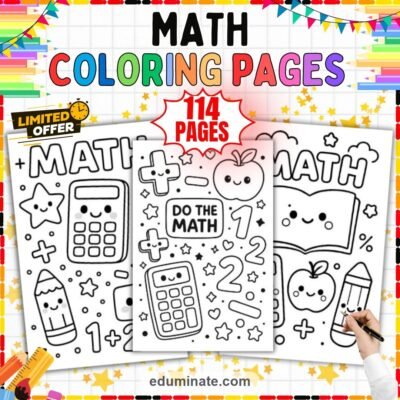
For a calm station, coloring pages can pair with counting. Kindergarten math coloring pages has 114 pages that combine number tracing, counting practice and art, for preschool to grade 1. Math coloring pages for grades K to 3 has 78 pages that blend foundational operations, geometry and coloring. Our post on math coloring pages for kindergarten has more ideas, and the early finishers activities post suggests other quiet work.
Frequently asked questions
What grade learns skip counting?
Schools differ, so check your curriculum. For reference, our packs are listed for grades 1 to 3 (repeated addition), grades 2 to 4 (number sequences) and preschool to kindergarten (counting 1 to 10).
Do I start with 2s, 5s or 10s?
One way is to start with 10s, then 5s, then 2s, since the patterns in 10s and 5s are easy to hear. Follow the order your curriculum uses.
Is skip counting the same as multiplication?
No. Skip counting is a way to get to multiplication. Multiplication is the operation, and skip counting is one method for finding the answer.
How far should a child count?
Start with the first ten numbers in a sequence, such as 5 to 50 when counting by 5s. Go further once the first ten feel comfortable. The chart above shows ten numbers for each sequence.
Related resources
- Repeated Addition Worksheets, Equal Groups Multiplication Foundation Drills
- Number Sequence Worksheets, Math Patterns Lesson Plan and Teacher Keys Pack
- Counting Numbers 1-10, Early Math Activities Set, 77 Pages Resource Packet
- Kindergarten Math Coloring Pages, Numbers Art Activity Sheets Pack for Kids
- Math Worksheets Coloring Pages, Numbers and Shapes Activity Sheets for Kids
- Addition and Subtraction Within 20, Math Worksheets, 6 Practice Pages Pack