Addition with Regrouping: 2, 3 and 4 Digit Examples
Addition with regrouping is the method for adding when the digits in a column make 10 or more, so a ten (or a hundred) has to move to the next column. This guide shows 2, 3 and 4 digit examples step by step, with a few other ways to see it, word problems, common mistakes and practice ideas.
Addition with regrouping
Take 47 + 36. The ones are 7 and 6, which make 13. Thirteen ones is one ten and three ones, so the extra ten has to go over to the tens column. That move is called regrouping. Many adults know it as carrying, and the two words describe the same step.
Regrouping works because of place value. Ten ones make one ten, ten tens make one hundred and ten hundreds make one thousand. A column can only show a single digit, so when it holds ten or more, ten of that group are traded for one of the next group. The total stays the same. Only the way it is grouped changes.
Addition with regrouping is the starting point for most multi-digit adding. Once a child understands it with two digits, three and four digits follow the same steps with more columns.
Adding with regrouping, step by step
These steps work for any size of number:
- Line up the numbers so that ones are above ones, tens above tens, and so on.
- Start on the right, with the ones column, and add the digits.
- If the total is 10 or more, write the ones digit below the line and put the new ten above the tens column.
- Move one column left and add the digits, plus the regrouped ten.
- Repeat until every column is done.
Here is 47 + 36 worked out.
- Ones: 7 + 6 = 13. Write 3 in the ones place and regroup 1 ten.
- Tens: 4 + 3 + 1 = 8. Write 8 in the tens place.
- Answer: 47 + 36 = 83.
2 digit addition with regrouping
Most children meet 2 digit addition with regrouping first. Here are two more examples that show the steps with different totals.
68 + 25
- Ones: 8 + 5 = 13. Write 3 and regroup 1 ten.
- Tens: 6 + 2 + 1 = 9. Write 9.
- Answer: 93.
89 + 47
- Ones: 9 + 7 = 16. Write 6 and regroup 1 ten.
- Tens: 8 + 4 + 1 = 13. Write 3 and regroup 1 hundred.
- Hundreds: there are no hundreds to add, so write the 1 that was regrouped.
- Answer: 136.
The second example shows that the answer can have more digits than the numbers being added. When the leftmost column makes ten or more, the extra digit goes in a new column on the left.
Other ways to see adding with regrouping
Some children understand the written method better after they see the same idea in another form. Each of these three ways gives the same answer.
Expanded form
Break each number into tens and ones. For 58 + 27: 50 + 8 and 20 + 7. Add the tens, 50 + 20 = 70, and add the ones, 8 + 7 = 15. Then 70 + 15 = 85.
Make a ten
For 8 + 7, take 2 from the 7 to complete the 8 to 10, which leaves 5: 8 + 2 + 5 = 15. This is the same trade the written method makes in the ones column.
Jumps on a number line
For 46 + 38, start at 46 and jump 30 to reach 76. Then jump 4 to reach 80 and 4 more to reach 84. The tens are added first and the ones are split to land on the next ten.
3 digit addition with regrouping
With three digits, a child may regroup in one column, in two columns or in all three. Ask the same question in every column: is the total 10 or more?
365 + 278
- Ones: 5 + 8 = 13. Write 3 and regroup 1 ten.
- Tens: 6 + 7 + 1 = 14. Write 4 and regroup 1 hundred.
- Hundreds: 3 + 2 + 1 = 6. Write 6.
- Answer: 643.
241 + 189
- Ones: 1 + 9 = 10. Write 0 and regroup 1 ten.
- Tens: 4 + 8 + 1 = 13. Write 3 and regroup 1 hundred.
- Hundreds: 2 + 1 + 1 = 4. Write 4.
- Answer: 430.
In the second example the ones column makes exactly 10, so a 0 is written. A zero in the answer is a common place to slip, so point it out.
678 + 456
- Ones: 8 + 6 = 14. Write 4 and regroup 1 ten.
- Tens: 7 + 5 + 1 = 13. Write 3 and regroup 1 hundred.
- Hundreds: 6 + 4 + 1 = 11. Write 1 and regroup 1 thousand.
- Thousands: write the 1.
- Answer: 1,134.
4 digit addition with regrouping
4 digit addition with regrouping uses the same steps with one more column. Take 2,648 + 1,975.
- Ones: 8 + 5 = 13. Write 3 and regroup 1 ten.
- Tens: 4 + 7 + 1 = 12. Write 2 and regroup 1 hundred.
- Hundreds: 6 + 9 + 1 = 16. Write 6 and regroup 1 thousand.
- Thousands: 2 + 1 + 1 = 4. Write 4.
- Answer: 4,623.
Encourage children to write the regrouped digit small above the next column, in the same place every time, so it does not get lost. A neat page does more for accuracy than speed does.
Chains of nines make a good challenge. For 99 + 1, the ones make 10, so write 0 and regroup. The tens make 9 + 1 = 10, so write 0 and regroup again. The hundreds column gets the 1, and the answer is 100.
Adding three numbers with regrouping
When three numbers are added in one column, the total can be 20 or more, so the regrouped amount may be 2 instead of 1. Take 28 + 35 + 17.
- Ones: 8 + 5 + 7 = 20. Write 0 and regroup 2 tens.
- Tens: 2 + 3 + 1 + 2 = 8. Write 8.
- Answer: 80.
Adding three numbers with regrouping is also a good time to talk about carrying a number larger than 1. The idea has not changed. Twenty ones make two tens.
Addition regrouping word problems
Story problems show why the method matters. In each of these addition regrouping word problems, decide what is being joined, then add.
- One box holds 47 crayons and a second box holds 36 crayons. How many crayons are there in all? 47 + 36 = 83 crayons.
- A shop sold 68 notebooks on Monday and 25 on Tuesday. How many notebooks did it sell in the two days? 68 + 25 = 93 notebooks.
- A class library has 128 picture books and 145 chapter books. How many books does it have? 128 + 145 = 273 books.
- A hall has 365 red chairs and 278 blue chairs. How many chairs are there? 365 + 278 = 643 chairs.
Ask children to underline the numbers, circle the question and write the number sentence before they calculate. Then they say the answer with its unit, such as 83 crayons, so that the number means something.
Check your answer
Two quick checks catch most errors. First, estimate by rounding. For 47 + 36, round to 50 + 40 = 90. An answer of 83 is close to that, so it is reasonable. An answer of 73 or 713 is not.
Second, work backward with subtraction: if 47 + 36 = 83, then 83 minus 36 should give 47. That check connects to the opposite skill, which is covered in the regrouping in subtraction guide. Regrouping addition and subtraction use the same place value ideas, and the two operations undo each other. Adding and subtracting with regrouping can be practiced side by side once each one is secure.
Common mistakes
- Forgetting the regrouped ten. A child writes 47 + 36 = 73 because the new ten was never added in the tens column.
- Writing both digits of the ones total. A child writes 13 in the ones place and gets 713 for 47 + 36.
- Misaligned columns. The numbers 365 and 78 must be lined up with the ones, so 8 sits under 5 and 7 sits under 6.
- Adding the regrouped digit to the wrong column. The new ten belongs with the tens, not the ones.
When you see an error, ask the child to explain the step aloud. Most of the time the child spots it while talking.
Ways to practice
Practice with objects first, and then move to paper.
Base ten blocks or paper strips
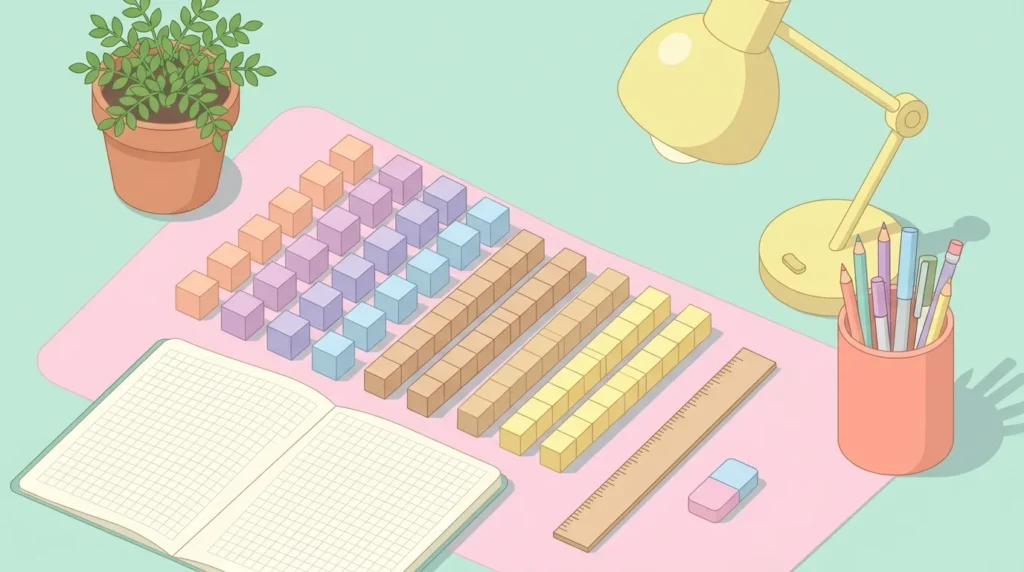
Use small cubes for ones and long rods for tens. When the ones pile reaches ten cubes, swap them for one rod. Children see the trade before they write it. Strips of paper cut into tens and ones work the same way.
Place value mat
Fold a sheet into columns labeled ones, tens and hundreds. Put counters in each column and trade ten counters for one in the next column.
Digit cards
Use number cards to make two two-digit numbers, then add them. The child sorts the sums into two piles: those that needed regrouping and those that did not.
Error hunt
Write a few worked problems and put one mistake in each. The child finds the error and fixes it. Use the mistakes listed above.
Practice material
When children are ready for pages of problems, these printable sets give them room to practice:
- Mixed Addition and Subtraction Within 100 for 2nd to 3rd grade: 200 mixed problems with two-digit regrouping practice and editable presentation slides.
- 3 Digit Addition and Subtraction for 2nd to 3rd grade: 16 printable pages with addition, subtraction, mixed equations and word problems.
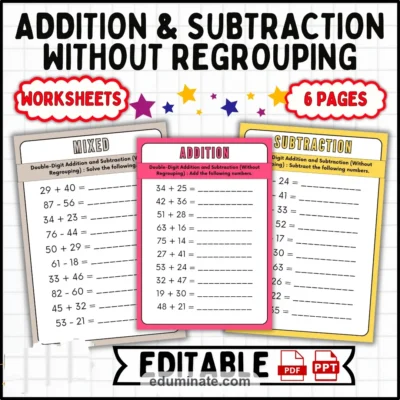
- Addition and Subtraction Without Regrouping for 2nd to 3rd grade: thirty horizontal problems with mixed operations and editable slides, a good step before regrouping.
- Mixed Addition and Subtraction Worksheets for 1st to 2nd grade: 60 horizontal problems within 20, with student cover sheets and editable slides.
- Word Problems Within 100 for 2nd grade: four printable pages of addition and subtraction story problems with answer blanks.
- Multi Step Word Problems for 2nd to 4th grade: fifteen multi-step addition and subtraction problems with space for working and editable slides.
Frequently asked questions
What is addition with regrouping?
It is adding when a column totals 10 or more. The ones digit stays in the column, and the extra ten (or hundred) moves to the next column on the left.
Is regrouping the same as carrying?
Yes. Addition with carrying and addition with regrouping describe the same step, and carrying is the older word. Regrouping describes it more exactly, because ten ones are traded for one ten.
How do I know when to regroup?
Add the digits in a column. If the total is 10 or more, regroup. If it is 9 or less, write the total and move on.
What grade learns addition with regrouping?
The printable sets above cover 1st to 4th grade, with the two-digit and three-digit regrouping sets made for 2nd to 3rd grade.
Related resources
- Mixed Addition and Subtraction Within 100 Worksheets
- 3 Digit Addition and Subtraction Worksheets Within 1000
- Addition and Subtraction Without Regrouping Worksheets
- Mixed Addition and Subtraction Worksheets Practice Drills
- Word Problems Within 100 Addition and Subtraction
- Multi Step Word Problems Worksheets Addition and Subtraction