Kindergarten Math Activities: Counting, Shapes and Addition
Kindergarten math activities make the most sense when children handle real objects before they pick up a pencil. This guide groups ideas by skill: counting, comparing, shapes and patterns, addition and subtraction, and measuring, and it ends with tips for choosing printable pages and writing word problems.
Kindergarten math activities that start with objects
Young children understand numbers best when they can touch what they count. A basket of counters, a handful of buttons or a set of blocks turns a number into something real. After children have counted objects, they can draw them, and after that they can write the number. That order, from objects to pictures to symbols, is one way to build understanding.
The activities below use ordinary supplies: counters, cubes, buttons, paper clips, index cards and a few sheets of paper. Pick one idea, try it for a week, and add the next when the first feels easy.
Counting activities
Counting looks simple, but it holds several skills at once. Children say the number words in order, touch one object for each word, and understand that the last number tells how many. Each piece needs practice.
Counting basket
Fill a small basket with a few objects, such as cubes or buttons. A child pulls out a handful, lines the objects in a row, touches each one and says the numbers. A partner checks by counting again.
Number hunt
Choose a target number, such as five. Children search the room for groups of five things, like five books on a shelf or five crayons in a cup. They can record what they found on a piece of paper.
Count to ten, then twenty
Start with ten and move to twenty when counting to ten is smooth. Use a number line or a strip of paper with boxes to keep track. Counting by tens comes later, and the guide to skip counting shows how it grows.
A printed set can supply extra practice. The Counting Numbers 1-10 early math packet has 19 student worksheets, a structured lesson plan and complete teacher keys, and children use it to count items, write digits and compare quantities from 1 to 10. That kind of page makes a good partner to the counting basket, since children can count real objects first and record on paper after.
Writing numbers
Number writing is a fine motor task as well as a math one. Let children practice in a salt tray, with a finger in a bag of paint or with a marker on a whiteboard before they use a pencil. Say a short phrase for each digit so children remember the shape, and keep sessions brief.
The kindergarten math pack with number tracing, counting and art has 114 printable pages that combine number tracing, counting practice and creative art. Pages like these give writing practice a gentle pace, since children color as they count.
Comparing numbers
Comparing builds the idea that numbers have size. Give each child two small piles of counters. They count both piles and decide which has more, which has fewer and whether the two piles are equal. For example, if one pile has six buttons and the other has four, the first has more.
Use the words more, fewer and equal aloud. Ask children to prove their answer by lining the objects up in two rows and pairing them one to one. The leftover objects show which pile is bigger.
Shapes and patterns
A shape hunt gets children out of their seats. Ask them to find a circle, a square, a rectangle and a triangle in the room. A plate is a circle, a window can be a rectangle and a book cover can be a rectangle too. Draw the shapes on a chart, and add the name next to each one.
Shape blocks also invite building. Let children make a tower or a path from blocks and describe it: how many flat sides, how many corners and which shape is on top.
Patterns start with two items repeating, such as red cube, blue cube, red cube, blue cube. Ask children to say the pattern, then continue it. Later they can make patterns with three items, or with objects of different sizes. The math worksheets and coloring pages pack offers 78 printable pages that blend foundational operations, geometry and coloring, and it works as a follow-up to the hands-on shape work.
Addition and subtraction with objects
Kindergarten math worksheets addition and subtraction pages make more sense when children have already acted out the problem. Use counters in two colors. Put three red counters on a mat, add two yellow counters and ask how many in all. The child counts the total and says the sentence: three and two make five.
Ten frames help children see how numbers fit together. Place counters in a ten frame and ask how many more it takes to fill it. If there are six counters, the answer is four. Pairs that make ten, such as 6 and 4, 7 and 3, 8 and 2, 9 and 1, and 5 and 5, are worth practicing often because they support later addition. Numbers from 11 to 19 can be seen as a full ten frame plus some more: thirteen is ten and three.
For subtraction, start with a group and take some away. Place five counters on the mat, cover two with a cup and ask how many are left. Children can lift the cup to check. The guide to fact families shows how addition and subtraction connect, and it can help once children know several facts.
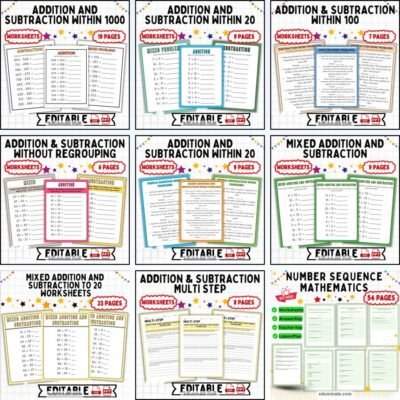
When children are ready for more, the addition and subtraction within 20 pack offers six printable worksheets on basic fact fluency, with single digit and double digit sums, subtractions and mixed equations within 20. A first look at early addition can also come from the early addition coloring sheets, a 30-page printable with 26 coloring sheets that review simple sums using school supplies.
Math word problems for kindergarten
Math word problems for kindergarten should be short, concrete and read aloud. Kindergarten math story problems work best with a prop or a drawing. The child acts out the story, counts, and then says the answer in a full sentence. Here are a few examples:
- Four soccer balls are in a bag. Two more go in. How many soccer balls are in the bag now? (6)
- There are five apples on the table. Ben eats one. How many apples are left? (4)
- Sara has three stickers. She gets two more. How many stickers does she have? (5)
- Seven cubes are in a tower. Three cubes fall off. How many cubes are left in the tower? (4)
Change the numbers and the objects often. Ask children to make up a story of their own, then solve it with counters. Once children are comfortable with these, the guide to addition and subtraction word problems shows the next step.
Measuring and sorting
Measuring starts with comparing. Which pencil is longer? Which block is shorter? Line up two objects at one end and look at the other end. Then measure with non-standard units, such as paper clips or cubes, and count how many fit along the object.
Sorting also feeds early math. Give children a jar of buttons and ask them to sort by color, size or number of holes. After sorting, they count each group and compare the totals. Different children will sort in different ways, and each way is worth talking about.
Kindergarten math games printable and homemade
A kindergarten math games printable can be as simple as a board with a path of squares and a set of number cards. A child turns over a card, counts that many spaces and moves a counter. Other ideas use plain supplies. Cover the number: place a counter on each number on a mat as it is called. Make ten: build a tower of ten cubes in two colors and record the pair. Compare and keep: two children each turn over a card, and the one with the larger number keeps both.
Keep the games short and the rules few. A game that takes a long time to explain loses its practice value.
Choosing printable pages for kindergarten
Kindergarten math worksheets work as a record of what children understand. Use them after hands-on work, not instead of it. Kindergarten math activities worksheets that match the activity of the week keep the practice focused, for example a counting page after a counting basket.
Easy math worksheets for kindergarten share a few features: large print, a small number of items per page and clear spaces for answers. Simple math worksheets for kindergarten should not crowd the page, because a child who is still learning to hold a pencil may lose the thread among many small boxes.
Math counting worksheets for kindergarten can mix counting objects, writing numbers and matching a number to a group. Kindergarten math printables can also take the shape of coloring sheets, where the child solves a task and then colors the result.
Kindergarten math practice at home
Kindergarten math practice at home can fit into ordinary routines. Count the steps up to the front door, sort the spoons from the forks while setting the table or ask how many more plates are needed. Short talks like these show that math appears in daily life.
Math homework for kindergarten should stay light. A single page of counting, or a short list of objects to find at home, is enough. Sit with the child, ask them to explain their thinking and praise the effort.
Frequently asked questions
What math should a kindergartener know?
Kindergarten math can include counting, comparing numbers, shapes, and simple adding and subtracting with objects. Your school or curriculum will list the exact skills for your class.
How can I make math fun for a five year old?
Use objects, short games and real-life questions. Keep sessions brief, and let the child lead where possible. Mistakes are useful, since they show what to practice next.
Should kindergarteners use printable pages?
Worksheets can help when they follow hands-on work. Choose pages with a few clear tasks and plenty of space, and mix them with games and real objects.
How do I teach addition to a kindergartener?
Start with objects. Put two groups together and count the total. Move to pictures, then to written number sentences. Ten frames and small word problems both help.
Related resources
- Counting Numbers 1-10: Early Math Activities Set, 77 Pages Resource Packet
- Addition and Subtraction Within 20: Math Worksheets, 6 Practice Pages
- Kindergarten Math Coloring Pages Numbers Art Activity Sheets Pack for Kids
- Math Worksheets Coloring Pages Numbers and Shapes Activity Sheets for Kids
- Math Back to School Coloring Pages: Cute Addition Practice Activity Pack