Weather Worksheets: Types of Weather and Activities

Weather worksheets give children a structured place to record what they see in the sky, name the types of weather and explain why it changes. This guide lists the main ideas to teach, the tools that measure weather, simple activities, and how to use reading passages, charts and coloring pages in a weather unit.
What weather worksheets can cover
A good weather unit moves from observation to explanation. Children first notice and describe what is happening outside. After that, they learn the words for what they noticed, and later they ask why it happens.
Weather is the condition of the air at a certain place and time: how warm it is, whether the air is dry or damp, whether the wind is blowing, and whether there are clouds or precipitation. It can change within an hour. Climate is different. Climate describes the typical weather of a region over many years, so it changes very slowly. A child can say “it is raining today”, which is weather, and “this region gets a lot of rain every year”, which is climate.
Pages that work well in a unit usually ask for one of four things:
- Labeling or sorting, such as matching a weather word to a description.
- Recording, such as a daily chart of temperature and sky conditions.
- Reading and answering questions about a short passage.
- Explaining, with a sentence or two of the child’s own words.
Types of weather for kids
Start with the words children already use, then add precise ones. The list below covers the weather types a young class meets first.
- Sunny: few or no clouds, so sunlight reaches the ground directly.
- Cloudy: clouds cover much of the sky.
- Rainy: liquid water falls from clouds.
- Snowy: frozen water falls as snowflakes, which happens when the air is cold enough.
- Windy: air is moving fast enough to sway branches and flags.
- Stormy: strong wind, heavy rain and often thunder and lightning.
- Foggy: a cloud of tiny water droplets sits at ground level, which makes it hard to see far.
Precipitation is the general word for water that falls from clouds. Rain, snow, sleet and hail are all precipitation. Sleet is rain that freezes into small ice pellets as it falls. Hail forms inside strong storm clouds, where ice pellets are carried up and down and gather more layers of ice until they are heavy enough to fall.
The step from “what” to “why” connects to the water cycle, since water evaporates, rises, condenses into clouds and falls again. The post on the water cycle walks through each stage if your class needs it.
Types of clouds
Clouds are a handy sky clue, and children can learn four basic types by shape.
- Cumulus: puffy clouds with flat bottoms, like piles of cotton. They are common on fair days.
- Stratus: a flat gray layer that covers the sky like a blanket. It can bring drizzle.
- Cirrus: thin, wispy streaks very high in the sky, made of ice crystals.
- Cumulonimbus: tall, dark storm clouds that can bring heavy rain, thunder, lightning and hail.
Make a set of cloud cards with a short description on the back. Children look out the window and decide which card fits. If the sky shows no clouds, they record “clear”. This kind of matching and recording is a natural fit for a worksheet because the child has to compare what they see with a written description.
Weather tools children can use
Scientists measure weather instead of guessing, and children can do the same with simple tools.
- Thermometer: measures temperature. It must be read in the shade for an honest air temperature.
- Rain gauge: collects rain so you can measure how much fell. A clear container with straight sides and a ruler taped to it works.
- Wind vane: shows the direction the wind is blowing from. If the vane points west, the wind is coming from the west.
- Anemometer: measures wind speed.
- Barometer: measures air pressure, which is the weight of the air pressing down. Falling pressure often comes before wet weather.
A classroom does not need all five. A thermometer, a homemade rain gauge and a paper wind vane give enough to run a week of observations.
Weather and climate in one unit
Once children have a few days of data, they can ask a bigger question: what is the pattern? Put a simple table on the board with a column for each day and rows for temperature, sky, wind and precipitation. After a week, the class reads it together.
To bring in climate, compare two places. A region with hot, dry summers and one with cold, snowy winters have different climates, and a map or a short passage can show both. Keep it simple at first: “Which place is warmer through the year?” and “Which place gets more snow?”
Seasons also belong here. Earth is tilted as it travels around the sun. When a part of Earth leans toward the sun, it gets more direct sunlight and longer days, which makes it warmer. When it leans away, days are shorter and the weather is colder. The tilt, not the distance from the sun, causes the seasons.
Weather reading passages
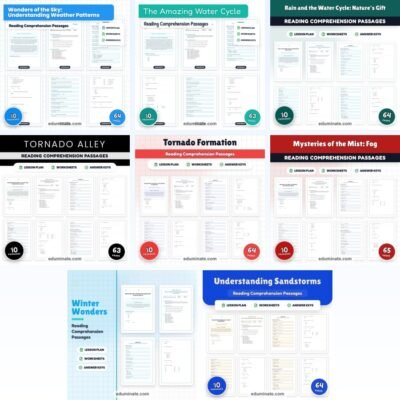
Passages let children meet vocabulary in context and practice finding evidence in a text. This weather patterns reading packet has 64 pages and ten detailed meteorology passages that explore climate, clouds, wind and storms, with complete answer keys. A teacher can use one passage per lesson, then connect it to the day’s weather log.
A related set focuses on one topic. These rain reading passages cover precipitation, the water cycle and storm science in ten passages, with worksheets, a lesson plan and answer keys. They suit a class that wants to go deeper on how rain forms.
Before reading, ask children to predict what a passage will say from its title. After reading, ask for one fact they learned and one question they still have. These two prompts make a strong exit ticket and take little time to mark.
Weather chart for calendar time
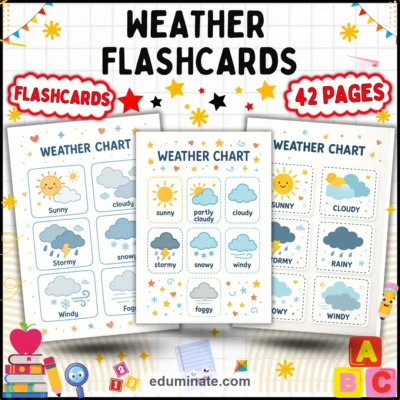
For younger children, a daily weather routine works well during calendar time. A child looks outside, picks the weather card that matches and places it on the chart. This preschool weather chart has 39 pages with 4 to 9 weather cards on each page, such as Sunny, Rainy, Cloudy and Stormy. The PDF has 42 pages in all.
Add a second step for older children. After choosing a card, they write a full sentence: “Today it is cloudy and cool.” Over a month, the cards and sentences form a weather journal that the class can review. Count how many days were sunny, cloudy or rainy, and make a simple bar graph from the counts.
Weather coloring pages
Coloring gives children a calm way to review the vocabulary after a lesson. These types of weather coloring pages include 100 printable pages featuring rain showers, sunny skies, stormy clouds and windy outdoor scenes. Children can color a page and then add a label or a one-sentence caption below it.
Sorting works well here too. Give each child a pile of finished pages and ask them to group them by weather type, then explain one group to a partner. It makes a short, quiet review at the end of a lesson.
Simple experiments and activities
A few hands-on activities make the ideas stick. All of these use ordinary classroom materials.
Rain gauge
Use a clear straight-sided container and tape a ruler to the outside so the zero mark sits at the bottom. Put it outdoors in an open spot, away from roofs and trees. After a rainy day, read the level and record it in a notebook.
Paper wind vane
Push a pencil with a rubber eraser into a block of clay. Cut an arrow from paper and fix it to a straw, then balance the straw on the pencil tip with a pin through the middle. The arrow swings to point toward the direction the wind comes from. Mark north on a card so the class can read the direction.
Cloud in a jar
Pour a little hot water into a clear jar and place a plate of ice cubes on top. The warm, damp air near the water cools at the top of the jar, and tiny droplets form. A teacher should handle the hot water. This shows condensation, the step that makes clouds in the water cycle.
Thunder and lightning
Lightning is a giant spark of electricity. It heats the air around it so fast that the air expands and makes the sound we call thunder. Light travels faster than sound, so we see lightning before we hear thunder. When thunder is heard, it is time to go indoors.
Weather vocabulary to teach
Strong weather vocabulary helps children write and talk about what they see. A short word wall gives a place to collect the words as the unit goes on. Good starting words include temperature, forecast, precipitation, humidity, front, breeze, gust and visibility.
A forecast is a prediction of coming weather. Ask children to make their own forecast for tomorrow after reading the sky, then check it the next day. They learn that forecasts are made from evidence and can be wrong, which is a real part of how meteorologists work.
Practice material
If you plan a whole weather unit, this weather reading bundle brings eight reading packets into one download, covering weather patterns, the water cycle, rain, tornadoes, snow, fog and sandstorms. It has 519 pages and is 30% off the separate prices.
The reading packets, the weather chart and the coloring pages are each listed below for separate use.
Frequently asked questions
What is the difference between weather and climate?
Weather is what the air is doing at a certain place and time, and it can change within hours. Climate is the usual weather of a region over many years.
How can I track weather in the classroom each day?
Choose a regular time, such as the start of the day. A child checks the sky, reads a thermometer and picks a weather card. The class records the result in a chart, which becomes a weather journal over a few weeks.
Why does the sky look gray before rain?
Thick clouds block much of the sunlight, so less light reaches the ground. The thicker the cloud layer, the darker the sky looks from below.
Which weather tools are easiest to make?
A rain gauge and a paper wind vane. Both use simple materials, and children can read them without help after one demonstration.