Two Digit Addition Worksheets: Steps, Examples and Tips
Two digit addition worksheets help children practice adding numbers like 34 + 25 and 46 + 38 with tens and ones in mind. This guide walks through the order to teach, worked examples, mental math methods, common mistakes and how to choose a good page.
What children need before two digit addition
Two digit addition builds on two earlier skills. The first is single digit facts, because every two digit problem is solved by adding digits one column at a time. The second is place value. A child needs to see that 47 is 4 tens and 7 ones, not just the digits 4 and 7 side by side.
A quick check can tell you if a child is ready. Ask for the sum of 6 + 5 and for the number of tens in 52. If both come easily, move ahead. If not, spend a little more time on facts or on base ten blocks.
Place value and expanded form
Place value is the idea that a digit’s position gives it a value. In 63, the 6 is in the tens place and means 60. The 3 is in the ones place and means 3. Writing this out is called expanded form: 63 = 60 + 3.
Expanded form is also a way to add. To find 34 + 25, break each number apart:
- 34 = 30 + 4
- 25 = 20 + 5
- Add the tens: 30 + 20 = 50
- Add the ones: 4 + 5 = 9
- Put them together: 50 + 9 = 59
Base ten blocks show the same thing. Three rods and four cubes join two rods and five cubes to make five rods and nine cubes.
Two digit addition without regrouping
Start with problems where the ones add up to 9 or less. No new ten is formed, so there is nothing to carry. Children can focus on lining up the digits and adding each column.
Here are some examples, with answers:
- 21 + 13 = 34
- 45 + 32 = 77
- 60 + 25 = 85
- 52 + 36 = 88
- 14 + 5 = 19
Look at 52 + 36. The ones are 2 + 6 = 8. The tens are 5 + 3 = 8. The answer is 88. Both digits are the same, which is a nice moment to point out that a pattern can happen by chance and each column still needs its own check.
A good page at this stage has plenty of room, clear horizontal or vertical problems and a mix of ones and tens that do not cross a ten. The Addition and Subtraction Without Regrouping pack has thirty horizontal practice problems, mixed operations and editable presentation slides, which suits this step.
Vertical addition step by step
Vertical addition stacks one number above the other, with the ones under the ones and the tens under the tens. Teach the steps in the same order each time:
- Write the bigger number on top if you like, and line up the digits.
- Add the ones column first, from the right.
- Write the ones answer under the line.
- Add the tens column.
- Write the tens answer and read the whole number aloud.
Grid paper helps many children keep digits in straight columns. If your page does not have a grid, show children how to turn lined paper sideways so the lines become columns.
Moving on to regrouping
Regrouping, sometimes called carrying, happens when the ones add up to 10 or more. Ten ones become one new ten, which moves to the tens column. We cover this in detail in our post on addition with regrouping, so here is a short example.
Take 38 + 27. Add the ones: 8 + 7 = 15. Write 5 in the ones place and carry the 1 ten to the tens column. Add the tens: 3 + 2 + 1 = 6. The answer is 65.
More examples to try:
- 47 + 26 = 73
- 19 + 45 = 64
- 56 + 18 = 74
- 39 + 44 = 83
- 28 + 35 = 63
Base ten blocks again help. When ten unit cubes sit on the table, children trade them for one rod and move it over to the tens. The Mixed Addition and Subtraction Within 100 Worksheets have 200 mixed problems within 100, with two-digit regrouping practice and editable presentation slides.
Mental math methods for two digit addition
Not every sum needs a written algorithm. Showing children several methods helps them pick one that suits the numbers.
Add the tens, then the ones
For 46 + 32, add 40 + 30 = 70, then 6 + 2 = 8. The answer is 78. This is expanded form done in the head.
Jump on a number line
For 35 + 24, start at 35. Jump two tens: 45, then 55. Then jump four ones to land on 59. A number line sketch makes a good record of the thinking.
Round and adjust
For 49 + 23, round 49 up to 50. Then 50 + 23 = 73. Take away the 1 you added, so the answer is 72. For 28 + 35, round 28 to 30 and get 65. Take away 2 to get 63.
Make a friendly number
Some numbers are easy to combine. In 37 + 26, you can move 3 from the 26 to the 37 to make 40 + 23. The sum is 63.
Estimation as a check
Estimation catches many careless errors. Before solving, round each number to the nearest ten and add. For 38 + 27, round to 40 + 30 = 70. The actual answer, 65, is close, so it makes sense. If a child writes 515, the estimate shows right away that something went wrong.
Make estimation a habit by asking, “About how much do you expect?” before children begin a row of problems.
Common mistakes to watch for
- Misaligned digits. A child adds a ones digit to a tens digit. Use grid paper or draw column lines.
- Writing both digits of a column sum. For 38 + 27, a child writes 5 and 15 side by side to get 515. Remind children that each column holds only one digit in the answer, and extra tens move left.
- Forgetting the carried ten. The answer comes out too small, such as 55 instead of 65. Ask children to write the small 1 above the tens column every time.
- Adding the carried ten to the wrong column. The 1 ten belongs with the tens, not the ones.
When you find a mistake, ask the child to explain the steps aloud. Often they spot the slip themselves.
Two digit addition word problems
Word problems show why the skill matters. Keep the numbers realistic and the story short.
- A garden has 34 tomato plants and 28 pepper plants. How many plants are there in all? 34 + 28 = 62.
- A soccer team scored 46 goals in the fall and 37 in the spring. How many goals is that for the year? 46 + 37 = 83.
- A student read 52 pages on Monday and 29 pages on Tuesday. How many pages is that? 52 + 29 = 81.
Ask children to underline the numbers, circle the question and write the number sentence before they solve. The Word Problems Within 100 pack has 4 printable worksheets of real-world story problems within 100, with answer blanks for second graders.
Choosing two digit addition worksheets
When you look at a set, check these points:
- Does it separate problems with regrouping from problems without it?
- Are there both horizontal and vertical problems?
- Is there room to show work?
- Is there an answer key?
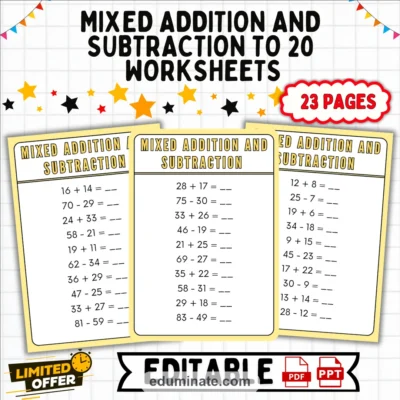
The Mixed Addition and Subtraction Worksheets hold 60 horizontal problems within 20, which suits a quick review of facts before moving to bigger numbers. For a wider selection, the Addition and Subtraction Worksheets Bundle gathers ten worksheet packets, covering addition, subtraction, word problems, regrouping and number patterns, in 152 pages.
A path to three digit addition
Once two digit addition is secure, a third column adds hundreds. The steps are the same: start at the ones, move to the tens, then the hundreds, regrouping as needed. For example, 214 + 325 = 539, because 4 + 5 = 9, 10 + 20 = 30, and 200 + 300 = 500. The 3 Digit Addition and Subtraction Worksheets offer 16 printable pages, with addition, subtraction, mixed equations and word problems.
Problems in order of difficulty
A good set of two digit addition worksheets moves in small steps. Here is one ladder you can use when you plan a week of practice, with answers.
Step one: add tens only
- 30 + 40 = 70
- 20 + 50 = 70
- 60 + 30 = 90
Step two: a two digit number plus a one digit number
- 23 + 4 = 27
- 51 + 6 = 57
Step three: adding without regrouping
- 32 + 16 = 48
- 41 + 27 = 68
- 73 + 25 = 98
Step four: regrouping
- 25 + 17 = 42
- 48 + 36 = 84
- 69 + 23 = 92
- 57 + 28 = 85
Let children stay on a step until it feels easy. A child who moves quickly through step three can try step four, while a child who needs time can repeat the earlier steps with new numbers.
Practice routines for two digit addition
Short routines keep the skill fresh between worksheets.
- Add ten. Write a number such as 34 on the board. Children say 44, then 54, then 64. Next, try adding 20 at a time.
- Tens first. Give two numbers and ask children to add only the tens. For 52 + 36, they say 50 + 30 = 80, then add 2 + 6 = 8 to reach 88.
- Two methods, one answer. Partners solve the same problem in two ways, such as vertical addition and a number line, then compare.
- Cover and reveal. Cover the answer to a solved problem, and ask the group to estimate before you reveal it.
These routines can last a few problems. They do not replace a worksheet, but they give children more chances to see tens and ones at work.
Frequently asked questions
When should children start two digit addition?
When they can add single digit numbers with a reliable strategy and can tell the tens from the ones in a number.
Should I teach regrouping right away?
One way to start is with problems that need no regrouping, so children can focus on lining up digits. Regrouping can follow once that feels smooth.
Do children need the vertical method?
Not at first. Expanded form, number lines and mental methods all build understanding. The vertical method is one tool among them.
How can I help a child who mixes up the columns?
Use grid paper or base ten blocks, and name the columns aloud as you work: ones first, then tens.