Addition Flashcards to Print: Facts to 20 for K-2
FreeTry a printable pack for free first. No card needed.See free packs
Addition flashcards give children short, repeated practice with the facts they need to know by heart: sums up to 20. The best sets show one clear equation per card, grow from easy facts to harder ones, and print on ordinary paper so you can cut, laminate and sort them. They suit kindergarten, first grade and second grade, and they work well for a two minute warm-up, a math center or a quiet quiz at home.
Here are the kinds of cards worth looking for:
- Plus zero and plus one cards for beginners who are still learning to count on.
- Doubles, such as 6 + 6, and near-doubles, such as 6 + 7.
- Making ten cards, such as 8 + 2 and 7 + 3, with the bridge to ten built in.
- Teen sums from 11 to 20, such as 9 + 6 and 8 + 7.
- Vertical and horizontal layouts, so children see the equation both ways.
In this article (10 sections)
- What fact fluency means for young children
- Free addition flashcards
- What the addition flashcards set holds
- Getting the cards in a larger flashcard collection
- How to use addition flashcards in class
- Cutting, laminating and storing the cards
- Pairing cards with hands-on tools
- Which cards for which child
- Sending practice home
- Frequently asked questions
What fact fluency means for young children
Fact fluency does not mean racing. It means a child looks at 7 + 5 and knows the answer without building it on fingers each time. That quick recall frees attention for the harder parts of math later, such as multi-digit addition and word problems. Most children get there through many short visits with the same facts, not one long drill, and flashcards suit that pattern well because a deck can be pulled out for two minutes while the line waits or the bus is late.
It helps to teach strategies first and use cards second. A child who knows that doubles are easy, that 9 + 6 is the same as 10 + 5, and that adding zero changes nothing will learn facts faster than a child who only repeats them. The cards then become a way to practice what the child already understands.
Free addition flashcards
Many families search for addition flashcards hoping for a free download. At the time of writing we did not find a free addition flashcard pack in our shop. If you need cards today, you can write facts on index cards by hand, one equation per card, and start with the doubles. Our shop does list free packs on other topics, and a free pack takes an email address, which opens a free account and keeps the file in My Library. The paid set below adds a full range of facts, already laid out and ready to cut.
What the addition flashcards set holds
The Addition Flashcards pack costs $8.99. It is a single PDF of 73 pages for kindergarten to 2nd grade: 71 pages of cards plus 2 pages for a student name and review. Each page has four large cards with clear numerals, bold addition signs and clean borders, with dashed cutting lines around every card. The product page lists A4 files that print on US Letter with Fit to page.
According to the product page, the cards cover these groups:
- Plus zero and plus one facts for beginners.
- Doubles and near-doubles that encourage quick mental strategies.
- Making ten combinations and bridge-to-ten equations.
- Two-digit plus single-digit cards with sums from 11 up to 20.
- Vertical equation formats that prepare children for column addition.
- Horizontal cards that practice reading number sentences from left to right.
The cards use bold black numbers with no pictures, which keeps attention on the numbers and makes them readable from across a table or a rug. Because there are 71 card pages, you can print a few pages at a time and add new ones as children master the earlier facts.
Getting the cards in a larger flashcard collection
If you also teach letters, numbers, colors or sight words, the Printable Flashcards Mega Bundle includes the addition cards in a collection of 25 flashcard packs. It holds 1,458 pages across 25 PDF files and costs $110.85. The separate prices add up to $184.75, so the bundle saves $73.90, or 40 percent. The packs cover alphabet, colors, numbers, shapes, sight words, multiplication facts, food, tools, transportation and classroom vocabulary. It is a large purchase, so it makes the most sense for a school team, a tutoring center or a teacher who will use many of the packs. If you only need addition practice, the single pack is enough.
How to use addition flashcards in class
Morning warm-up
Hold up five cards and ask the whole class to answer together. Keep the pace steady, then slow down on any card that makes children hesitate. Five cards take about two minutes, and doing it every day builds a habit. Put the missed cards in a pile and show them again tomorrow.
Math centers
Place a small set in a box or on a metal binder ring at the center. Partners take turns: one shows the card, the other answers, and the pair sorts cards into two piles, facts they know and facts that need more practice. At the end of the center time, each child writes down how many cards are in the know pile. That gives you a quick, honest picture of progress without a test.
Small group intervention
With a group of three or four children, pull only the cards that match one strategy, such as making ten. Ask each child to explain how they got the answer. The explanation matters more than the speed. A child who says, “I took 1 from the 6 to make the 9 into 10, then added 5,” is using a strategy that will work on facts they have never seen. A child who says, “I just counted,” tells you where to go next.
Games that keep the cards fresh
- Addition war: split the deck between two players, both flip a card, work out the sum, and the larger sum takes both cards.
- Memory match: choose pairs with the same sum, such as 6 + 4 and 7 + 3, turn them face down in a grid and find the pairs.
- Around the room: one child stands behind another, a card is shown, and the first to answer moves on.
- Sum sort: lay out cards labeled 10, 12 and 15 on a mat, and children place each equation under its answer.
Cutting, laminating and storing the cards
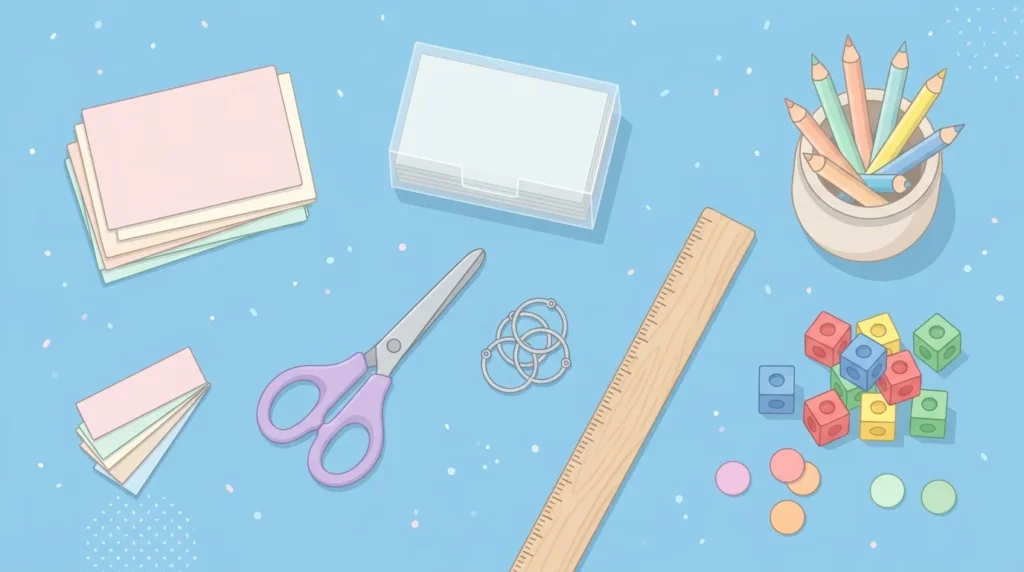
Print on white cardstock if you can. Thin paper works for a single use, but cardstock lasts through a full year of sorting and dropping. Cut along the dashed lines with a paper trimmer or scissors, and have a helper do it if the class is young, since cutting 71 pages takes a while. Laminated cards can be written on with a fine-tip dry-erase marker, so children can fill in missing sums or draw counting dots and then wipe the card clean. Plastic sleeves do the same job and cost less.
For storage, keep mastered facts in one envelope and current facts in another. Children enjoy moving a card from the practice envelope to the known envelope, and the visible pile gives a clear sense of progress.
Pairing cards with hands-on tools
Cards on their own can feel abstract for a child who is still counting objects. Keep counters, connecting cubes or ten-frames next to the deck. The child reads the card, builds both numbers with the cubes, joins them and counts. After a few weeks the cubes often stay in the box because the child no longer needs them. Let that happen at the child’s own pace.
Which cards for which child
Kindergarten
Start with plus zero and plus one cards, and stay with sums within 10 for a long while. Use cubes beside every card and accept answers said aloud, since writing numerals can be tiring.
First grade
Move to doubles, near-doubles and making ten. Introduce the teen sums once a child can make ten quickly. Mix easy and harder cards in each round, so a child meets some wins in every set.
Second grade
Use the full range, including the vertical cards. Time one minute rounds and let the child try to beat their own count, never a classmate’s. When facts are secure, our guide to addition with regrouping shows how they carry into larger numbers.
Sending practice home
Five minutes a night is plenty. Print one or two pages, cut them apart and put them in an envelope with a short note: show a card, wait, then say the answer if the child is stuck. Ask parents to stop while the child still feels successful. Facts that stay tricky, such as 8 + 7 or 9 + 6, deserve a few extra rounds each week, so tell families which ones to focus on.
Frequently asked questions
Which addition facts are on the cards?
The set covers facts from plus zero up to sums of 20. It includes doubles, near-doubles, making ten combinations and mixed problems with sums from 11 to 20.
How many cards are on each page?
Each page has four cards, surrounded by dashed cutting lines. The pack has 71 card pages and 2 pages for a name and review.
Can children write on the cards?
Yes. Printed on cardstock and laminated, or slipped into plastic sleeves, the cards take fine-tip dry-erase markers, so children can write sums and wipe them off.
Can I print these on US Letter paper?
The product page says the A4 file prints on US Letter with Fit to page. Check the preview pages before you print a class set.