3 Digit Addition and Subtraction With Regrouping
3 digit addition and subtraction with regrouping means adding or subtracting numbers in the hundreds while carrying or borrowing between the ones, tens and hundreds columns. Second and third graders learn it best by working the ones column first, asking whether they need to regroup, and writing the new tens or hundreds clearly above the next column. Short daily practice with clean worksheets makes the steps habitual.
Here are the types of problems that make a good practice set:
- Addition with a carry from the ones to the tens, such as 348 + 526.
- Addition with carries in two columns, such as 197 + 388.
- Subtraction where the ones digit on top is smaller, such as 911 – 378.
- Mixed pages where the sign changes, so children read before they calculate.
- Word problems that ask whether to add or subtract.
In this article (11 sections)
- What regrouping means
- Adding three digit numbers with regrouping
- Subtracting three digit numbers with regrouping
- Not every problem needs regrouping
- Free 3 digit worksheets
- The 3 Digit Addition and Subtraction Worksheets pack
- A wider addition and subtraction collection
- How to use the worksheets in class
- Common mistakes to watch for
- Checking answers
- Frequently asked questions
What regrouping means
Regrouping is trading between place values. In addition, ten ones become one ten, and ten tens become one hundred. In subtraction, it goes the other way: when the top digit is too small, one ten becomes ten ones, or one hundred becomes ten tens. Children who understand it as a trade make fewer mistakes than children who only memorize “carry the one” and “borrow from the neighbor.”
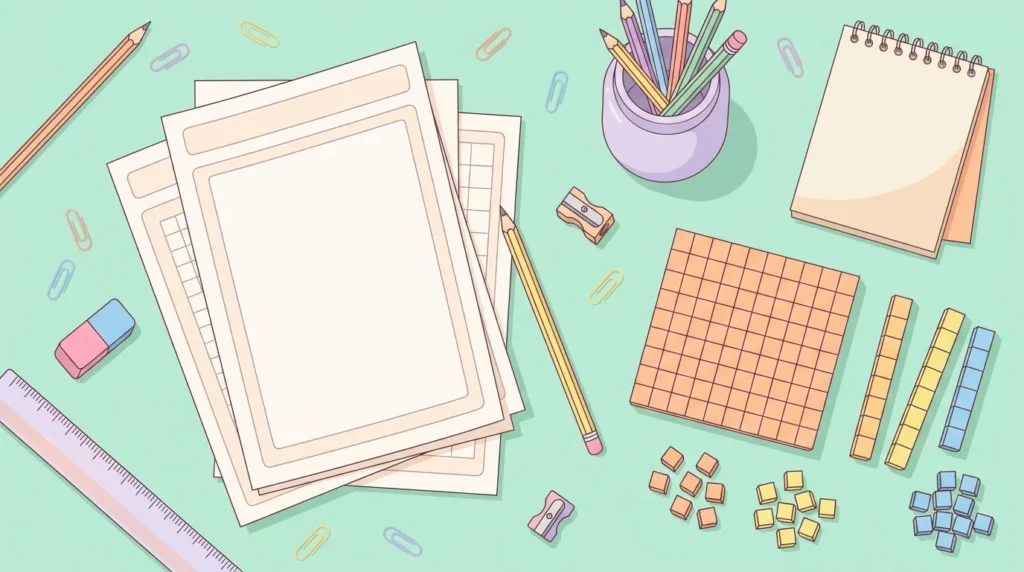
Before you use a worksheet, make sure children have seen the trade with their hands. Base ten blocks or paper strips work well. Ten unit cubes lined up against one rod show why ten ones are the same as one ten. When a child has made a trade with blocks at the table, the written step makes sense.
Adding three digit numbers with regrouping
Take 348 + 526 and work from the right.
- Add the ones: 8 + 6 = 14. Write 4 in the ones place and regroup the 10 as 1 ten above the tens column.
- Add the tens: 4 + 2 + 1 = 7. Write 7. No regrouping is needed here.
- Add the hundreds: 3 + 5 = 8. Write 8.
- The sum is 874.
A second example shows regrouping twice. For 197 + 388, the ones are 7 + 8 = 15, so write 5 and carry 1. The tens are 9 + 8 + 1 = 18, so write 8 and carry 1 to the hundreds. The hundreds are 1 + 3 + 1 = 5. The sum is 585. Ask children to check by estimating: 200 + 400 is about 600, and 585 is close, so the answer is reasonable.
Subtracting three digit numbers with regrouping
Take 911 – 378. The ones digit on top is 1, which is smaller than 8, so regroup.
- Take one ten from the tens column. The 1 ten becomes 10 ones, and the ones column now has 11. The tens column has 0.
- Subtract the ones: 11 – 8 = 3.
- The tens column now shows 0, which is smaller than 7, so regroup again. Take one hundred from the hundreds column, leaving 8 hundreds. The 0 tens become 10 tens.
- Subtract the tens: 10 – 7 = 3.
- Subtract the hundreds: 8 – 3 = 5.
- The difference is 533.
Problems with a zero in the tens place, like this one, are where many children get stuck. Spend extra time on them with blocks, and let children say out loud what they are trading. Our guide to regrouping in subtraction covers more worked examples if you want a second explanation.
Not every problem needs regrouping
A set that includes only problems with regrouping teaches children to regroup every time, even when they should not. For example, 629 – 214 needs no trading at all. Good practice sets mix the two. Before children calculate, ask them to look at each column and say “regroup” or “no regroup.” That one second look prevents many errors, and it builds the habit of reading the numbers before touching them.
Free 3 digit worksheets
Many searchers want free pages. At the time of writing we did not find a free 3 digit addition and subtraction pack in our shop. You can write your own on blank paper: ten problems on a page, with the numbers lined up in columns, and a box above each column for the carried digit. Our shop does list free packs on other topics, and a free pack takes an email address, which opens a free account and keeps the file in My Library. The packs below add ready-made pages, word problems and an answer key.
The 3 Digit Addition and Subtraction Worksheets pack
The 3 Digit Addition and Subtraction Worksheets pack costs $3.00 and is listed for 2nd to 3rd grade. It is 19 pages, and the download includes a PDF with the answer key and an editable PowerPoint file. The A4 pages print on US Letter with Fit to page, according to the product page. The page states 120 math problems across the set, in four sections of four pages each:
- Three digit addition, with ten column problems per page, such as 348 + 526, 197 + 388 and 726 + 193.
- Three digit subtraction, with ten problems per page, including 911 – 378, 785 – 349 and 629 – 214.
- Mixed addition and subtraction, with problems such as 273 + 518, 831 – 437 and 674 + 289.
- Word problems within 1000 about collecting marbles, library books and art stickers.
The remaining pages are a cover page with name and class fields and two teacher support pages. The layouts leave generous space around each equation, so children have room to write carried tens and show their regrouping. Each word problem has response blanks for the calculation and the unit label, which lets you check how a child set up the problem and not only the final number.
A wider addition and subtraction collection
The Addition and Subtraction Worksheets Bundle includes the 3 digit pack with nine other packs: within 20, word problems, regrouping-free practice within 100, mixed drills, multi-step word problems, number sequences and repeated addition. It has 10 resources and 152 pages in 22 PDF and PowerPoint files, listed for kindergarten to 4th grade, and costs $22.74. The separate prices add up to $34.98, so it saves $12.24, or 35 percent. It is useful for a teacher who needs to give some children easier work and others harder work from the same download. For a class that only needs three digit practice, the single pack is enough.
How to use the worksheets in class
A five day plan
- Day 1: addition only. Use blocks to show one trade, then children complete one page.
- Day 2: more addition, with a focus on problems that regroup twice.
- Day 3: subtraction. Start with problems that regroup once, then try a zero in the tens place.
- Day 4: a mixed page. Children circle the sign before they begin.
- Day 5: word problems. Children underline the question and write whether they add or subtract before calculating.
Morning work and centers
One page at a time fits morning work. At a center, partners solve the same problem separately, compare answers, and talk through any difference. The partner who found a mistake explains where it started.
Sub plans and homework
Because the pages are self-explanatory and come with an answer key, they work well as emergency sub plans. They also go home easily. Mark the columns lightly in pencil for children who tend to misalign digits, or print on graph paper for practice with spacing.
Common mistakes to watch for
- Subtracting the smaller digit from the larger one in each column, whatever its position. Ask, “Which number is on top?”
- Forgetting to reduce the next column after borrowing. Have children cross out and rewrite the digit in a different color.
- Misaligned columns, which make the ones and tens line up wrongly. Lined paper turned sideways helps.
- Adding the carried digit to the wrong column. Write it small above the correct column.
- Choosing the wrong operation in word problems. Ask what the question wants: more in all, or how many are left.
Checking answers
Teach two checks. For addition, estimate by rounding to the nearest hundred. For subtraction, add the difference back to the number you subtracted, which should give the starting number. For 911 – 378 = 533, check: 533 + 378 = 911. Children enjoy this check because it proves their own answer without asking an adult.
Frequently asked questions
What grades are these worksheets for?
The single pack is listed for 2nd to 3rd grade. The bundle is listed for kindergarten to 4th grade because it includes easier packs as well.
Is there an answer key?
Yes. The 3 digit pack includes an answer key, and the download also has an editable PowerPoint file.
Do all problems need regrouping?
No. The sets mix problems that need regrouping with some that do not, so children learn to check each column first.
Can I print on US Letter paper?
The product page says the A4 file prints on US Letter with Fit to page.