
Planet Earth Coloring Page: Free Pack and Class Ideas
FreeFree printable for this topic: Free Earth Day Coloring Pages (16 Printable Caring for Nature Sheets)Get it free
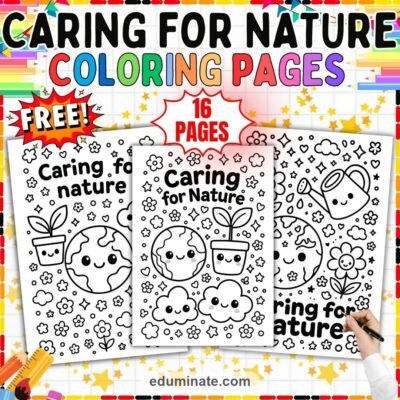
A planet Earth coloring page is a good starting point for talking about looking after the planet. Children color a round blue and green Earth, then add the things that keep it healthy: trees, plants, clean water and a recycling bin. The sets below suit preschool to third grade and fit an Earth Day lesson in April or any science week.
Here are the page types you will find in the Earth and nature packs:
- A smiling Earth with flowers, trees and clouds around it.
- Potted plants, a watering can and a garden bed to care for.
- Recycling bins and sorting scenes for paper, plastic and cans.
- Tree planting and green seedlings.
- Simple slogans such as Caring for Nature and Love Nature in outline letters children can color.
In this article (8 sections)
Free planet Earth coloring pages
There is a free pack in our shop. Free Earth Day Coloring Pages (16 Printable Caring for Nature Sheets) is marked Pre-K to 3rd grade. The PDF has 16 pages: 12 coloring pages, plus a welcome page with name, date and class lines, a coloring tips page, a thank-you page and a terms page. The designs pair a smiling Earth with flowers, potted plants, trees, clouds, a watering can and a recycling bin.
A free pack takes an email address, which opens a free account and keeps the file in My Library. You can download it again from there whenever you need it. The page does not list a paper size, so look at the preview before you print a class set.
Twelve pages go quickly in a full class. If you want more variety, or you need pages for several days, the paid packs below add more designs and some different subjects.
Bigger Earth and nature packs
| Pack | Grades | Pages | Price |
|---|---|---|---|
| Caring for Nature Coloring Pages, Earth Day Recycling Coloring Sheets | K to 3rd | 50 | $6.99 |
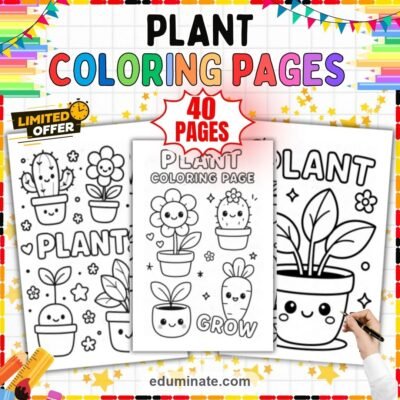
| Spring Plant Coloring Pages, Earth Day Garden Activity Sheets | Pre-K to 3rd | 40 | $5.99 |
| Nature Walk Coloring Pages, Outdoor Explorer Art Activity Pack | Pre-K to 4th | 41 | $5.99 |
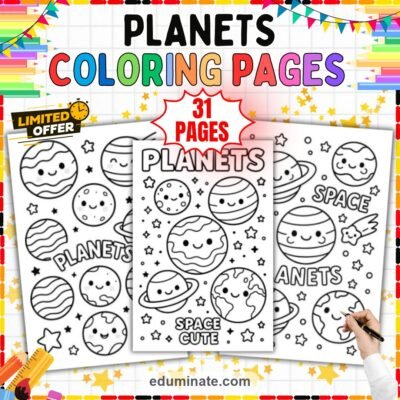
| Planets Coloring Pages, 31 Cute Outer Space Art Activities | Pre-K to 3rd | 31 | $4.99 |
The 50-page Caring for Nature pack is the larger version of the free one. It has 46 coloring sheets on recycling, wildlife conservation, clean air, tree planting and water preservation, and it lists A4 files that print on US Letter with Fit to page. You will see friendly Earth characters, recycling bins, forest trees, pollinators and garden flowers. Choose it when you want a week of Earth Day pages and more than one sheet.
The 40-page Spring Plant pack leans toward gardens. It is marked for Earth Day, green garden planting and nature preservation. The 41-page Nature Walk pack suits park visits and trail units, with a wider age range up to 4th grade. The 31-page Planets pack shows friendly Earth drawings next to a ringed Saturn, cratered moons and comets, so it fits a space unit where Earth is one stop among several.
Reading, math and bundles for an Earth Day week
Coloring gets children interested, and then they need something to read and work out. These are worksheets and passages, not coloring pages. Each lists A4 files that print on US Letter with Fit to page.
- Earth Day Reading Comprehension Passages and Questions Pack has 64 pages for grades 3 to 5 and costs $7.99. It covers recycling, school gardens, composting, clean energy and wildlife protection across ten passages.
- Recycling Worksheets, Reading Passages with Questions and Answer Key has 63 pages for grades 3 to 5 and costs $7.99. It follows waste reduction, paper life cycles and ocean conservation.
- Recycling Math Activities, Environmental Word Problems has 80 questions on 13 pages, with an answer key, an answer sheet and a lesson plan. The whole download is 35 pages for grades 3 to 6 and costs $4.99.
For a whole environment unit in one download, the Pollution Worksheets Bundle holds eleven reading packets on pollution, recycling, composting, clean water and caring for the environment. It has 716 pages for grades 2 to 8 and costs $58.43. The separate prices add up to $89.89, so you save $31.46, which is 35 percent. This bundle is reading material only, so pair it with one of the coloring packs above.
We also have a full guide to Earth Day reading comprehension, which suits the older end of a mixed-age class.
Conversation starters while children color
Coloring is a good moment for short questions. Children are focused, their hands are busy, and they often answer more freely than at a circle time. The free pack itself suggests a few questions. These are ones that work well:
- What do plants need to grow?
- Why do we recycle?
- What can we do to keep our park clean?
- What is one thing you can do this week to help nature?
After coloring, ask each child to share one small action, such as watering a plant, turning off a tap or picking up litter. Write the answers on a chart and keep it up for the week. Children enjoy checking whether anyone did what they said.
Classroom ideas that go with the pages
Plant seeds after coloring
Colored pages of seedlings and watering cans lead naturally to a real planting activity. Give each child a small paper cup with soil and a seed, and write the date on the cup. The product page for the 50-page pack suggests this kind of follow-up, along with sorting recyclable plastics and a schoolyard cleanup.
Recycling sort
Print a recycling bin page and use it as a sorting mat. Children color the bin, then place real clean items, such as an empty box or a paper cup, in the right pile. Keep to clean, dry items and talk about what goes in each bin where you live.
Link the pages to science
The pages fit a short environmental science lesson without extra setup. Ask children to name what a plant, a tree or a clean river gives to people, and write the answers around a colored Earth on the board. Then ask what happens when litter or waste is left outside. Younger children can answer by pointing at their pictures. Older children can write two sentences and read them to a partner. Keep the talk short, since the coloring is the main task and the discussion is the bridge to the next lesson.
A classroom Earth display
Mount each colored Earth on a sheet of blue paper and hang the pages in a cluster. Add a label under each one with the child’s promise to help nature. A wall of small Earths makes a simple display for a hallway.
Early finishers and calm-down corners
Nature pages suit a quiet corner. Keep a few in a folder with a tin of crayons. Children who need a break can color for five minutes, then return to the group.
Fine-motor and focus tips
- Color the large Earth first, then the small flowers and leaves.
- Show how to blend blue and green on the planet by pressing lightly in the overlap.
- Offer thick crayons to younger children and pencils to older ones for the fine lines.
- Use a short timer for children who rush, and ask them to add one extra detail before they stop.
- Print on slightly thicker paper if the class will use markers.
Which page for which age
Preschool and kindergarten children do best with one large Earth and a few clear shapes. Accept any colors, since the child who colors the Earth purple is still learning that it is round. First and second graders can color a full scene, add a title and write one sentence about it. Third graders can plan their colors, describe the planet’s land and water, and write a short promise paragraph using a reading pack as a source.
Frequently asked questions
Is there a free planet Earth coloring page?
Yes. The free Caring for Nature pack has 12 coloring pages with a smiling Earth, plants, trees and recycling. It takes an email address, which opens a free account and keeps the file in My Library.
What is the difference between the free and the paid pack?
The free pack has 16 pages, with 12 coloring pages. The paid pack has 50 pages, with 46 coloring sheets, and it covers more topics, such as wildlife conservation, clean air and water preservation.
Do the pages only work in April?
No. The pages work for Earth Day, but they also fit spring plant lessons, science and environment units, and any time a class is talking about kindness to the planet.
What grades are these for?
The free pack is marked Pre-K to 3rd grade and the 50-page pack is marked K to 3rd. The reading packs start at grade 2 or 3, so they fit older children in the same unit.