Space Coloring Pages: Planets, Rockets, Stars and Moon
Space coloring pages let children color planets, rockets, stars and the moon while they learn how the solar system fits together. Choose planet pages for science units, rocket pages for children who love machines, and sun, moon and star pages for day and night lessons. Most sets suit kindergarten to fifth grade.
Look for these page types when you build a space set:
- Planets in order from the sun, with room to color rings, stripes and craters.
- Rockets and a space shuttle with a launch pad and flames to shade.
- Stars of different sizes, good for patterns and counting.
- The sun and moon, including crescent shapes for day and night talks.
- Comets and cratered moons for older children who like detail.
In this article (10 sections)
- Free space coloring pages
- Space coloring sets, one topic at a time
- The whole space theme in one download
- Using space coloring pages for science
- Math with space pages
- A space science center
- Rocket coloring pages for movement and design
- Fine-motor and calm-down tips
- Matching pages to ages
- Frequently asked questions
Free space coloring pages
People often search for free space coloring pages. At the time of writing, we do not have a free pack on this topic. A quick option is to have children draw their own planet on blank paper with a compass or a round lid, then color it, which makes a good five-minute warm-up. Free packs from our shop on other topics take an email address, which opens a free account and keeps the file in My Library.
If you want ready-made pages for a unit, the sets below cover the main space topics.
Space coloring sets, one topic at a time
All the sets are PDFs. Check the grade range on each product page, because some are written for Pre-K to 3rd grade and others reach fifth grade.
- The Planets Coloring Pages Solar System Space Art Activity Sheets pack has 100 pages for kindergarten to 5th grade and costs $11.99. It is the largest single space set and the best fit if you want to cover the solar system in depth.
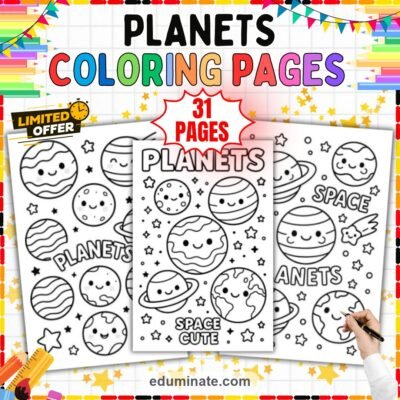
- The Planets Coloring Pages, 31 Cute Outer Space Art Activities pack has 31 pages in total, with 27 dedicated coloring illustrations, for Pre-K to 3rd grade at $4.99. It shows smiling planets, a ringed Saturn character, Earth, striped gas giants, cratered moons and comets. It is a gentler start for young children.
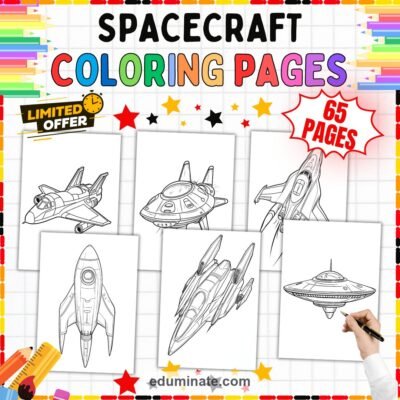
- The Spacecraft Coloring Pages Rockets and Space Shuttle pack has 65 pages for kindergarten to 5th grade at $7.99. It lists A4 files that print on US Letter with Fit to page.
- The Star Coloring Pages pack has 47 pages for Pre-K to 4th grade at $5.99, and it also lists A4 files that print on US Letter with Fit to page.
- The Sun Moon and Stars Coloring Pages pack has 39 pages in total, with 35 dedicated illustrations, for Pre-K to 3rd grade at $4.99. It includes sun faces, crescent moons resting on clouds and sky scenes.
The whole space theme in one download
The Space Coloring Sheets Bundle brings seven packs together in one download. It has 380 pages for Pre-K to 5th grade and costs $34.25. The separate prices add up to $48.93, so the bundle saves $14.68, or 30 percent. It covers planets, the solar system, stars, the sun, the moon and spacecraft.
The bundle suits a school that runs a space unit across several grades. A kindergarten class can use the cute planet pages while fifth graders color the detailed spacecraft, all from the same file.
Using space coloring pages for science
The order of the planets
Give each child a planet page. Ask them to find out which place the planet holds from the sun: Mercury is first, Venus second, Earth third, Mars fourth, then Jupiter, Saturn, Uranus and Neptune. Children write the number in a corner of the page, then line up in order to make a class solar system. This turns coloring into a sequencing game with a clear answer.
Colors that match the real planets
Show a photo of each planet on the board before coloring. Earth is blue and green with white clouds. Mars is reddish. Jupiter has bands of tan and white. Saturn has rings. Children then choose colors that match what they see. Those who want a fantasy color scheme can have a free page at the end.
Day and night
Use a sun page and a moon page side by side. Ask: when do we see the sun, and when do we see the moon? Children color the sun page in warm colors, the moon page in cool colors, and then stick the two pages back to back to make a card that flips from day to night.
Moon shapes
The moon seems to change shape over about a month. Draw four circles on the board and shade each differently: full, half, thin crescent and new. Children copy the shapes in a row on a strip of paper, then color a moon page and write which shape it shows. Older children can add the dates they observed the real moon.
Rockets and forces
Before coloring a rocket page, ask what pushes a rocket up. Children can guess, and you can explain that hot gas pushes down and the rocket moves up. They then color the flames in warm colors. Older children can label the nose, body and fins.
Math with space pages
- Count the stars. Ask children to color 10 stars gold and the rest silver, then count how many of each.
- Patterns. Color a row of planets in a repeating pattern, such as blue, red, blue, red.
- Big and small. Order the planet pages by size, from the smallest to the largest, and write a sentence with the words smaller and larger.
- Subtraction. A page shows 9 stars. If 4 are colored yellow, how many are left? Five.
A space science center
A small table gives children a way to explore on their own. Set out:
- A stack of planet, rocket and moon pages.
- Crayons and colored pencils in dark blue, purple, gray, orange and yellow.
- A poster or a printed chart of the planets in order.
- A magnifying glass to look at the crater details.
- Index cards for writing one new fact.
Children choose a page, color it, then write one fact on a card. Collect the cards and read a few aloud at the end of the day. For background reading on the planets themselves, see our guide to the solar system for kids.
Rocket coloring pages for movement and design
Rocket coloring pages often become the favorite in a space set, because children can add their own ideas. Ask each child to give the rocket a job: it could carry supplies to a space station, visit the moon or study a planet. They color the rocket to match, then write one sentence about the trip. Another option is a design challenge. Children draw a second rocket beside the printed one, make three changes and explain why. This takes ten minutes and builds speaking skills along with color work.
Fine-motor and calm-down tips
Space pages have many small circles, stars and craters, and that gives the hand good practice.
- Practice on craters and rings builds fine motor skills in a way that feels like play.
- Color the large background shapes first
- Color the large background shapes first, then the small stars and craters.
- Try dark paper colors on the background and white or yellow on top for a night sky effect.
- Press lightly with the first coat, then a second coat for a deeper shade.
- Pair the page with quiet time, since the slow work of filling a planet is calming for many children.
Matching pages to ages
Preschool and kindergarten
Choose pages with one big subject, such as a single planet or a rocket. Cute planet pages with simple shapes are a good fit.
First to third grade
Add labels, a short fact and number work. Children can color the whole solar system in a row, with names under each planet.
Fourth and fifth grade
Choose the detailed spacecraft pages. Ask for shading, a labeled diagram and a paragraph on one mission or one planet.
Frequently asked questions
Which space set should I buy first?
For a solar system unit, start with the 100-page Planets pack. For younger children, the 31-page Planets pack has smaller, cuter pages. If you do not know yet, the bundle covers every topic.
Are there free space coloring pages?
We do not have a free space pack at the moment. When we do offer free packs, they take an email address, which opens a free account and keeps the file in My Library.
Can I print on US Letter?
The Spacecraft pack and the Star pack state that their A4 files print on US Letter with Fit to page. The other packs do not list a page size, so check each product page first.
What colors should I use for the planets?
Match photos when you can. Earth is blue and green, Mars is reddish, Jupiter has tan and white bands and Saturn is pale gold with rings. For fun pages, any colors work.