Apple Coloring Pages: Trees, Baskets and Orchard Scenes
Apple coloring pages give young children a simple, familiar shape to fill, and they fit a fall classroom, a nutrition lesson or a plant unit. Start with a single big apple for preschoolers, then move to apple trees and orchard baskets for first and second grade. Most sets run from preschool to third grade.
Look for these page types in a good apple set:
- A whole apple beside a sliced one, with the core and seeds shown.
- An apple tree with fruit on the branches and roots below the ground.
- A basket of apples, from a few apples to a heaped bushel.
- Plain apples with a leaf and stem for the youngest colorers.
- Smiling apple characters with big eyes for a cheerful look.
In this article (9 sections)
Free apple coloring pages
Most parents and teachers hope to find free apple pages. At the time of writing, we do not have a free apple pack. A child can draw a circle with a stem and a leaf on blank paper and color it, which works as a quick starter. Free packs from our shop on other topics take an email address, which opens a free account and keeps the file in My Library.
The paid sets below give a full theme of apple pages in one PDF. Choose by page count and grade range.
Apple coloring sets compared
- The Apple Coloring Book Pages pack has 14 pages for Pre-K to 2nd grade and costs $3.00. It is the smallest set and a good place to start. One page shows a whole apple beside a halved apple with its core and seeds, another shows a basket with seven apples, and the apple tree page has six apples hanging from the branches. Three pages show an apple with a simple smiling face, and two are plain apples with a leaf and stem for younger children. It lists A4 files that print on US Letter with Fit to page.
- The Apple Orchard Coloring Pages pack has 59 pages for Pre-K to 3rd grade at $6.99. Most pages show baskets heaped with apples under a leafy tree or on the grass, so it reads like one long walk through an orchard. It lists A4 files that print on US Letter with Fit to page.
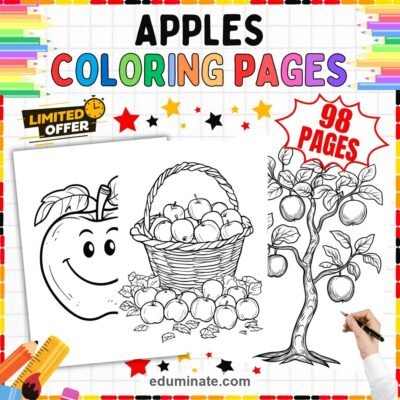
- The Fall Apple Coloring Pages pack has 98 pages for Pre-K to 2nd grade at $10.99. Many pages center on a single apple in a different pose, some plain and some smiling, with a few showing a bite mark. It lists A4 files that print on US Letter with Fit to page.
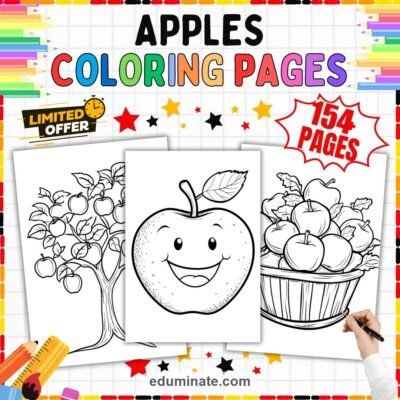
- The Apple Coloring Pages Big Printable Set has 154 pages for Pre-K to 2nd grade at $16.99. The pages have large designs and clear lines, with some apples shown with light shading lines already drawn in, which helps children practice blending light and dark tones. It lists A4 files that print on US Letter with Fit to page.
All the apple packs in one place
The Apple Coloring Pages Bundle includes eight packs and 514 pages in one download for Pre-K to 3rd grade. It costs $44.05, while the separate prices add up to $62.93, so the bundle saves $18.88, or 30 percent. It covers smiling apples, apple trees, baskets and orchard scenes.
That is a lot of pages. It makes sense for a school, a co-op or a teacher who plans a long apple and fall unit. If you only need a handful of pages for one afternoon, the 14-page pack is likely enough.
Ways to use apple pages in class
Parts of an apple
The page with a halved apple is a good prompt for a short science lesson. Cut a real apple in half across the middle and show the seeds in a star-like shape. Name the parts: skin, flesh, core, seeds and stem. Then ask children to color each part of the page a different color and label it.
From seed to tree
Use the tree page to tell how an apple grows. A seed grows into a small tree. Roots hold the tree and take in water. Leaves use sunlight to make food. Flowers appear, and fruit grows where they were. Children can number four pages in order. Our guide to tree coloring pages has more on the parts of a tree.
Counting and sorting
Give each child a basket page. Ask them to color the apples red, green or yellow, then count each color. They write a number sentence, such as 3 + 2 + 2 = 7 for a basket with seven apples. For a graph, collect the counts from the class and mark them on a bar chart.
Apple taste test (with permission)
If your school allows food activities and you have checked for allergies, set out slices of red, green and yellow apples. Ask children to taste one slice of each and vote for a favorite. They then color an apple on their page in that color and add a word that describes the taste, such as sweet, sour or crisp. If food is not allowed, children can vote by looking at pictures.
Writing about apples
- Younger children finish a sentence: “An apple is …”
- Children in first and second grade write three sentences about their favorite apple.
- Third graders compare apples and oranges in a short paragraph.
Early finishers and morning bins
Keep a stack of apple pages and a cup of crayons where children can reach them. One rule keeps the task meaningful: finish one page before you take another. Children who work quickly can add a background, a ground line or a sky.
Apple tree and basket pages for a harvest unit
Apple tree coloring pages are a good base for a harvest unit. Color the tree first, then talk about where the fruit grows. A fruit basket page adds a second step: where do the apples go once they are picked? Children can say the basket goes to a market, a kitchen or a school lunch table. Ask them to count the apples in a basket and compare with a friend’s page. The halved apple page is a natural moment to talk about apple seeds, and to ask how many seeds a child can count inside a real apple. The number changes from apple to apple, so the result makes a good graph.
Fine-motor tips for apple pages
An apple is a round shape with a small stem, so it gives practice with curves and short strokes.
- Regular practice with round shapes builds fine motor skills for writing.
- Show children how to color in small circles
- Show children how to color in small circles that overlap, which gives an even finish.
- Use a lighter touch at the top of the apple and press harder near the bottom for a shadow.
- Ask for two shades of red on a single apple: a light red and a dark red.
- Color the leaf and stem last, using short strokes so the color stays inside the lines.
- For the youngest children, tape the page to the table so it does not slide.
Choosing a page by age
Preschool
Choose large single apples with thick lines. The 14-page pack has plain apple pages for this, and the 98-page and 154-page sets have many single-apple pages. Do not worry about staying in the lines at this age.
Kindergarten and first grade
Trees and baskets work well. Ask children to color the trunk brown, the leaves green and the apples in any color. Add a sentence below.
Second and third grade
Orchard scenes suit these ages, since there are many objects to color. Challenge children to shade, blend two colors and write a paragraph about a visit to an orchard, real or imagined.
Display ideas
- Cut out colored apples and hang them on a paper tree on the wall.
- Make a class graph of favorite apple colors using finished pages.
- Staple pages into a small book called All About Apples.
- Send a page home with a note asking families to name one dish they can make with apples.
Frequently asked questions
What age are apple coloring pages for?
Every set above lists Pre-K at the low end and 2nd or 3rd grade at the top. Check the grade range on each product page.
Which set is best for a small budget?
The 14-page Apple Coloring Book Pages pack costs $3.00 and covers the main page types: a single apple, a halved apple, a basket and a tree.
Can I print these on US Letter paper?
The 14-page, 59-page, 98-page and 154-page packs state that their A4 files print on US Letter with Fit to page.
Are there free apple coloring pages?
We do not have a free apple pack right now. Free packs from our shop take an email address, which opens a free account and keeps the file in My Library.