Crayon Coloring Pages: Free and Printable Sets
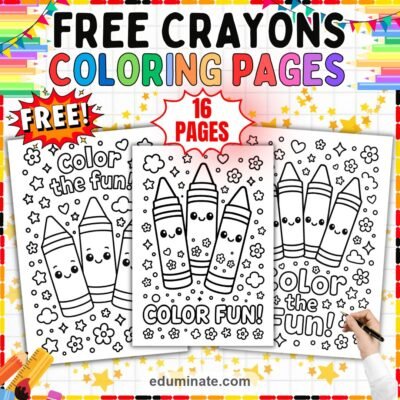
Crayon coloring pages are printable sheets of crayon drawings that children color in, and they work well for preschool through 2nd grade because the shapes are big, simple and easy to finish. There is a free pack of 16 pages, plus larger paid sets if your class goes through them quickly.
Ideas and page types to look for:
- Single large crayon drawings with thick outlines, ideal for first-time colorers.
- Pages with several crayons in a row, so children can match a drawn crayon to the real color.
- Back to school sheets with phrases such as Color Your World.
- School supply pages that mix crayons with other classroom items.
- Busy pages with background details for children who want a longer task.
The free pack is a good place to start. A free pack takes an email address, which opens a free account and keeps the file in My Library. Below you will find how to use the pages, what the paid sets add and tips for building a strong crayon grip.
In this article (10 sections)
Why crayons are a good starting point
A crayon has a thick body and gives resistance on the page, so it helps a child feel the pressure of their own hand. For many four-year-olds, a crayon is the first drawing tool they can control. Coloring a drawn crayon also has a pleasing logic: the object on the page is the tool in the child’s hand.
That makes crayon pages a gentle first step before pencil work. The thick outlines on the pages act as a boundary, which helps children learn to stay inside the lines. Staying inside the lines is a skill built over many weeks of short practice, not something to expect on day one.
For kindergarten teachers, school supplies coloring pages also double as a first lesson in caring for classroom tools. Children who color a crayon are more likely to hold a real one with care. A good pencil grip develops from many small experiences like this one, and a child who learns to color inside the lines at five usually finds writing less of a struggle at six.
Free crayon coloring pages
Free Crayons Coloring Pages is a 16 page PDF for preschool to 2nd grade. The pages show kawaii-style crayon characters with smiling faces, and the listing says they are designed to build fine motor skills. The file prints on US Letter with Fit to page.
A free pack takes an email address, which opens a free account and keeps the file in My Library. You can use the pack at home or in one classroom. Sixteen pages is enough for a first trial with a small group, and it shows you whether the style suits your children before you decide on anything larger.
What the paid packs add
The free pack is a sample size. The paid sets give you more pages, so you are not reprinting the same sheets every week. All three below are PDF downloads for preschool to 2nd grade, and each page prints on US Letter with Fit to page, according to its listing.
- Cute Crayon Coloring Pages: 30 pages with 26 kawaii crayon designs, $4.99. A good second step after the free pack.
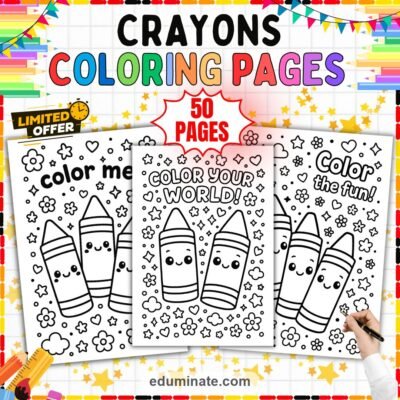
- School Supplies Coloring Sheets: 50 pages, $6.99, with kawaii crayon characters for early learners.
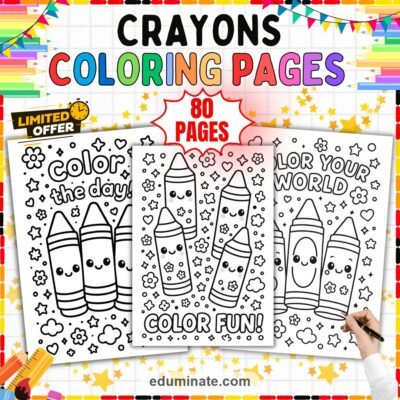
- Crayons Coloring Pages for Back to School: 80 pages, $9.99, with back to school themes and phrases such as Color Your World.
If you want all three plus ten more back to school sets, the Classroom Coloring Pages Bundle has 13 packs and 579 pages for $52.57. The separate prices add up to $80.88, so the bundle is 35% off. It includes the three crayon packs above, along with school supplies, classroom rules, first day and first week of school coloring sheets. It is best for a team or a whole grade level rather than one classroom.
Open the “Look inside” samples on each product page before you buy. Downloaded files cannot be refunded.
Ways to use crayon coloring pages in class
Arrival routine
Put a crayon page and a small box of crayons at each seat. Children can start coloring as they unpack, which gives you a few quiet minutes to greet families. A familiar activity also eases the first weeks of the year for children who feel unsure about school.
Color matching
Give each child a page with several crayons drawn on it and a box of real crayons. Ask them to pick a crayon from the box for each drawn one and color it. Then ask what color they chose and why. Young children often name colors well before they can write them, so this is a good oral activity.
Color words
With older children, have them write the color name under each finished crayon. Kindergartners and 1st graders can sound out words such as red, blue and green. Check the spelling later, and keep this a low-pressure task.
Early finishers
A bin of pages by the door lets children who finish early keep working without asking you what to do. Larger packs are useful here because they give you many different pages to choose from.
Sub plans
A page plus a box of crayons is a plan any substitute can run. Add a line on the board: “Color the crayons. Tell your neighbor which color you used most.”
Quiet table in a center rotation
Include a crayon station among your centers. It requires no teaching and no supervision, so it works while you pull a small reading group.
Fine motor tips
Coloring is real work for small muscles. These small changes help:
- Break crayons in half. A short crayon forces a pinch grip with the fingertips.
- Tape the page down so it does not slide while the child presses.
- Start with big shapes before pages with fine detail.
- Ask children to color in one direction, such as side to side, before they try circles.
- Show a light touch first, then a firm touch, and let them see the difference in color.
If a child grips the crayon in a fist, try a small piece of crayon or a short golf pencil style tool. Do not correct the grip every time. A quick model and a smile do more than repeated reminders.
Talking about colors
A coloring session gives you a chance for a short language exercise. Try one of these:
- Ask each child to say “I used red for the cap” in a full sentence.
- Let them describe how a light color differs from a dark color.
- Count the crayons on a page and say the number together.
- Sort finished pages into piles by the main color.
These tasks take two minutes and connect coloring with speaking, counting and sorting. The cute faces on the crayons also invite short stories, such as “What might this crayon say?” That works well in a circle with a partner.
Care of real crayons
Pages are only half of the activity. A few habits keep your supply in good shape:
- Use small cups or boxes per table so crayons do not roll away.
- Keep a collection tray for broken pieces and let children use them for pinch grip practice.
- Teach “crayons down” as a cue for listening. It is quick and clear.
- Check the box at the end of the activity and count them back together.
Our post on kawaii coloring pages explains why the cute style works so well for young learners and how to use it across a unit.
Printing tips
Print on plain paper if children will use crayons, since thicker paper is only needed for watercolor or marker work that bleeds. Use black and white mode to save ink. If your printer cuts off the edge of the page, choose “Fit to page” in the print dialog. Print a few extra copies of favorite pages because some children will ask to color them twice.
Frequently asked questions
Are there free crayon coloring pages?
Yes. The Free Crayons Coloring Pages pack has 16 pages. It takes an email address, which opens a free account and keeps the file in My Library.
What age are crayon coloring pages for?
The packs here are listed for preschool to 2nd grade. Four- and five-year-olds do well with the large shapes, and older children can add patterns and color words.
How many pages do I need for a class?
If each child colors one page a week, a pack of 30 pages lasts about a term and a pack of 80 lasts much of the year. Many teachers print a handful of different pages and let children choose.
Can I use the pages with markers or colored pencils?
Yes. The pages are black and white line art, so any coloring tool works. Crayons are best for building grip strength in the youngest children.