Helping Verbs Worksheet Guide: Be, Have, Do and Modals

A helping verbs worksheet should teach students to spot the helper, the main verb and the job each one does in a sentence. This guide gives the full list, clear examples for each group and ideas for practice with the be, have, do and modal verbs.
What are helping verbs?
A helping verb comes before a main verb and adds information, such as time, ability or a question. Helping verbs are also called auxiliary verbs. A helping verb and a main verb together form a verb phrase.
Look at this sentence: “The students are reading.” The main verb is “reading”, which names the action. The helping verb is “are”, which tells us the action is in progress. Together, “are reading” is the verb phrase.
For a wider view of verb categories, see our guide to the types of verbs. Helping verbs are one of those categories, and they sit beside action verbs and linking verbs.
The helping verbs list
There are three families of helping verbs, plus the modals. Learning them as groups is easier than memorizing a long list.
- Forms of be: am, is, are, was, were, be, being, been.
- Forms of have: have, has, had.
- Forms of do: do, does, did.
- Modal verbs: can, could, may, might, must, shall, should, will, would.
Put the list on a chart where students can see it. Many worksheets ask students to circle the helping verb, so a visible list keeps the task fair while they learn.
Helping verbs that are forms of be
Forms of be pair with an -ing verb to show an action in progress, and with a past participle to make a passive sentence.
- The class is building a model. (is + building)
- We were walking home. (were + walking)
- The window was broken by the wind. (was + broken)
The right form depends on the subject:
- I am, he is, she is, it is, you are, we are, they are.
- I was, he was, she was, it was, you were, we were, they were.
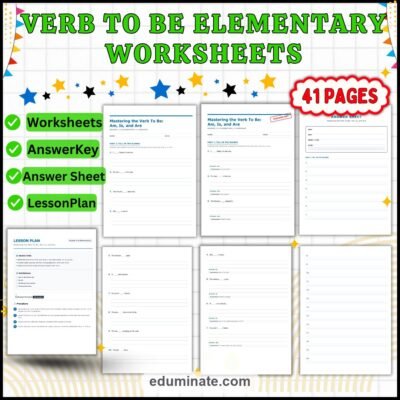
The Verb To Be Worksheets set has 90 questions for grades 1 through 3, practicing am, is and are through fill in the blank, multiple choice, true or false and sentence correction, with an answer key, answer sheet and lesson plan.
A caution for teachers: be is not always a helper. In “The sky is blue”, the word “is” is the only verb and it links the subject to a description. It helps only when another verb follows it, as in “The sky is turning blue.”
Helping verbs that are forms of have
Have, has and had combine with a past participle to show an action that is complete or connected to the present.
- I have finished my project.
- She has written three pages.
- They had eaten before the game started.
The choice between “have” and “has” follows subject verb agreement. “Has” goes with he, she, it and singular nouns. “Have” goes with I, you, we, they and plural nouns.
- The teacher has a new book. (singular)
- The teachers have new books. (plural)
Like be, have can be a main verb: “She has a red pencil.” Here “has” means “owns”, and it is the only verb in the sentence. Ask students to check whether another verb follows it.
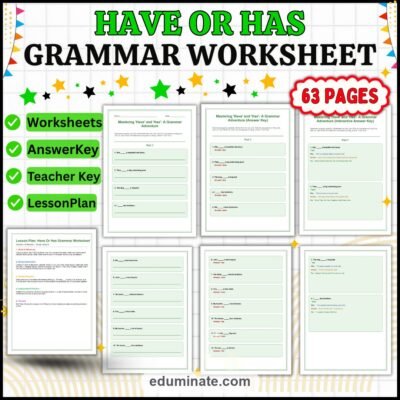
Two sets focus on this area. The Have or Has Worksheet set has fill in the blank practice, a true or false error check, a farm reading passage, writing prompts, a full answer key, a detailed teacher key and a Grade 2 lesson plan. The Has and Have Worksheets pack has 62 pages with fill in the blank practice, a true or false section, a reading passage, plain and teacher answer keys and a lesson plan.
Helping verbs that are forms of do
Do, does and did help form questions and negatives in the simple present and past. They are followed by the base form of the main verb.
- Do you play soccer?
- She does not like loud noise.
- Did they finish the experiment?
The main verb stays plain after a form of do. Compare “She likes soccer” with “She does not like soccer.” The -s moves to “does”, so it does not appear on “like” as well. Students often write “She does not likes soccer”, which is a good error-correction sentence.
Do can also be a main verb: “I do my homework after dinner.” There, “do” is the only verb, and it means “complete”.
Modal verbs as helping verbs
Modal verbs add a shade of meaning, such as ability, permission, obligation or advice. They are always followed by the base verb, and they do not change for different subjects.
- Ability: I can solve this puzzle. She could read before first grade.
- Permission: May I borrow a pencil? You may leave when you finish.
- Obligation: We must wear helmets. Students must walk in the hall.
- Advice: You should drink water. He should check his answers.
- Future: We will visit the library tomorrow.
Notice that “can” does not become “cans”. We say “She can swim”, never “She cans swim” and never “She can swims.” The Modal Verbs Worksheet is a 14 page set that practices ability, permission, obligation and advice with multiple choice, true or false, sentence rewrites and a reading passage, plus an answer key, teacher key and lesson plan.
How to find the helping verb in a sentence
Students can follow a short routine on a helping verbs worksheet.
- Find the main verb: the word that names the action or state.
- Look just before it for a word from the helping verbs list.
- Check for more than one helper. Some phrases have two or three.
- Skip words that interrupt, such as “not” or “always”. They are not part of the verb.
Try this sentence together: “The students have been reading quietly.” The main verb is “reading”. The helping verbs are “have” and “been”. The whole verb phrase is “have been reading”. The word “quietly” is an adverb and is not part of the phrase.
Another one: “She has not finished her homework.” The helping verb is “has” and the main verb is “finished”. The word “not” sits in the middle of the verb phrase but is not a verb.
A third: “We should have left earlier.” Here “should” and “have” are both helping verbs, and “left” is the main verb. That makes a verb phrase of three words.
Helping verbs in questions
In many questions, the helper moves in front of the subject. Turn a statement into a question and watch the helper jump.
- She is reading. becomes Is she reading?
- They have finished. becomes Have they finished?
- You can come. becomes Can you come?
- He walks to school. becomes Does he walk to school?
The last example shows a useful fact: when the statement has no helper, the question brings in “do” or “does”. Ask students to underline the helper in both versions.
Practice ideas for a helping verbs worksheet
A worksheet is more useful with a little structure around it. Here are a few ways to use one.
Sort by family
Give students sentence strips and four columns: be, have, do and modal. They place each strip under the family of its helping verb.
Circle and underline
Ask students to circle the helping verb and underline the main verb in each sentence. This simple routine keeps the roles separate.
Rewrite as a question or negative
Give a statement and ask for the question or the negative. This shows how helpers behave.
Fix the error
Offer sentences like “He have finished” and “They was playing” and ask students to fix them. Remind them to check the subject.
When students are ready for verb patterns after helpers, the Gerunds and Infinitives Worksheet set is a 71 page set with a 16 page student worksheet, a 13 page answer key, a 41 page teacher key with explanations and a 1 page lesson plan, for grade 7 to 8 grammar practice.
The Verb Tenses and Verb Forms Worksheets Bundle brings together five verb packets for upper elementary and middle school: past continuous and past simple, irregular verbs, subject verb agreement, modal verbs, and gerunds and infinitives. It has 263 pages and is 20% off the separate prices.
Common mistakes with helping verbs
When you collect work, watch for these patterns. Each comes with a fix to show students.
- Wrong agreement with be: “They was playing” should be “They were playing.”
- Wrong agreement with have: “He have finished” should be “He has finished.”
- Extra -s after does: “She does not likes soccer” should be “She does not like soccer.”
- -s added to a modal: “She cans swim” should be “She can swim.”
- Past form after did: “Did you went?” should be “Did you go?”
- Missing helper: “The students reading” should be “The students are reading.”
Ask students to name the rule behind each fix, not just copy the corrected sentence. For example, the second item is a subject verb agreement problem: “he” takes “has”.
Quick check sentences with answers
Use these for a warm-up. Students find the helping verb or verbs and the main verb.
- The team is practicing. [helping verb: is; main verb: practicing]
- We have planted the seeds. [helping verb: have; main verb: planted]
- Did you finish the book? [helping verb: did; main verb: finish]
- You should wear a jacket. [helping verb: should; main verb: wear]
- They had been waiting for an hour. [helping verbs: had, been; main verb: waiting]
Sentence 5 is a good test of the routine. Two helpers come before the main verb, and “for an hour” is not part of the verb phrase.
Frequently asked questions
Is “will” a helping verb?
Yes. “Will” is a modal verb, and it helps the main verb show the future, as in “We will visit the library.”
Can a sentence have more than one helping verb?
Yes. In “She should have been resting”, the helping verbs are “should”, “have” and “been”, and the main verb is “resting”.
How do I know if “be” or “have” is a main verb?
Check whether another verb follows it. If no other verb follows, it is the main verb, as in “The sky is blue” and “She has a red pencil”.
What grade should learn helping verbs?
The packs described in this guide cover a range. The verb to be set is written for grades 1 through 3, while the gerunds and infinitives set is written for grades 7 to 8. Choose by the sentence difficulty your students can handle.