Leaf Coloring Pages for Fall Science and Art
Leaf coloring pages are printable line drawings of leaves that children color in, and they fit fall science, nature walks and quiet art time from preschool to 3rd grade. The best sets show real leaf shapes such as oak, maple and elm, so the coloring turns into a closer look at how leaves differ.
Ideas and page types to look for:
- Single large leaves with clear outlines for the youngest colorers.
- Maple leaves with pointed lobes, the classic fall shape.
- Oak leaves with rounded lobes, which contrast well with maple.
- Pages with several leaf types together, useful as a simple chart.
- Pages with visible veins, so children can trace and color the lines inside a leaf.
Below are ways to use the pages with a leaf unit, fine motor tips and the real packs we have, from 15 pages to 100.
In this article (9 sections)
Why leaves are a good coloring topic
Leaves are everywhere in autumn, and children can pick one up on the way to school. That makes the drawn page feel real. A child who has just held an oak leaf is more interested in coloring one, and they can compare their page to the object in their hand.
Leaf shapes also teach observation. A maple leaf has pointed lobes, an oak leaf has rounded ones, and an elm leaf is oval with a jagged edge. Coloring forces a child to follow the outline slowly, which is a quiet way to notice those differences.
Leaf veins deserve a mention. The lines running through a leaf carry water, and they make a branching pattern that children enjoy tracing with a finger before they color. Pages that show veins give extra fine motor skills practice, because the child must go around each small section. Many teachers pair this with autumn art, such as a collage of real fall leaves pressed under a book overnight. A page that has been colored, then cut out, can sit on the same board as the real leaves for a mixed display.
Ways to use leaf coloring pages
Before or after a nature walk
Take children outside to collect two or three fallen leaves each. Back inside, let them match their real leaf to a page. Ask: “Which page is most like your leaf? What is different?” Then color the page using the colors of the real leaf.
Leaf rubbings next to coloring
Place a real leaf under a sheet of thin paper and rub over it with the side of a crayon. The veins appear. Put the rubbing beside the coloring page and ask children to find the same lines in both. This pairs well with the pages that show veins.
Sorting and charting
Have children sort their finished pages into groups: pointed, rounded, long and thin. Make a simple class chart on the board. Even preschoolers can sort into two piles, and 2nd graders can write a sentence for each group.
Parts of a leaf
For 1st through 3rd grade, a labeled drawing is a short science task. Ask children to color a leaf, then add labels for the stem, the blade and the veins. Keep a model on the board and let them copy it.
Early finishers
A stack of leaf pages near the door gives early finishers a calm choice. Because each page is different, children do not feel they are repeating the same task.
Fall bulletin boards
Cut out finished leaves and pin them to a paper tree. Each child’s leaf has its own colors, so the board shows the whole class. For more display ideas, see our post on tree coloring pages, which has more ideas for tree and leaf art.
Sub plans
Leave pages, crayons and two questions: “What colors did you choose? Why?” It takes no preparation and fits any substitute.
Why leaves change color
A short explanation is useful for older children. Leaves contain a green substance that helps the plant make food. In autumn, many trees stop making it. As the green fades, other colors that were in the leaf all along become visible, such as yellow and orange. Some leaves also form red colors in the fall.
You do not need to go further than that for 1st or 2nd grade. Ask children to color a leaf twice: once green, as it looks in summer, and once in fall colors. Compare the two pages side by side and ask what changed. Stick to what your class can see, and leave the chemistry for later grades.
Fine motor tips
Leaf outlines have curves, points and small inner lines, which makes them good fine motor practice.
- For preschoolers, start with big maple shapes and thick crayons.
- For kindergarten, ask children to color the edge first, then fill in the middle.
- For older children, use colored pencils to shade from dark at the stem to light at the tip.
- Offer a mix of yellow, orange, red and brown, and let them choose.
If a child wants a green leaf in November, let them. The page is theirs.
Leaf coloring packs on Eduminate
Each pack below is a PDF download, listed for preschool to 3rd grade. We read every product page, and the facts here come from those listings. The listings say these four single packs print on US Letter with Fit to page. We did not find a free leaf pack on the shop, so all of these are paid.
- Leaf Coloring Pages: Fall Autumn Foliage: 80 pages for $9.99, with 76 distinct line art drawings. It shows lobed oak leaves, pointed maples and tropical monstera, as well as autumn foliage.
- Leaves Coloring Pages: Autumn Forest Foliage: 100 pages for $11.99, with 96 distinct drawings. It includes pointed sycamore and maple leaves, birch and elm foliage, and lobed white oak leaves.
- Fall Leaf Coloring Pages: Autumn Nature Activity Sheets: 40 pages for $5.99, written for seasonal nature studies, fall crafts and fine motor practice.
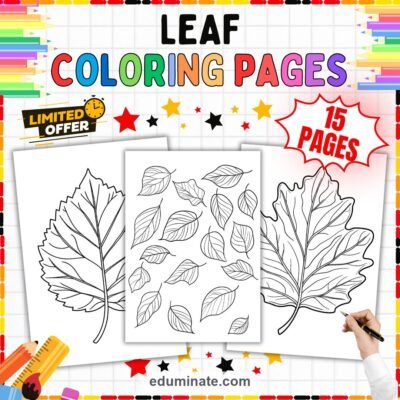
- Maple Leaf Coloring Pages: 15 pages for $3.00, the smallest set, with clean bold lines and roomy shapes. A good choice for a single lesson or a small group.
All four are in the Leaf Coloring Sheets Bundle: 235 pages in four PDF files for $23.23. The separate prices add up to $30.97, so the bundle is 25% off. It suits a teacher who wants a full leaf unit in one download. If you only need a class set for one lesson, the 15 or 40 page pack is plenty.
Check the “Look inside” samples on each product page before buying. Downloaded files cannot be refunded.
Planning a leaf week
A leaf unit can fit in five short sessions:
- Monday: a nature walk to collect leaves, then a maple page.
- Tuesday: leaf rubbings and a page with veins.
- Wednesday: sort leaves by shape and color the matching pages.
- Thursday: color a summer leaf and a fall leaf, then compare.
- Friday: build a class leaf display and let children talk about their favorite.
Each session needs about twenty minutes. Adjust it to your class and the weather. If a walk is not possible, bring a bag of leaves into the room.
Printing tips
- Print one-sided so children can color on a clean back if they press hard.
- Use regular copy paper. For leaf crafts that you cut out, heavier paper holds up better.
- Print smaller packs in full and choose a handful from the larger ones to save paper.
- If the edge of the page is cut off, choose “Fit to page” in the print dialog.
Use the packs in one classroom or at home, as the license explains.
Frequently asked questions
What age are leaf coloring pages for?
The packs listed here are for preschool to 3rd grade. Younger children use the bold, simple shapes, and older children can shade and add labels.
Are there free leaf coloring pages?
We did not find a free leaf pack in our shop. The smallest paid set is the 15 page maple leaf pack at $3.00.
Can I use the pages outside of fall?
Yes. Leaves are a plant topic all year. A set with oak, maple and tropical shapes works well in a plant unit in spring as well.
How do I keep children from rushing?
Set a simple goal such as “Use at least two colors and fill the whole leaf.” Tell children that finishing slowly is fine.