Math Diagnostic Assessment and Placement Tests by Grade
FreeTry a printable pack for free first. No card needed.See free packs
A math diagnostic assessment is a test given before teaching, to find out what students already know and where the gaps are. A placement test does a similar job for one decision: which course or group a student should start in. The tests below are printable and cover grades 1 to 12. Each has an answer key, so you can score a class in an evening and sort students into groups the next day.
A useful diagnostic should do the following:
- Sample every major strand of the grade, so one weak area does not hide.
- Take one or two class periods, not a week.
- Score quickly, with an answer key and an answer sheet.
- Show skills, not only a total, so you can group students by need.
- Leave students feeling that they were checked, not graded.
In this article (10 sections)
- Diagnostic, placement and summative are different jobs
- Elementary diagnostics, grades 1 to 6
- Sixth grade, start of year and end of unit
- Middle school diagnostics and summative tests
- Math placement tests for older students
- How to give a diagnostic
- Reading the results
- Turning scores into groups
- Explaining the test to students and families
- Frequently asked questions
Diagnostic, placement and summative are different jobs
A diagnostic comes first. It tells you what to teach. A placement test sorts students into a course. A summative test comes last and tells you what was learned. The same questions can play more than one role, but your purpose changes how you present the test and what you do with the scores.
For a diagnostic, tell students directly that it will not count for a grade. Say that you want to know where to start. Students who think a test will judge them tend to rush or guess. Students who know it only decides where to start often try harder. These packs are practice tests written to give you a picture, and a single test is one piece of evidence about a student.
Elementary diagnostics, grades 1 to 6
Three packs cover the elementary years.
| Pack | Grades | Questions | Price |
|---|---|---|---|
| Basic Math Diagnostic Test | 1 to 5 | 80 | $4.99 |
| Assessment Test in Math | 3 to 6 | 80 | $4.99 |
| Math Level Assessment Test | 3 to 5 | 80 | $4.99 |
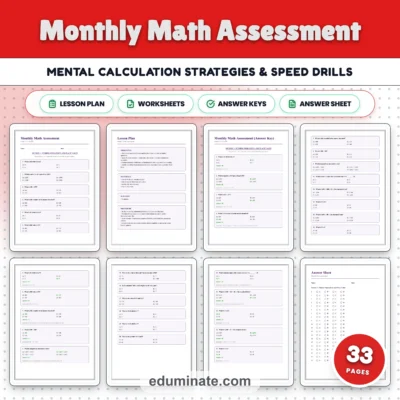
Basic Math Diagnostic Test is for grades 1 to 5, with 80 questions on place value, computation, multiplication and fractions. Because it spans five grades, it works for new students who arrive with no records, and for teachers who want to see how far above or below grade level a group is working. Assessment Test in Math is an informal check for grades 3 to 6 with 80 questions on operations, word problems, facts and mental math. Math Level Assessment Test is meant for monthly checks in grades 3 to 5 and covers operations, place value, fractions, geometry and vocabulary.
A monthly check works well as a low-stakes routine. Students who see the same format each month get used to it, and you can compare month to month without building a new test each time.
Sixth grade, start of year and end of unit
Sixth grade is where students meet ratios and early algebra, so a diagnostic helps most there. Three packs target this grade.
| Pack | Grades | Questions | Price |
|---|---|---|---|
| Math Assessment Practice | 6th | 70 | $3.99 |
| Math Diagnostic Test | 6th | 75 | $3.99 |
| Math Assessment Test | 6th | 80 | $4.99 |
Math Assessment Practice is a start-of-year set with 70 questions on decimals, fractions, order of operations and expressions, at $3.99. Math Diagnostic Test has 75 questions on arithmetic, fractions, ratios and true or false concepts, also $3.99. Math Assessment Test goes a little deeper with 80 questions on decimals, properties, vocabulary and algebra. If your students are weak on missing values in equations, our guide to the missing number worksheet has ideas for practicing that skill.
Middle school diagnostics and summative tests
For 6th to 9th grade, use one of these.
| Pack | Grades | Questions | Price |
|---|---|---|---|
| Pre Algebra Diagnostic Test | 7th | 70 | $3.99 |
| Pre Algebra Assessment Test | 4 to 7 | 80 | $4.99 |
| Math Summative Test | 6th to 9th | 80 | $4.99 |
| Maths Test Exam Study Guide | 6 to 9 | 80 | $4.99 |
Pre Algebra Diagnostic Test is for 7th grade, with 70 questions on integers, equations, ratios, geometry and statistics, at $3.99. Pre Algebra Assessment Test is written for grades 4 to 7 and has 80 questions on number sense, fractions, geometry and word problems, so it can serve as a readiness check for students heading into pre-algebra. Math Summative Test is for the end of a middle school unit or term, with 80 questions on number operations, fractions, algebra, geometry and data. Maths Test Exam Study Guide is a final review for grades 6 to 9 with 80 questions on algebra, geometry and proportions.
Math placement tests for older students
When the question is which course a student belongs in, a placement test needs to reach back to earlier skills and forward to the next course.
| Pack | Grades | Questions | Price |
|---|---|---|---|
| Math Placement Exam Practice Test | 6th to 9th | 75 | $4.99 |
| Math Placement Test | high school | 85 | $4.99 |
| Math Assessment Test Practice | 8th to 11th | 80 | $4.99 |
Math Placement Exam Practice Test is for grades 6 to 9 and covers arithmetic, fractions, pre-algebra, geometry and word problems in 75 questions. Math Placement Test is a high school test with 85 questions on pre-algebra, algebra, geometry, algebra II and statistics. Math Assessment Test Practice is for integrated math 1, grades 8 to 11, with 80 questions on equations, functions, systems, exponents and geometry.
A placement test gives one data point. If a student lands near a cut line, add a class grade, a short conversation and a look at their work, since a single score on a practice set should not decide a student’s path alone.
How to give a diagnostic
- Choose the pack one grade level below if you suspect the class has gaps, and the grade level itself if you do not.
- Split it over two sessions if students tire. Most of the packs here have a worksheet of about 12 pages, which is a lot for a young student in one sitting.
- Collect the answer sheets and score them with the key.
- Mark each missed question by skill, not only by number.
- Group students by the two or three skills that show up most often.
Reading the results
Look for patterns before totals. If six students miss the same fraction questions, reteach the fraction skill to a small group. If one student misses almost everything on place value, check whether the issue is the content or the reading. Students who read slowly may know the math and still run out of time.
Keep a simple class tracker with a row per student and a column per skill. After a unit, repeat a section of the diagnostic and see which cells change. That tells you whether the small group work paid off.
Turning scores into groups
After scoring, sort students into three piles by skill, not by total. One pile is students who missed the same strand, for example fractions. Another is students who did well overall but made careless slips. The third is students who finished everything correctly and need a challenge. Each pile gets a different plan for the next week.
- Skill gaps: a small group lesson of 10 to 15 minutes, three times a week, using a few questions from the same strand.
- Careless slips: ask the student to check each answer with a different method before moving on.
- Ready for more: give a harder pack from the next grade level as a choice during center time.
Re-sort the groups every two or three weeks. Groups should move, because a group that never changes turns into a label.
Explaining the test to students and families
Say what the test is for in one sentence: it helps me plan what we do first. Tell older students the same thing, and add that nobody is expected to know everything on it. For families, a short note works, with the date and a line that the test is a starting point. Keep the language plain, and avoid placing a student in a group with a name that sounds like a rank.
Frequently asked questions
How long does a diagnostic take?
Most packs listed here have 70 to 85 questions, and a worksheet of about 10 to 13 pages. Plan one to two class periods, or split it over two days.
Should students see their scores?
That is your call. Many teachers share skills feedback, such as which areas to work on, instead of a percent. It keeps the focus on the next step.
Can I use a diagnostic as a final test?
Yes, a repeat of the same test at the end shows growth, but wait several weeks so students are not simply remembering answers. For an end of unit test, the summative pack is a better fit.
Do the packs include answer keys?
Yes. Every pack listed includes an answer key, and most add an answer sheet and a lesson plan. The product page lists the exact files.