Spring Coloring Pages for Kids: Flowers, Rain and Kites
Spring coloring pages give children a calm way to welcome warmer weather in the classroom. Good sets show the things children notice outside: tulips and daisies, rain boots, gentle showers and kites on a windy day. The packs below cover preschool to third grade, and they use clear outlines so younger children can finish a page without help.
Here are the kinds of spring pages you can find:
- Tulips, daisies and buttercups with big petals to color one at a time.
- Potted plants and garden scenes for a gardening or plant unit.
- Rain boots, rainbow arches and soft showers for April weather.
- Windy kites and early spring scenes for the month of March.
- Sunny meadow pictures for children who like a full background.
In this article (10 sections)
- Free spring coloring pages
- Spring coloring packs compared
- All five packs in one download
- Classroom uses for spring coloring pages
- Why spring suits coloring
- Seasonal activities that pair with the pages
- Fine motor skills and focus tips
- A simple 20 minute spring lesson
- Which page for which age
- Frequently asked questions
Free spring coloring pages
Many people search for a free spring download. At the time of writing, we do not have a free pack on spring. If you need pages today, a simple project works well: hand each child blank paper, ask them to draw one flower with a stem and two leaves, then color it and add a title. If you want a free pack on another theme, free packs take an email address, which opens a free account and keeps the file in My Library.
The paid packs below add what the blank-paper approach cannot: a whole themed folder of finished line art, ready to print, so a substitute or a parent helper can run the activity with no drawing skill.
Spring coloring packs compared
Every pack below is a single PDF, and each product page says the A4 files print on US Letter with Fit to page.
- The Spring Coloring Pages Renewal Garden Flowers pack has 32 pages for $4.99. It shows blooming flowers, pastel rain boots, rainbow arches and gentle showers. It is listed for Pre-K to 2nd grade.
- The Spring Time Coloring Pages pack has 27 pages for $3.99, with tulips, daisies, buttercups and potted plants. It is listed for Pre-K to 3rd grade.
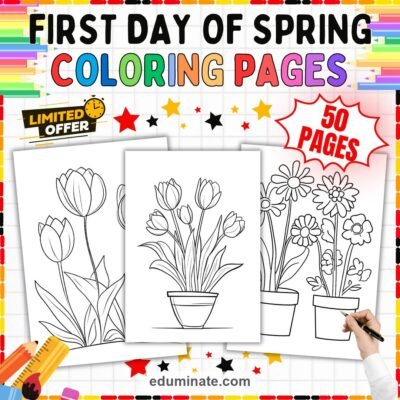
- The First Day of Spring Coloring Pages pack has 50 pages for $6.99. It features tulips, daisies, potted garden flowers and sunny seasonal scenes, made to mark the start of the season. It is listed for Pre-K to 3rd grade.
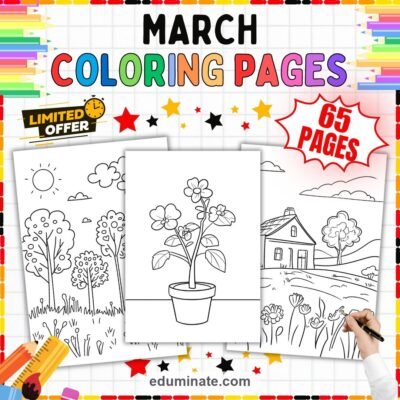
- The March Coloring Pages pack has 65 pages for $7.99, with windy kites, spring blossoms and sprouting flowers for early spring. It is listed for Pre-K to 3rd grade.
- The Printable March Coloring Pages pack has 29 pages for $3.99. The product page suggests it for weather charts, spring arrival crafts and morning work. It is listed for Pre-K to 2nd grade.
If you want one pack to start with, the 32-page Spring Coloring Pages pack has the widest mix of flowers, rain and rainbows. The 50-page First Day of Spring pack gives more pages if you need a set for a full class.
All five packs in one download
The Spring Coloring Sheets Bundle includes all five packs. It has 203 pages for Pre-K to 3rd grade and costs $20.96. Bought separately the five packs add up to $27.95, so the bundle saves $6.99, which is 25 percent. A spring bundle is handy when several classes share one folder, since each class can start on a different pack.
Classroom uses for spring coloring pages
Early finishers and indoor recess
Keep a spring folder on a shelf. When rain keeps everyone inside, children can choose a page and color at their desks. The activity is quiet and has an obvious finish line.
Label the parts of a flower
After children color a tulip or daisy, ask them to add arrows and labels for the petals, the stem and the leaves. Younger children can say the names aloud to a partner. This links a coloring task to a short science lesson on plant parts.
Rain and weather talk
The rain boot and shower pages open a simple weather chat. Ask: what do we wear when it rains, and why? Children can write one sentence about their favorite rainy day activity.
Seed to flower sequence
Print a few flower pages and ask children to put them in order from small plant to full bloom. Then they color each stage and number them. This fits a plant life cycle unit without extra prep.
A spring garden wall
Cut around the colored flowers and fix them to a long strip of green paper along the wall. Each child adds one flower, and the class garden grows over the week. Add a sign that says how many flowers are in the garden once everyone has finished.
Why spring suits coloring
Spring is the season children can watch change from the classroom window. Buds appear, rain falls more often and the days get longer. Spring flowers have big, simple shapes, so they are easy to outline and color, and a class can talk about what it sees outside while the pencils move. The spring season also gives a natural reason to draw on science: plants need water and light, and rain helps them grow.
Seasonal activities that pair with the pages
Pages are a quiet start or finish to a bigger unit. Here are a few seasonal activities that need little prep:
- Plant a bean in a clear cup, and color a page each time you measure the stem.
- Take a short walk and bring back a list of five signs of spring to write on the board.
- Keep a weather log for a week, and color one rain or sun picture for each day.
- Sort colored flower pages by number of petals and make a simple bar graph.
- Talk about the plant life cycle and place the colored pages in order from seed to flower.
These activities give children a reason to look closely at real plants before they color, which tends to make their choices more careful. A child who has just seen a real tulip will often choose red or yellow without being told.
Fine motor skills and focus tips
- Ask younger children to color the biggest petals first and the small details last.
- Show how to use short strokes that follow the shape of a petal, working from the edge inward.
- Offer crayons for large areas and colored pencils for stems and leaves.
- Try a two-color challenge for restless children, such as only yellow and green, and see what they make.
- Print on slightly thicker paper for markers, so the color does not show through.
Flower and leaf shapes have curves, which are harder to follow than straight lines. A child who colors a petal edge carefully is using the same control needed for round letters later on.
A simple 20 minute spring lesson
- Take three minutes to ask what children notice outside in spring. Write three words on the board, such as bloom, rain and warm.
- Hand out a page and let children color for ten minutes.
- Each child writes or says one sentence about their page, such as “The tulip is red and tall.”
- Spend the last few minutes on a gallery walk where children visit three pages and name one thing they like.
The same plan works for a sub, since it needs only the printed pages and a few crayons. For more flower-themed pages and activity ideas, see our guide to flower coloring pages.
Which page for which age
Preschool and kindergarten
Choose pages with a single large flower or boot. Offer thick crayons and accept any color choice. A purple tulip is still a tulip.
First and second grade
Children can handle garden scenes with several parts. Ask them to color the background too, and to add a sentence under the picture.
Third grade
Older children can add shading to petals and write a short paragraph about what changes in spring. The 50-page and 65-page packs, both listed up to 3rd grade, give them the most pages to choose from.
Frequently asked questions
Are there free spring coloring pages in your shop?
Not at the time of writing. Free packs on other themes take an email address, which opens a free account and keeps the file in My Library.
What is on the pages?
The packs described here cover flowers, gardens, rain, kites and early spring scenes.
What grades do they suit?
The packs are listed for Pre-K to 2nd grade or Pre-K to 3rd grade, and the bundle covers Pre-K to 3rd grade.
Can I print them on US Letter paper?
Yes. Each of the five product pages states that its A4 files print on US Letter with Fit to page.