Flower Coloring Pages: Ways to Use Them in Class and at Home
Flower coloring pages give children a calm way to practice color choice, hand control and attention to detail, and they connect easily to a plant unit. This guide shows how to use them for science, art and quiet time, what to look for in a set, and how to get the best results from crayons, pencils and markers.
Why flower coloring pages work so well
Flowers are a friendly subject. They have clear, repeating shapes, such as petals around a center, and children already know many of them. A daisy, a tulip and a sunflower look different enough that a child can tell them apart, but each is simple enough to color without frustration.
Flowers also invite open choices. There is no wrong color for a petal, so a child can experiment. That freedom is one reason these pages suit mixed groups, where some children are confident colorers and others are just starting.
The same pages can serve many goals:
- A calm activity after a busy lesson or a loud recess.
- Fine motor practice, since coloring within shapes uses the same hand control as writing.
- A link to a science topic, such as plants and how they grow.
- A quiet task for early finishers.
- Wall decoration for a garden or plant display.
Choosing printable flower coloring pages
Sets vary a lot, so it helps to check a few details before you print.
Outline weight
Thick outlines suit younger children, because they are easier to stay inside. Thinner, more detailed outlines suit older children who want a challenge.
Level of detail
A large single bloom is a good fit for beginners. Pages with a whole bouquet, a garden border or a botanical drawing with many small leaves take more time and patience.
Variety
A set with many kinds of flowers keeps interest high. A child who has colored roses may enjoy daisies, tulips or sunflowers next.
Number of pages
If you plan to use pages across a whole class or a full unit, a larger set saves you from searching for more every week.
Here are some sets of different sizes, so you can match the amount to your needs.
- The Flower Coloring Pages set of 150 sheets features roses, daisies, tulips, sunflowers and spring blossoms, made for art centers, nature science and calm classroom time.
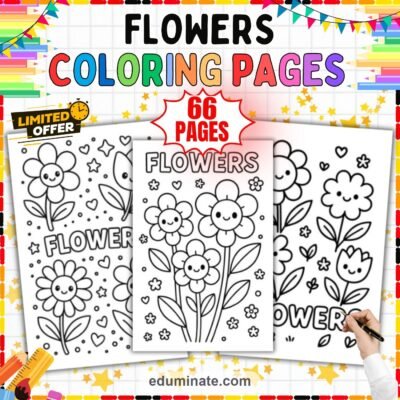
- The Flower Coloring Pages to Print set has 66 pages of daisies, tulips, sunflowers and garden blossoms.
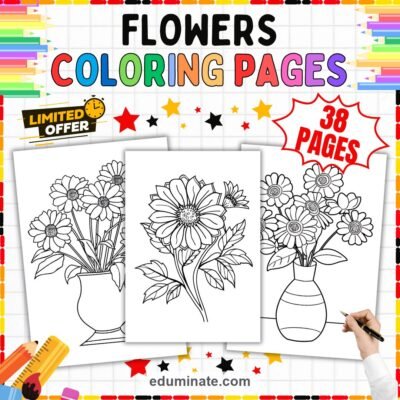
- The Flower Coloring Book Pages set has 38 pages with botanical dahlias, vase bouquets and garden blooms, a good choice for older students and calm art time.
- The Floral Coloring Pages Bundle gathers nine coloring packs covering flowers, garden blooms and botanical designs, in 559 pages.
Using flower coloring pages to teach the parts of a flower
A flower page can double as a short science lesson. Before children color, show them the main parts of a flower and where to find them on a real bloom or a picture.
- Petals: the colorful outer parts that many people notice first.
- Stem: holds the flower up and carries water from the roots.
- Leaves: make food for the plant using sunlight. Our guide to photosynthesis for kids explains how.
- Roots: under the soil, they take in water and hold the plant in place.
- Center of the flower: in many flowers this is where seeds begin to form.
After the short talk, ask children to color each part a different color and say the name aloud as they go. A child who colors the stem green and says “stem” is already connecting the word to the shape. If you want more depth, use the pages in a plant unit with real flowers on the table for comparison.
For plant-focused art, the Plant Coloring Pages Printable Bundle brings together six coloring packs covering potted plants, foliage, plant parts and life cycles, in 385 pages. It is a natural next step when a class moves from flowers to the whole plant.
Color practice with flowers
Flowers give children a gentle way to think about color. Here are a few activities that need nothing but a page and some crayons.
Real colors and imagined colors
Ask a child to color one flower the way a real one looks, then another in any colors they like. Talking about the difference builds language: “Which colors did you choose, and why?”
Warm and cool colors
Give a child two pages. On the first, use only warm colors, such as red, orange and yellow. On the second, use cool ones, such as blue, green and purple. Compare the two pages side by side.
Color mixing
With crayons or colored pencils, layering one color over another produces a new one. Yellow over blue gives green. Red over yellow gives orange. Let children try it on the petals and observe what happens.
Light to dark
Show children how pressing lightly makes a pale color and pressing harder makes a deep one. A petal that shifts from light at the tip to dark at the center looks richer, and it teaches control of the hand.
Symmetry and patterns
Many flowers are symmetrical, which makes them a good starting point for a quick math connection. A daisy has petals spaced evenly around a center. A tulip looks almost the same on its left and right sides.
Ask children to color a pattern around the petals, such as red, yellow, red, yellow. Or ask them to color matching petals on each side of a flower in the same colors. These small tasks make children look more closely and think about repetition and balance.
Tools: crayons, pencils, markers and paints
- Crayons: easy to hold and forgiving. Good for younger children and for pressing hard.
- Colored pencils: allow fine detail and shading. They suit older students and botanical pages. A box of good colored pencils lasts a long time.
- Markers: bright and quick, but they can bleed through thin paper. Slip a spare sheet underneath.
- Watercolors: turn a page into a painting, if the paper is heavy enough. Test one page first.
Heavier paper makes a difference, especially for markers and paint. If your printer allows, use a thicker stock for pages you plan to display.
Flower coloring sheets for different ages
One set of flower coloring sheets can stretch across several ages if you change the task, not just the page.
Preschool and kindergarten
Give a large, simple bloom and let the child color freely. The goal is hand control and enjoyment. Talk about colors and petals as the child works. Do not worry about staying inside the lines.
First to third grade
Add a purpose. Ask children to label the stem, leaves and petals, or to color a pattern around the flower. This is also a good age for the warm and cool color activity above.
Fourth grade and up
Older students often enjoy botanical coloring pages with many small leaves and fine lines. Offer colored pencils and encourage shading from light to dark. A detailed page can take a long sitting, so let students return to it over a few days. Garden coloring pages with borders, pots and bouquets give a wider scene to work with and suit students who like to plan a color scheme before they start.
A short flower unit built around coloring
If you would like a simple plan, here is one way to organize a week.
- Day one: look at real flowers or photographs, and name the parts. Color a page and label the petals, stem and leaves.
- Day two: talk about what plants need to grow, such as water, light and soil. Color a potted plant page.
- Day three: practice color mixing and shading on a flower page.
- Day four: look for symmetry and patterns, and color a page that follows one.
- Day five: choose a favorite page, finish it with care and display it.
The plan stays flexible. If the class loves one day, stay there a little longer. If you only have a few days, pick the ones that fit your lessons.
Flower coloring pages for quiet time and wellbeing
Coloring is slow and repetitive in a good way. It gives a child something to do with their hands while their mind settles. Teachers often use coloring pages to wind down after a hard lesson, and parents use them for a calm moment at the end of the day.
If your class has a quiet area, a tray of flower pages and a cup of pencils can be a simple tool. Our guide to calm down corner ideas has more suggestions for setting that space up.
Ways to display finished flower pages
Children take pride in work that is shown. A few simple display ideas:
- Build a paper garden on a bulletin board, with a stem and leaves cut from green paper under each flower.
- String the finished pages along a wall like bunting.
- Bind a class book, with one flower page from each child.
- Send pages home, so families can see what was made.
If you want to pair the pages with preschool activities, see our post on flower activities for preschoolers. And for more printable options to try before you buy, see our roundup of free printable coloring pages.
Keep a few spare pages in a folder for children who finish early, so that no one waits with nothing to do. A quiet coloring task also helps a child who needs a short break between lessons.
Frequently asked questions
What age are flower coloring pages for?
They suit a wide range. Simple pages with thick outlines fit young children, while detailed botanical pages fit older students and adults who enjoy coloring. Choose the level that matches the child’s hand control.
How can I use flower coloring pages in a science lesson?
Label the parts of a flower, compare the pages with a real bloom, or use the pages as a place to record observations from a plant unit.
Which coloring tools work best?
Crayons suit younger children. Colored pencils suit detailed pages. Markers are bright but may show through thin paper.
Can I print the pages more than once?
Within the license that comes with the product, yes. Many teachers keep a master set and print fresh copies when needed.