Calm Down Corner Ideas for the Classroom and at Home
A calm down corner is a small, quiet place where a child can take a short break. This article gives calm down corner ideas for teachers and parents: how to choose a spot, what to put in it, how to introduce it, and some simple emotions activities for preschoolers. It also looks honestly at where coloring pages fit. It is a set-up guide, not a behavior program.
What a calm down corner is
A calm down corner is a small, agreed place to pause. A child chooses to go there for a short break, then returns to what the class or family is doing. It is a choice that is offered, not a punishment or a time-out.
Keep expectations modest. A corner gives a child somewhere to pause. It does not fix behavior by itself. If a child finds big feelings hard very often, talk to the child’s doctor, teacher or school counselor.
How to set up a calm down corner
Pick a quiet spot
Choose a place away from the door and the busiest wall, where a child can sit without being in the middle of the room. A corner of the room, the side of a bookshelf or a spot behind a low divider all work.
Keep it small and tidy
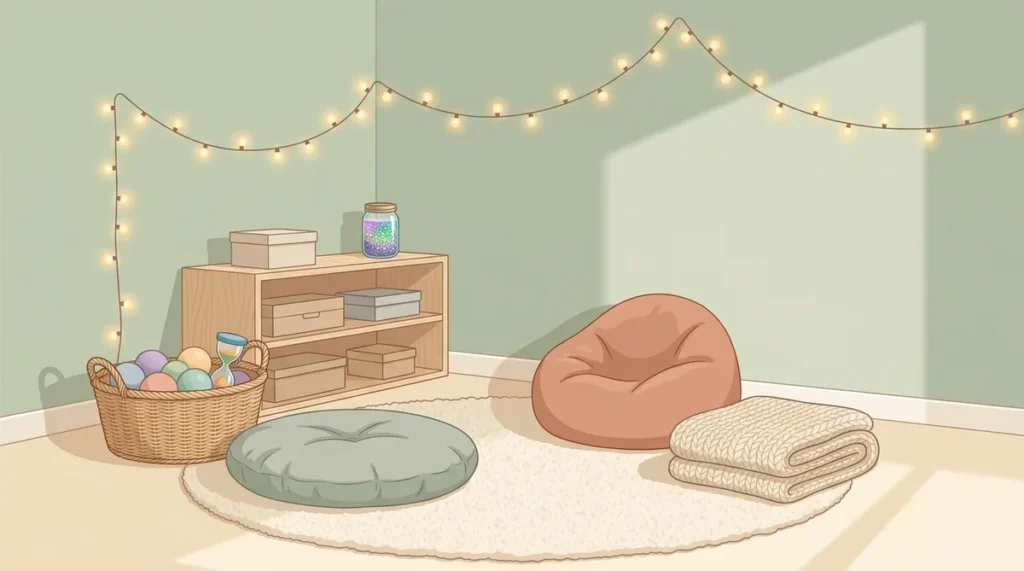
A small space feels cozy and is easy to reset. A rug, a cushion and a basket are enough. Tidy it at the end of each day so it looks inviting.
Choose a few items, not many
Too many things turn the corner into a play area. Start with three to five items and swap them every few weeks.
Post three simple steps
Write short steps and add little drawings you make yourself. For example:
- Notice how you feel.
- Pick something from the basket.
- When you are ready, go back and tell a grown-up if you want to.
Agree the rules together
Talk with the class or family about how the corner works: who can use it, how a child asks, and how a child comes back. Practice it once when everyone is calm, so it is not new on a hard day.
Calm down corner ideas for the classroom
These calm down corner ideas for classroom use need little space or money. The table lists common items and what each one offers.
| Item | What it offers | Classroom or home |
|---|---|---|
| Soft seat or cushion | A comfortable place to sit | Both |
| Timer | A clear sense of how long the break is | Mostly classroom |
| A few books | Quiet looking and reading | Both |
| Paper and crayons | Something to do with the hands | Both |
| Feelings chart | Words and pictures for feelings | Both |
| Printable coloring pages | A quiet activity a child can choose | Both |
To keep the corner from becoming a place to avoid work, agree when it is for: a short break, then back to the task. How many children can use it at once is the teacher’s decision. A folder of quiet choices works well here, and our post on early finishers activities shows how to set one up. For more low-prep ideas, see our list of teaching ideas for teachers.
Introduce it step by step
Spend the first few days showing the corner as a whole class. Show each item and say what it is for. Read the three steps together, then let a few volunteers practice walking over, choosing an item and coming back. Keep the first visits short and matter-of-fact, so the corner does not become a special event. If students ask to visit it all at once, a simple sign-up or a “one at a time” rule keeps it fair.
Calm down corner ideas for home
The calm down corner ideas for home are the same, just smaller. A corner of the bedroom or living room, with a cushion and a basket of supplies, is plenty.
Use the same three steps, and let your child help choose what goes in the basket. A cushion, two or three books, paper, crayons and a feelings chart on the wall are enough to start. Show the corner on a quiet afternoon, not in the middle of a hard moment. Taking a break there yourself, with a book or a cup of tea, lets your child see you use it too.
Emotions activities for preschoolers
These emotions activities for preschoolers can happen in the corner or anywhere else. Keep them playful and short.
Name the feeling with a feelings chart
Draw a few simple faces on a sheet of paper (happy, sad, angry, worried, tired) and write the feeling word under each one. A child can point to the face that matches how they feel. Say the feeling word aloud as you point, so the word and the face go together.
Draw or color how you feel
Emotions art activities for preschoolers can be as simple as a blank page and some crayons. Ask a child to pick a color for a feeling and fill a page with it. There is no right answer, and you do not need to explain the picture.
Read a picture book and talk about it
Choose a picture book where a character has a strong feeling. Ask: “How do you think she feels?” Keep it relaxed and let the child lead the talk.
Play simple breathing games
Ask a child to smell an imaginary flower and then blow out an imaginary bubble. Treat it as a game, keep it short, and stop if the child does not want to play. These games are play only. We make no health claims for them.
Using coloring pages in the corner
Coloring is a quiet activity that many children choose. It asks a child to hold a crayon and fill a shape, which gives the hands something to do. Printable emotions activities for preschoolers, such as coloring pages, can sit in a folder in the corner. Rotate the pages every few weeks and let the child choose which one to color.
Check the outline size before you print: large, simple shapes suit younger children, and detailed doodle pages suit older ones. Our post on fine motor activities explains how to choose by outline.
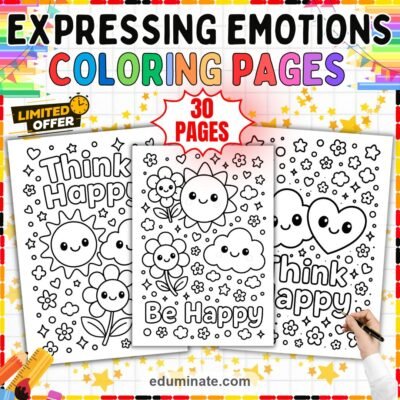
The Expressing Emotions Coloring Pages are 45 pages with cheerful smiley faces, calming sunshine and social emotional learning prompts for preschool and elementary students (Pre-K to grade 2). A smaller option is the Emotions Coloring Pages: 30 pages with smiling sunshine, happy flowers and cheerful clouds with positive SEL messages (Pre-K to grade 2).
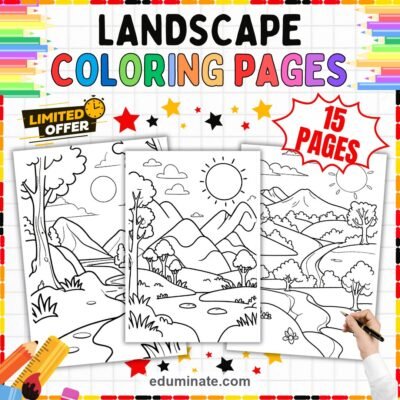
For scenery pages, the Landscapes Coloring Pages are 15 pages of winding forest rivers, sunny mountain valleys and country trails (K to grade 5), described in the listing as for calm creativity. The Mountains Coloring Pages are 60 pages with cute smiling alpine peaks, pine trees, wildflowers and cheerful suns (Pre-K to grade 3).
Practice material
Eduminate does not have a behavior or therapy program. The packs above are coloring packs, and their emotions and calm themes are as the listings describe them. They are a quiet activity for a calm corner, not a treatment, a behavior plan or a social-emotional curriculum. Look at the preview pages on each product page to check the outline size and the artwork before you choose.
Frequently asked questions
Is a calm down corner a time-out?
No. A time-out is something an adult decides for a child. A calm down corner is a choice offered to a child, and the child returns when ready.
How long should a child stay?
It varies. You can agree on a short break and use a timer or a signal. The adult in charge decides what works for the group.
What if a child uses the corner to avoid work?
Agree in advance that the corner is for a short break and that work comes next. If a child asks often, talk with the child quietly to find out what is hard about the task.
Does a calm down corner work for older students?
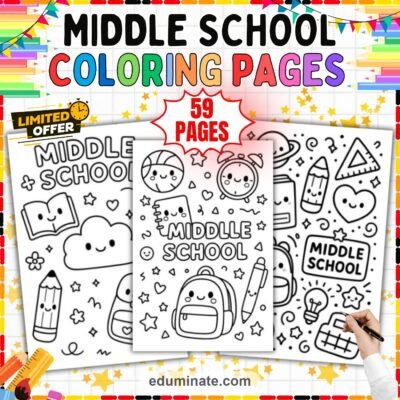
It varies. Older students may prefer a quieter, less childlike space. The Middle School Coloring Pages are 59 pages with cute backpacks, books, alarm clocks and doodle art (grades 5 to 8), described in the listing as for back to school advisory and calm down mindfulness. A school counselor can help with a child who struggles often.