Fall Bulletin Board Ideas for a Cozy Classroom Display
Fall bulletin board ideas start with simple shapes: leaves, tree branches and acorns that students color, cut and add one by one. This guide offers layouts you can build with a class, a plan for the setup, and printable pages that become the pieces.
Why leaves and trees make a good fall display
Leaves are easy to make and easy to recognize. They come in warm colors and many shapes, and no two have to look alike. A board made of leaves feels full even when each piece is simple.
The theme also connects to science. Students can sort leaves by shape, compare an oak leaf with a maple leaf, and talk about how trees change in the fall. The board then becomes part of the lesson and not only decoration.
Here is why a student-made board suits the season:
- Every student can add a leaf, so the whole class has a part in it.
- The pieces can be colored during quiet work time.
- The board can fill up slowly across several weeks.
- A missing leaf is easy to replace.
Plan the board before you start
Measure and count
Measure the board and decide how big each leaf will be. Large leaves fill a board quickly. Small leaves give you room for more of them and a fuller look.
Pick a background
A soft cream, light blue or pale gray background lets warm leaf colors stand out. Cover the board edge to edge so that old staple holes do not show.
Choose a border
A bulletin board border frames the display. Use a strip of brown paper, a scalloped edge or a border made of paper leaves in a repeating pattern.
Cut the title
Choose a short title and cut tall letters from construction paper. Place it at the top in one line so it can be read from across the room.
Fall bulletin board ideas to build
Each of these layouts uses only objects and words, so you can build it with paper and a few markers.
A bare tree with falling leaves
Cut a tree trunk with branches from brown paper and staple it in the middle of the board. Leave the branches empty. Each student colors a leaf page, cuts out the leaf and staples it onto a branch or on the ground below. Over a few weeks the bare tree fills with color.
Title idea: “Our Class Tree Is Changing.”
A reading tree
Use the same tree, but each leaf carries a book title. When a student finishes a book, the student writes the title and the author’s last name on a leaf and adds it to the tree. The board tracks what the class reads.
A word tree
Each leaf holds a vocabulary word or spelling word on one side and a sentence on the other. The tree turns into a display of words the class has learned.
A leaf sorting board
Divide the board into three sections. Label them with the leaf types the class is studying, such as oak, maple and elm. Students color real or printed leaves, then place them in the right group. An oak leaf has rounded lobes, and a maple leaf has pointed ones, so the board helps students look closely at the edges.
An acorn counting board
Cut a large tree shape and give each student an acorn to color. Students attach their acorns and write a number under each one, such as counting by twos: 2, 4, 6, 8, 10. The board doubles as a number line for skip counting.
A kind words branch
Each student writes one kind word or thank-you note on a leaf. Keep the notes about everyday actions, such as sharing a pencil or helping with a project. The branch fills with short notes from the class.
A weather and season board
Mount a bare tree and a cloud shape, then add labels for cool, windy, rainy and sunny days. A helper moves a leaf marker to match each day. After a month, count the days of each kind and record the numbers on a strip.
Printable pages that become leaves, trees and acorns
Coloring pages give you the shapes ready to go. Students color them, you cut or they cut, and the board builds itself. Here are some of our sets that work for these displays.
- The Fall Coloring Sheets Bundle has eight coloring packs in one download, covering autumn scenes, acorns and September fall activities. It has 251 pages.
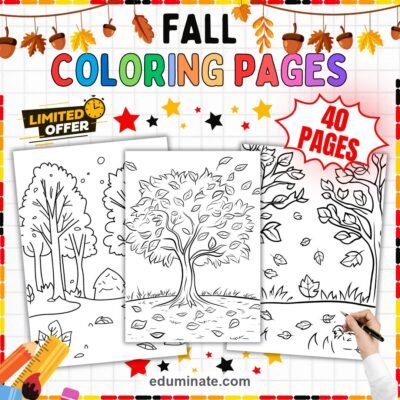
- The Fall Coloring Pages for Kindergarten and First Grade set has 40 pages with woodland paths, drifting leaves and graceful forest trees.
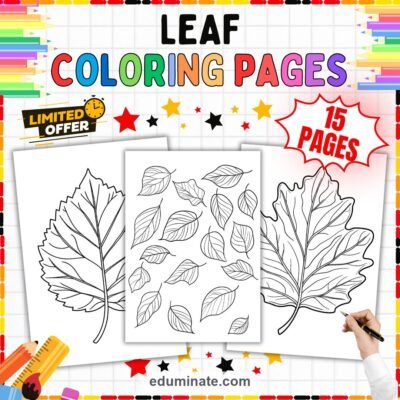
- The Leaf Coloring Pages set has 80 pages with lobed oak leaves, pointed maples, tropical monstera and autumn foliage.
- The Leaves Coloring Pages set has 100 pages with sharp maple points, fluttering elm leaves and lobed oak foliage.
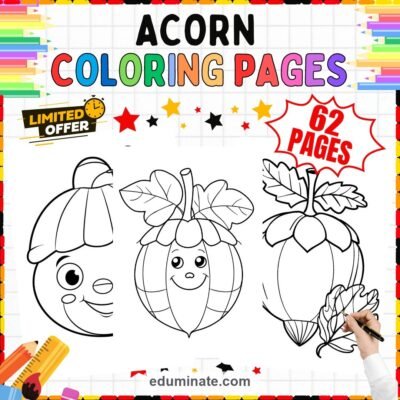
- The Acorn Coloring Pages set has 58 printable sheets with leafy caps and plain autumn acorns.
- The Maple Leaf Coloring Pages set has 15 pages that suit tree botany units, nature walks and seasonal art.
The leaf sets give you the most variety for a large tree. The maple set is a good small choice when you only need one kind of leaf for a sorting board.
From coloring page to leaf on the tree
- Print. Heavier paper holds up better on a wall, especially when it is colored with markers.
- Color. Offer warm crayons and colored pencils: red, orange, yellow and brown. Colors can be mixed on the same leaf.
- Cut. Cut along the outline. Younger students may need help, so thick outlines are easier.
- Add details. Draw veins with a darker pencil, or fold the leaf down the center and open it again to give it a crease.
- Attach. Staple the leaf by its stem so it hangs naturally from a branch.
Ask students to put their name on the back. That way the front of the board stays clean.
Leaf shapes to look for
A leaf board is a good moment to talk about shapes in nature. Here are three that show up in the sets above.
- Oak leaves: rounded lobes along the edge.
- Maple leaves: pointed lobes,.
- Elm leaves: an oval shape with a toothed edge.
Ask students to compare a pointed leaf and a rounded leaf, and to explain how they can tell. Writing one sentence about the difference is a quick language exercise.
Layout tips for a tidy board
- Overlap a little. Leaves that slightly overlap look like a real canopy.
- Mix sizes. Use big leaves near the top and smaller ones below.
- Place some on the ground. A few leaves along the bottom edge look like leaves that have fallen.
- Limit your colors. If you keep the border, title and trunk in two or three shades, the leaves stand out more.
- Keep the center clear. Leave the trunk and main branches visible.
Making the board part of the lesson
A fall display can serve several subjects at once.
- Science: sort leaves by shape and label the parts of a tree.
- Math: count the leaves by color. If the tree has 6 red leaves, 4 orange leaves and 5 yellow leaves, that is 15 leaves in all.
- Writing: add a sentence to each leaf about a sight on the walk to school.
- Art: compare shading on a leaf, from light at the edge to dark at the center.
Early finishers can add a leaf to the board while they wait for the class. Our guide to early finishers activities has more ideas for filling those minutes.
Taking the board down
When the season changes, take the board down with care. Peel staples gently so the paper does not tear. Send leaves home with students, or save the best ones in a folder for next year. Store the tree trunk flat, and you will have the core of your next fall display ready to go.
Autumn leaves to use in a leaf display
A leaf display gets its life from variety. Mix the leaf types so the tree has maple leaves, oak leaves and the occasional elm leaf. Students who finish a leaf quickly can color a second one in a different pattern, such as stripes or dots, to make the tree look full.
The colors do not have to be real. A tree with blue leaves can start a good talk about why real leaves change color. Ask students which colors they have seen outside, then let them choose.
A door display for the class
A door is a good spot for a smaller class display. Cover it in cream paper and add a brown trunk. Leaves in warm colors go on the branches, and a short title runs across the top. Because everyone walks past the door, it works well for pieces students are proud of.
Fall bulletin board ideas for different grades
Kindergarten and first grade
Use large leaves with thick outlines. A single leaf per student, colored at the table and stapled by an adult, is a good goal.
Second and third grade
Add words. A vocabulary tree or a reading tree suits this age, and students can write on their own leaves.
Fourth grade and up
Older students can sort leaves by shape and label them. A small group can plan the board and write the title.
Frequently asked questions
How early should I put up a fall bulletin board?
Whenever your class is ready for it. A bare tree can go up first, and the leaves can be added as students finish them.
Do the leaves have to be real?
No. Paper leaves from coloring pages are flat, easy to staple and last the whole season. Real leaves dry out and curl.
What can I do if I have no wall space?
Hang a tree on a door, a cabinet or a window. A string across the room can also hold leaves with clothespins.
How do I keep a board from looking messy?
Plan the layout first, leave space between pieces and limit your colors for the title and border.