Growth Mindset Posters for Classroom: Ideas and Uses
Growth mindset posters for classroom walls put short, encouraging phrases in front of students every day. This guide covers how to choose the wording, where to hang the posters, and how to turn them into habits with coloring, talk and small classroom routines.
What growth mindset posters are
A growth mindset is the idea that skills can get better with effort, practice and good strategies. A growth mindset poster puts that idea into a few words that a student can read at a glance, such as “Work Hard” or “Never Give Up.”
A poster alone does not change how students think. It works best as a reminder that you point to when it fits the moment. A student who is stuck on a hard problem sees the wall, and you can say, “Look at the poster. What can we try next?”
Posters in this style tend to fall into three kinds:
- Single phrases: one short sentence in large lettering.
- Reframing pairs: a fixed thought on one side and a growth thought on the other.
- Strategy posters: a list of things to try when work gets hard.
Choosing wording for growth mindset posters
Words matter. A good poster is short, positive and tells students what to do.
Keep it short
Aim for a handful of words. Students read a poster from a distance, so long sentences get skipped.
Say what to do
“Try a different way” gives students a next step. “Don’t be sad” does not. Phrases that name an action are more useful on a wall.
Use the word yet
The word “yet” turns a stopping point into a pause. “I can’t do this” becomes “I can’t do this yet.” It is a small change that is easy to remember.
Avoid labels
Skip phrases that sort students into types, such as “smart” or “not smart.” Posters should talk about effort and strategies.
Phrases that work well on a wall
Here are some phrases you can use on posters. They are short, and each one can start a conversation.
- Believe in Yourself
- Work Hard
- Never Give Up
- Mistakes Help Me Learn
- Not Yet
- Try Again
- Ask for Help
- Keep Going
A few reframing pairs for a two-sided poster:
- “I can’t do this” becomes “I can’t do this yet.”
- “I made a mistake” becomes “I found something to fix.”
- “This is too hard” becomes “This will take practice.”
- “I give up” becomes “I will try another way.”
Growth mindset posters for classroom walls: ready-made sets
Making posters by hand takes time. Printed sets give you bright, readable pages in one download.
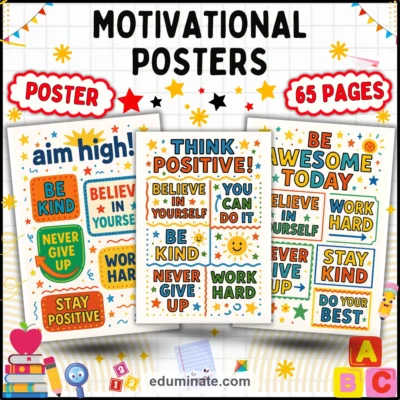
- The Motivational Posters for Classroom packet has 62 motivational poster pages in bright lettering, with phrases like Believe in Yourself, Work Hard and Never Give Up. The PDF has 65 pages in all.
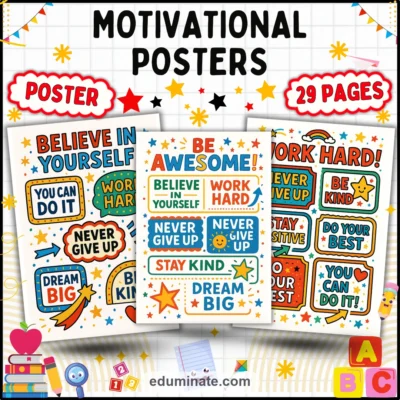
- The Classroom Motivational Posters for Students packet has 26 poster pages with boxed phrases of the same kind. The PDF has 29 pages in all.
- The Classroom Posters Bundle gathers six poster and card sets in one download, covering shapes, alphabet and number, healthy habits and motivational posters plus affirmation cards. It has 297 pages.
Print a few at a time rather than the whole set. A wall with three or four posters that rotate gets more attention than a wall covered in forty.
Where to hang growth mindset posters
Where a poster hangs changes how often it gets read.
- Near the door. A phrase students pass on the way in sets a tone for the day.
- Beside the math or writing area. Students who struggle will look up from the work in front of them.
- At eye level. A poster hung high above a cabinet gets ignored.
- On a bulletin board. A board with a border gives your posters a clean frame. Group three or four posters together, with a title across the top.
- At a calm corner. A few posters near a quiet spot give a student something to read while they settle.
Rotate the posters every few weeks. A phrase students have seen a hundred times fades into the wall, and a fresh one gets noticed.
Bringing the posters to life
A poster becomes useful when the class uses it. Here are some routines that tie words to action.
A phrase of the week
Choose one poster and put it at the front of the room. Talk about it on Monday. Ask students what it means and when it might help. On Friday, ask for a time during the week when they used it.
Morning meeting talk
Start the morning meeting by reading one poster aloud together. Ask a student to share a small example, such as practicing a hard word until it came out right.
A strategy menu
When a student says “I’m stuck,” point to a short list of things to try: reread the directions, try a smaller piece, ask a partner, look at an example. A poster with the list saves you from repeating yourself.
Mistake of the day
Put a wrong answer on the board and ask the class to find the error and fix it. This makes a mistake something to work on together.
Write about it
Ask students to write two or three sentences about a time something was hard and what they did next. Keep the topic about school, sports or a hobby. The poster supplies the starting words.
Growth mindset coloring pages
Coloring gives students a quiet way to spend time with a phrase. They choose colors, slow down and read the words as they color them.
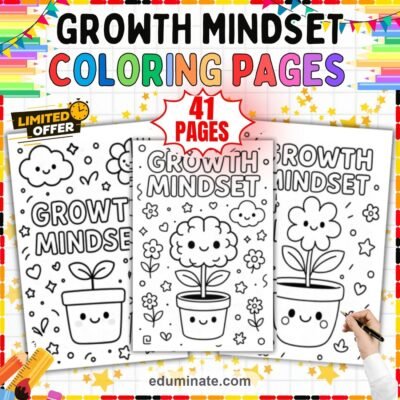
- The Growth Mindset Coloring Pages set has 41 printable pages, and is described as a good fit for back to school week, positive affirmations and social emotional learning.
- The Printable Growth Mindset Coloring Pages set has 25 pages, suited to morning meetings, mindfulness corners and positive classroom culture.
- The Growth Mindset Coloring Sheets Bundle has seven coloring packs in one download, covering growth mindset, positive quotes and encouragement. It has 281 pages.
Ways to use them with the posters:
- Let students color a page and hang it on a class board beside the posters.
- Offer a page to a student who finishes early.
- Put a stack at a calm corner for students who need a short break.
- Send a finished page home for the family to see.
For more on setting rules and expectations that go with these messages, see our post on a classroom rules poster.
A growth mindset bulletin board
A board can pull the posters and the coloring pages together.
- Cover the board in a calm color, such as light blue or soft green.
- Add a title across the top, such as “Yet Is a Powerful Word.”
- Hang three or four posters in a row beneath the title.
- Add colored pages from students around the posters.
- Keep a space for sticky notes where students can post “I used to find this hard, and now I can” notes about school skills.
The sticky note section keeps the board changing, and it gives students a way to see their own progress.
Making sure the words match the room
Posters work when the room backs them up. If the poster says “Mistakes Help Me Learn,” then a mistake in class should be treated as something to look at, not something to hide.
- Praise effort and strategies: “You tried three different ways.”
- Let students redo work after feedback.
- Model your own mistakes. Say aloud when you make one and what you will do next.
- Keep the tone calm when answers are wrong.
Students notice whether the wall matches the way the room runs.
Posters for different ages
Kindergarten and first grade
Choose the shortest phrases and read them aloud together. Pair each poster with a simple action, such as tracing the words in the air or coloring a page with the same phrase.
Second and third grade
Students can start to explain a phrase in their own words. Ask them to finish the sentence “I can keep going when…” and post a few answers beside the poster.
Fourth grade and up
Older students can write their own phrases and make a poster for the wall. A class vote on the three best phrases gives the display a sense of ownership.
Using posters with families
A poster set is also useful at home. Print one or two pages and send them with a short note that explains the phrase of the week. Families can hang the page on the refrigerator or a bedroom wall and use the same words when homework gets hard.
A short note might read: “This week our class is working on the phrase Keep Going. When a task feels hard at home, ask your child what they could try next.” Keep the note brief and kind, and ask nothing of the family beyond a short talk.
Keeping the message fresh
Any wall display loses its power after a few weeks. A little rotation helps the words stay alive.
- Switch which posters hang by the door each month.
- Ask a student to choose the phrase of the week.
- Add a new student-made page next to the printed posters.
- Retire a poster for a while and bring it back later.
The aim is not to fill the room with slogans. It is to keep a few useful words in front of students at the moments they need them.
Frequently asked questions
How many growth mindset posters should I hang?
Three to five at a time is plenty for most rooms. Rotate them so that each one gets noticed.
What age are the posters for?
Short phrases suit a wide range of ages. Read them aloud with younger students, and let older students discuss what they mean.
Do I need to explain each poster?
Yes, at least once. A quick talk about what a phrase means and when it helps makes it more than decoration.
Can I use coloring pages and posters together?
Yes. Hang the posters on the wall and use the coloring pages as a calm activity that repeats the same phrases.