Classroom Rules Poster: Wording, Examples and Display
A classroom rules poster gives the whole room one clear list of how people treat each other and the space. This guide covers sample rules you can borrow, wording that works for different ages, a way to write the rules with your students, and tips for displaying the poster so it gets read.
What a classroom rules poster should do
A rules poster does a small number of jobs. It tells students what is expected, it gives the teacher something to point to, and it shows visitors what the room runs on. If a poster does those three things, it is working.
Three habits help a poster stay useful:
- Keep the list short. Four to six rules can be remembered. Fifteen cannot.
- Say what to do. “Walk in the hallway” gives a student something to act on. “No running” only names what to stop.
- Use words students already know. A rule that needs a dictionary is hard to follow.
Rules also work better when they cover a group of behaviors, not one single thing. “Be kind” covers words, hands, and how we share materials, so one rule does the work of several.
Classroom rules examples you can borrow
Here is a classroom rules list written in plain, positive wording. Pick the ones that fit your room, and reword them as you like.
- Listen when someone is speaking.
- Raise your hand to share.
- Keep your hands and feet to yourself.
- Use kind words.
- Walk inside the building.
- Take care of school things.
- Tell the truth.
- Try your best.
That is eight, which is a little long for a poster. Group them if you need to. “Listen” and “Raise your hand” can sit together as “Listen and wait your turn”. “Keep your hands and feet to yourself” and “Use kind words” can become “Be kind”.
Classroom rules for kindergarten and younger students
Classroom rules for kindergarten need to be short enough to say out loud together. Three or four rules, each a few words long, is a good target. Here is one set:
- Listen.
- Be kind.
- Raise your hand.
- Walk.
Pair each rule with a plain symbol, such as a check mark for “Try your best” or an arrow for “Walk”. Keep the symbols simple, with no faces or people. A symbol helps a child who cannot read yet remember the rule.
For older students, a poster can carry longer wording. “Respect the people and materials in our room” covers a lot, and older students can unpack what it means in their own words.
Positive classroom rules: rewording the “don’ts”
First drafts often come out as lists of things not to do. Turning each one around gives you positive classroom rules that tell a student where to go next.
- “Don’t shout out” becomes “Raise your hand to speak.”
- “No running” becomes “Walk in the hallway.”
- “Don’t touch other people’s things” becomes “Ask before you borrow.”
- “No talking while I talk” becomes “Listen when the teacher is speaking.”
- “Don’t be mean” becomes “Use kind words.”
The positive wording is not about being soft. It is about being clear. A student who hears “no running” still has to guess what to do instead.
How to build the rules with your class
Students may take rules more seriously when they helped write them. This does not mean the class decides everything. It means they have a voice, and you steer the result.
- Start with a conversation. Ask what a classroom needs so that everyone can learn and feel safe. Write every idea on the board.
- Sort the ideas. Look for ideas that mean the same thing and circle them with one color.
- Turn each group into a short rule. Offer a draft sentence and let the class adjust it until it sounds right.
- Agree on four to six rules. Read them aloud together once the list is down.
- Write the final version on the poster. Students can sign their names around the edge to show they agree.
If a rule comes up that you cannot allow, explain why instead of removing it quietly. Students learn from hearing the reason.
Design and display tips
A well-worded poster that nobody can read from their seat does not help. These details make the difference.
- Large, dark lettering on a light background reads from across the room.
- Put it where students look, such as beside the door or at the front of the room, and not behind a cabinet.
- Leave space around it. A poster surrounded by other charts gets lost.
- Number the rules or give each its own line so you can say “Let’s look at rule two” in a quick reminder.
- Laminate it if it will hang all year, and keep a spare printout for when the first wears out.
If you teach more than one class in the same room, use one poster for all, and write the class names on sticky notes when you want to mark a rule that a particular group is working on.
Class rules and classroom expectations
Teachers use the two terms in different ways. One useful split is that class rules are the few big agreements that apply all day, and classroom expectations are the detailed behaviors for particular moments, such as lining up, working in a group or using the library.
A poster carries the rules. Expectations are better taught as routines, with a short example of what each moment looks like: where to put a bag, how quiet the room is during silent reading, how to ask for help. Write these on a separate chart or in a notebook, and add to them as the year goes on.
Making the poster by hand: materials and layout
- A sheet of poster board or chart paper
- Thick markers in dark colors
- A ruler, to draw light guide lines so the lettering stays straight
- Colored paper or sticky notes for headings
- Tape or putty to hang it
Write a title across the top, such as “Our Class Rules”, then put each rule on its own line with a number or a plain shape beside it. Draw the letters in pencil first, trace them in marker and erase the pencil. Keep the wording at one reading level, and leave a few blank lines at the bottom for any rule the class adds later.
Reviewing the rules through the year
Rules need a check-in now and then. After a long break, or when you notice the same slip again and again, read the poster together and ask which rule matters most right now. Students can suggest one change, and if the class agrees, you rewrite that line. A poster that changes a little during the year shows that the rules are alive.
Teaching the rules, not just posting them
Hanging a poster is the first step. The rules only mean something once students have practiced them, so spend time at the start of the year acting each one out. Show what “walk in the hallway” looks like, then let students try it. Show the opposite and ask what is different.
Come back to the poster when a rule slips. Point to it, read the line together and ask what the class can do to get back on track. That keeps the conversation about the rule and not about one student.
Routines support rules. A calm space where a student can reset also helps keep the rules in place, and the calm down corner ideas post has setups for that. A predictable start to the day helps too, as in the post on morning work for kindergarten.
Printables that go with a rules poster
A poster covers the rules, and other printables cover the habits around them. The packs below are supporting pieces to hang or hand out beside your own rules poster.
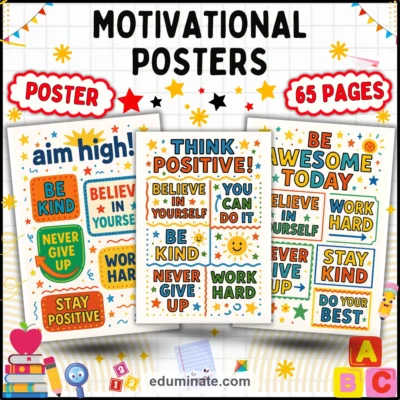
The Classroom Posters Bundle puts six poster and card sets in one download, covering shapes, alphabet and number, healthy habits and motivational posters plus affirmation cards. It is 297 pages at 30% off the separate prices. The Motivational Posters for Classroom set is 62 poster pages in bright lettering, with phrases like Believe in Yourself, Work Hard and Never Give Up.
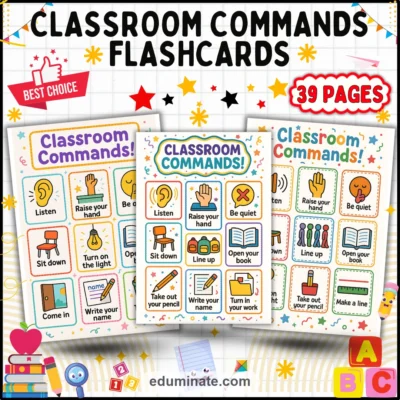
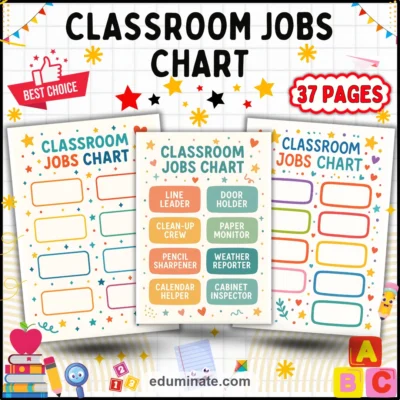
Directions are part of a smooth classroom too. The Classroom Commands Flashcards are 36 card pages with nine picture cards on each, covering directions like Listen, Line up and Open your book. For shared responsibility, the Jobs Chart for Classroom has 34 chart pages, 18 with job names printed and 16 with empty boxes you fill in yourself. The Classroom Charts Bundle puts four chart sets in one download, covering classroom jobs charts, a weather chart and a transportation chart, at 162 pages and 25% off the separate prices.
For a quiet activity that reinforces the rules, the Classroom Rules Coloring Pages set has 50 pages, and each page shows four rules like Listen, Be Kind and Raise Your Hand.
When a rules poster is not working
If students ignore the poster, look at the poster first. Check that the lettering is large enough, that the rules are few and that the wording is positive. A poster with ten rules in small print tells students nothing.
Next, look at how the rules are used. A rule that is never mentioned until someone breaks it feels like a trap. Mention the rules when things go well too: “Everyone listened while Amal was reading, and that is rule one in action.” Praise that names the rule helps students connect the words on the wall to what they just did.
Last, check that you apply the rules in the same way each day. Students notice quickly when a rule matters on Monday and not on Thursday.
Frequently asked questions
How many rules should a classroom have?
Four to six is a practical range. Fewer rules are easier to remember, and broad rules such as “Be kind” cover many situations at once.
Should students help write the rules?
It is a good idea. Students who help word the rules understand them better, and a signed poster gives them a reason to remember. You still decide the final list.
Where is the best place to hang a classroom rules poster?
Choose a spot every student can see from their seat, such as near the door or the front board. Keep the area around it clear.
Can the same poster work for different grade levels?
The idea works for any age, but the wording should change. Use a few short words for the youngest students and fuller sentences for older ones.
Related resources
- Classroom Posters Bundle: Shapes, Alphabet, Healthy Habits and Motivation
- Motivational Posters for Classroom: Growth Mindset Poster Pages
- Classroom Commands Flashcards: Printable Classroom Command Cards
- Jobs Chart for Classroom: Classroom Jobs Chart Printable
- Classroom Rules Coloring Pages: Classroom Management Activity
- Classroom Charts Bundle: Jobs, Weather and Transportation Charts