Morning Work for Kindergarten: Easy Ideas and Center Tasks
Morning work for kindergarten is a short, independent first task that children can start on their own while the teacher takes attendance and greets families. This page covers a simple morning routine, bins and ideas that need little prep, literacy and math center ideas, and quiet printables.
Morning work for kindergarten: what it is for
Morning work gives children a calm, predictable start. A child comes in, unpacks and sits down to a task that is familiar and small enough to finish. The task should not need the teacher’s help, so the teacher is free to talk with families and the class.
Choose tasks that children have seen before. A new activity belongs at a center or in a lesson first. Morning work should feel like something the child already knows how to do.
A simple morning routine
One way to organize the start of the day is the same five steps each morning. The table shows what the child and the teacher each do.
| Step | What the child does | What the teacher does |
|---|---|---|
| Arrive | Says hello and walks in | Greets each child and family |
| Unpack | Hangs up the coat and puts away the bag | Reminds and helps as needed |
| Choose a bin | Takes a bin or task and finds a spot | Takes attendance |
| Tidy | Puts the materials back where they belong | Gives a signal when time is nearly up |
| Meeting | Joins the group on the carpet | Begins the day’s first lesson |
Adapt the steps to your own school day. Nothing here is a fixed rule. A symbol card for each step (a coat hook, a bin, a chair), posted by the door, lets children check the order for themselves instead of asking. A short chime or a quiet hand signal can signal the move from tidying to the meeting.
Soft start classroom
A soft start classroom opens the day gently, with quiet choices instead of a rush to the first lesson. Children settle in at their own pace by picking something calm to do. Some children arrive tired, nervous or excited, and a gentle start gives them time to settle before the group begins. A short, fixed list of choices on a card or a shelf label keeps the start quiet, because children know what is available without asking.
Keep the list of choices short, and use choices children already know how to use. If a child needs a quieter place, a corner with soft seating can help. See our post on calm down corner ideas for how to set one up.
Morning bins and morning tubs
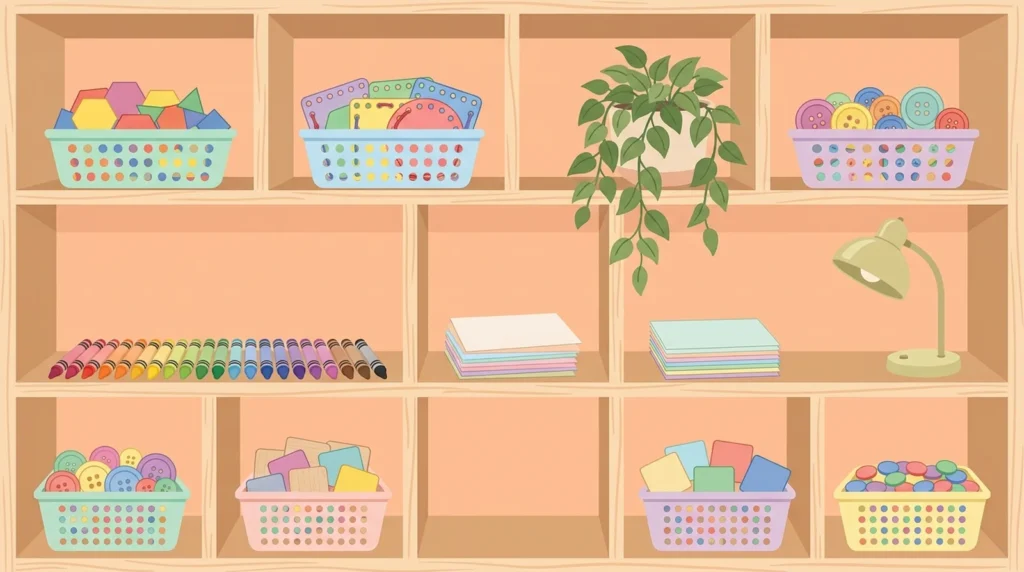
Morning bins hold a small set of materials for one task. Morning tubs are the same idea in a larger container. Either way, the bin is a tool the child can finish before the meeting starts, and it can be tidied up in one step.
Items that fit well in a bin include:
- play dough and a few simple tools
- puzzles with a small number of pieces
- pattern blocks and a pattern card
- lacing cards with laces
- magnetic letters on a tray
Rotate the bins by day of the week so each one comes back after a few days. Supervise small items such as beads and buttons, since they can be a choking hazard for younger children.
A sample week of bins shows how the rotation can look:
| Day | Bin | What is inside |
|---|---|---|
| Monday | Play dough | Dough, rolling pin, cookie cutters |
| Tuesday | Pattern blocks | Blocks and a pattern card |
| Wednesday | Lacing | Lacing cards and laces |
| Thursday | Letters | Magnetic letters and a tray |
| Friday | Puzzles | Two or three simple puzzles |
Morning work ideas
These morning work ideas need only a few materials. They also work as kindergarten morning work ideas for a substitute plan.
- Trace and write the child’s name. Provide a name card and a pencil. The child traces the letters first, then writes the name again underneath without the model.
- Count and clip clothespins to a card. Draw dots on a card, and the child clips one clothespin to each dot while counting aloud. Squeezing a clothespin is also fine motor work.
- Sort buttons by color. A tray with a few cups for sorting works well. Supervise the buttons, and keep the amount small.
- Build a short word with letter tiles. Put a word card beside the tiles for the child to copy.
- Color a page. A coloring page is a calm choice. The child picks colors and works at a comfortable pace, and the page can go in a folder when time is up.
Literacy centers kindergarten
In literacy centers for kindergarten, children can work on word building, letter matching and short reading tasks.
- Word building: children arrange letter tiles to make a word from a card.
- Matching letters: children match uppercase and lowercase letters on cards.
- Reading a short decodable story: children read a page or two aloud to a partner.
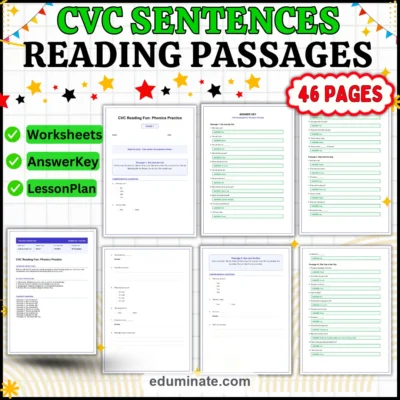
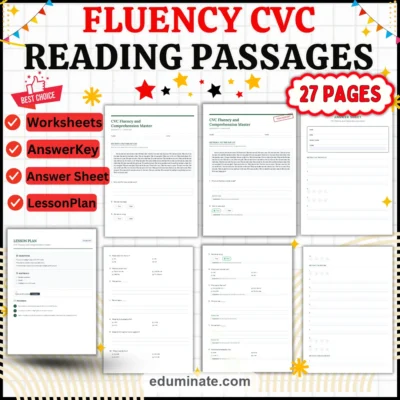
For the reading center, reading simple CVC sentences has ten decodable stories with comprehension questions across thirty-one worksheet pages, a lesson plan and fourteen pages of answer keys, for kindergarten to grade 1. The kindergarten CVC reading fluency passages has five targeted short vowel stories with multiple choice, true or false and fill in the blank questions, for kindergarten to grade 1.
Math centers kindergarten
Math centers in kindergarten can start with counting and number work:
- Counting objects: children count a handful of items and say how many.
- Number tracing: children trace and write digits.
- Pattern blocks: children copy or extend a pattern of colors and shapes.
- Sorting: children sort objects by color, size or shape.
For counting practice, counting numbers 1-10 has 19 student worksheets, a lesson plan and teacher keys, and children practice counting items, writing digits and comparing quantities from 1 to 10, for preschool to kindergarten.
Kindergarten center ideas
When you are planning kindergarten centers, a short rotation of four is easy to manage. These center ideas show one possible set:
- Literacy: letter tiles and word cards.
- Math: counters and a number card.
- Fine motor: play dough, tongs and lacing.
- Quiet choice: books or a coloring page.
To keep a rotation running smoothly, give each group a color or a table and a card that shows which center comes next. Children can move on a signal and leave the materials ready for the next group. Mix the centers to suit your class. Four is only a starting point, and the number can be smaller or larger depending on how many children you have.
Quiet fine motor and coloring options
Coloring and fine motor work are calm options for any part of the morning. Our post on fine motor activities has more ideas, and for children who finish early, see the early finishers activities.
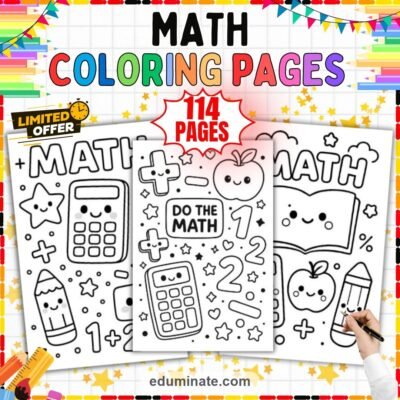
- Kindergarten math coloring pages: 114 pages that combine number tracing, counting practice and art, for preschool to grade 1.
- Math coloring pages: 40 pages with cheerful calculators, smiling rulers, pencils and number blocks, for preschool to grade 2.
- Cute crayon coloring pages: 30 pages with 26 kawaii crayon designs, described as fine motor practice, for Pre-K to grade 2.
Our post on math coloring pages for kindergarten has more ideas for using them.
Setting expectations
Teach the routine in the first weeks of school. Model each step yourself, then practice it together as a class. Let a child demonstrate how to take a bin and put it away, and let the class watch. When children follow the routine, tell them what they did well: “You put every piece back in the bin.”
Review the routine again after a long weekend or a break. A quick practice round on the first morning back is enough.
If a child has trouble with a task, make it smaller instead of taking it away. Give fewer pieces, a simpler card or a partner to start with. The goal is for every child to finish something each morning.
Practice material
The printable sets named above can sit beside the bins as one more choice. Each page lists a grade range, so you can match the set to your class.
| Set | Where it fits | Listed grades |
|---|---|---|
| Counting numbers 1-10 | Math center | Preschool to K |
| Kindergarten math coloring pages | Quiet choice, math center | Preschool to grade 1 |
| Math coloring pages (40 pages) | Quiet choice | Preschool to grade 2 |
| Cute crayon coloring pages | Fine motor, quiet choice | Pre-K to grade 2 |
| Reading simple CVC sentences | Literacy center | K to grade 1 |
| Kindergarten CVC reading fluency passages | Literacy center | K to grade 1 |
Frequently asked questions
How long should morning work take?
It depends on your schedule. Pick tasks that most children can finish in the time you have before the first lesson, and have a simple extra choice ready for those who finish early.
What if a child finishes early?
Keep a short list of quiet extras, such as a book, a coloring page or a puzzle. Our post on early finishers activities has more.
Do I need printables?
No. Bins with play dough, blocks, counters and lacing cards work well without any printing. Printables are one more option for a quiet choice.
What grade is morning work for?
Schools differ. For reference, the printable sets above are listed for preschool to kindergarten, kindergarten to grade 1, and preschool to grade 2.
Related resources
- Counting Numbers 1-10, Early Math Activities Set, 77 Pages Resource Packet
- Kindergarten Math Coloring Pages, Numbers Art Activity Sheets Pack for Kids
- Reading Simple CVC Sentences Worksheets for Kindergarten and 1st Grade Class
- Kindergarten CVC Worksheets, Reading Passages with Questions and Answer Key
- Cute Crayon Coloring Pages, Fine Motor Art Activity Sheets for Kids
- Math Coloring Pages, Cute Elementary Activities, 40 Printable Worksheets Sheets