Decodable Books and Readers: What They Are and How to Use

Decodable books are books whose words follow the phonics patterns a child has already been taught, plus a few common words the child learns to read by heart. This page explains what decodable text is, how it differs from leveled books, and how to use a decodable reader in kindergarten and grade 1.
Decodable books
A child can sound out most of the words in a decodable book. That is the whole idea. When a child knows the sounds for the letters s, a, t, m and p, a decodable page can use only words built from those sounds, such as sat, mat and tap. The child reads by blending the sounds, not by guessing from a picture.
Decodable text is written to match what the child has learned so far. As new patterns are taught, the books can use them.
What is a decodable book
What is a decodable book in practice? It is a short book in which most words use taught patterns. A page might read: Sam sat at the mat. Sam sat. Every word except the uses only the letters s, a, t and m, which a beginning reader may have been taught. The word the is called a heart word, because it does not follow the usual sound pattern and is learned separately.
Decodable text examples
These decodable text examples were written for this article. Think of a child who knows the short a sound and the heart words the and a.
- Decodable: Dan had a map and a bag. Every word uses short a or a heart word, or is a name that follows the pattern.
- Decodable: Sam and Dan had a nap. The same pattern.
- Not decodable yet: The cat chased a mouse. The word chased has an ed ending and a silent-e pattern that has not been taught, and mouse uses a vowel pair the child may not know.
Decodable readers
Decodable readers are small books or sets of short stories written to follow a sequence. The sequence usually starts with simple patterns, such as a few letters and short vowels, and moves toward longer words and more complex patterns. Different programs order the patterns differently, so follow the order your school uses.
Decodable readers are sometimes called phonics readers. Some are sold as sets of printed books. Others are printable stories, so a teacher can choose the pages that match what the class has learned.
Decodable vs leveled books
Decodable and leveled books are built differently.
| Decodable books | Leveled books | |
|---|---|---|
| What controls the text | The phonics patterns taught so far | Features like sentence length, repeated phrases and picture support |
| How the child reads | By sounding out and blending words | By using several kinds of clues |
| Typical use | Practice with taught patterns | Reading a range of simple texts |
Neither kind is better in every situation. A teacher chooses based on what a child needs next.
One practical difference: a leveled book may include words the child cannot yet sound out, which is why picture clues and repeated phrases are part of its design. A decodable book keeps the words inside the taught patterns, so the picture is not needed to work out the text. A beginning reader may be given both in the same week, one for sounding out and one for enjoying together.
Decodable books for kindergarten
Decodable books for kindergarten can be very short, with only a few words on each page. A first reader might have one short sentence per page. Decodable stories for kindergarten grow a little as the year goes on, adding more sentences and new patterns.
For early readers and beginning readers, a decodable page gives practice with the sounds taught so far, at a length that is easy to finish.
Choosing a decodable reader
To choose a decodable reader, compare the book with what the child has been taught. Look through the pages and ask whether the sounds and patterns in the words have all been covered in class. If a page has a pattern the child has not met, pick a different book or save that one for later. Short books with plenty of repetition are a good place to start.
How to use a decodable reader
Here is one routine for using a decodable reader.
- Warm up with the sounds. Say the letter sounds that appear in the book.
- Point under each word. A finger or a pointer helps the eyes move left to right.
- Blend. The child sounds out each word and then says it whole.
- Reread. A second and third reading gives the child more turns with the same words.
- Ask one question. Ask what happened, or who the story is about.
If the child gets stuck on a word, ask them to look at each letter and say the sounds again. For a heart word, simply tell the word and move on, since stopping for a long time breaks the flow of the sentence.
Rereading is one of the simplest reading fluency strategies, and phonics readers suit it because the text is short enough to repeat. Our post on reading comprehension strategies adds ways to talk about meaning once children can read the words.
Decodable words and sentences
A word is decodable for a particular child when that child has been taught the sounds and patterns in it. The word ship is not decodable for a child who has not learned the sh sound, but it is decodable once they have.
That is why decodable sentences need a few heart words, such as the and was. Heart words have a tricky part that does not follow the sounds. Teachers either have children read them by sight or point out which letters work in the usual way and which do not.
Teachers and parents can also write their own decodable sentences. Start from the sounds the child knows. A child who knows short a and short i could read: Sam and Tim sat in a big bin. Every word uses only those two vowels, except a, which is a heart word.
Simple activities with a decodable story
First read, second read, third read
On the first read, the child focuses on sounding out each word. On the second, the child tries to read in phrases. On the third, the child reads the whole story smoothly.
Find the word
Say a word from the story and ask the child to find it on the page. The child has to look closely at the letters in each word.
Draw a picture on paper
After reading, the child draws one object or place from the story. This is a simple classroom idea.
Retell in one sentence
Ask the child to tell what happened in one sentence. For children who need support, offer a sentence starter, such as First, ___. Our early finishers activities can fill any extra time.
Practice material
These printable story sets are built around decodable stories, as described on each product page. Each comes with answer keys.
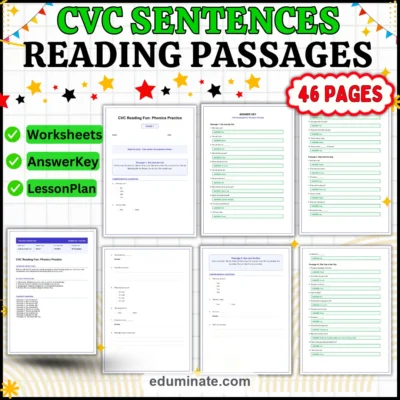
- CVC reading passages: five short vowel decodable stories, ten questions per section, bubble answer sheets and a ninety minute lesson plan, for kindergarten to grade 1.
- CVC stories reading comprehension: ten decodable stories, forty student worksheet pages with varied text dependent questions, a lesson plan and seventeen pages of answer keys, for kindergarten to grade 1.
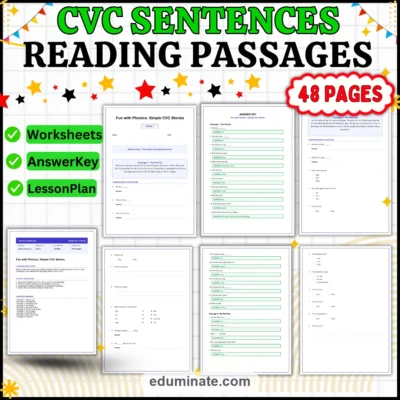
- Reading simple CVC sentences: ten decodable stories, with comprehension questions across thirty-one worksheet pages, a lesson plan and fourteen pages of answer keys, for kindergarten to grade 1.
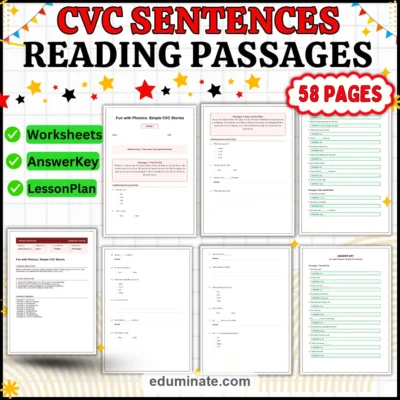
- CVC sentences reading comprehension: ten decodable stories, thirty-one student worksheet pages and sixteen pages of answer keys, for kindergarten to grade 1.
- Short vowel CVC reading passages: ten decodable phonics stories with comprehension questions across thirty-one worksheet pages and twenty pages of answer keys, for kindergarten to grade 1.
- Decodable CVC reading passages: ten short vowel adventure stories with 150 comprehension questions across thirty student worksheet pages, for grades 1 to 3.
A seventh set, the kindergarten CVC reading fluency passages, has five targeted short vowel stories with multiple choice, true or false and fill in the blank questions, for kindergarten to grade 1.
Frequently asked questions
Are decodable books only for kindergarten?
No. They fit any reader who is still learning phonics patterns. Our decodable sets are listed from kindergarten up to grade 3.
Do decodable books replace other reading?
No. Children should also hear a wide range of books read aloud and read other kinds of text. Decodable books are one part of a child’s reading.
How long should a child read a day?
Keep it short enough that the child stays comfortable. A few minutes with one book, reread a couple of times, is a good place to start. Let the child set the pace.
What grade uses decodable books?
Schools differ, so check your curriculum. For reference, our decodable story sets are listed for kindergarten to grade 1, and one set for grades 1 to 3.
Related resources
- CVC Reading Passages Worksheets for Kindergarten and First Grade Phonics Set
- CVC Stories Reading Comprehension Passages for Kindergarten and Grade 1 Set
- Reading Simple CVC Sentences Worksheets for Kindergarten and 1st Grade Class
- CVC Sentences Kindergarten, Reading Passages, Questions and Answer Key Grade 1
- Short Vowel Worksheets, CVC Words Reading Passages and Questions 1st Grade
- Kindergarten CVC Worksheets, Reading Passages with Questions and Answer Key
- Decodable Passages, Decodable CVC Printable Pages, Questions and Answer Key