CVC Words: What They Are, Examples and How to Teach Them
CVC words are short words made of a consonant, a vowel and another consonant, like cat, sun and pig. They are usually the first words children learn to sound out. This guide explains what CVC words are, gives a CVC words list for each short vowel and shows how to teach blending and segmenting step by step. It closes with word families, games and the move from single words to sentences and short stories.
What are CVC words
The letters stand for the pattern: Consonant, Vowel, Consonant. A CVC word has three sounds, and the vowel in the middle makes its short sound.
Five CVC words examples: cat, dog, sun, bed, pig. Say each one slowly. You hear three separate sounds: /c/ /a/ /t/.
The letters w, x and y can be tricky at the end of a word. The word box ends in two sounds (/k/ and /s/), and words like cow and toy have vowel sounds that are not short. The lists below skip those words so every example is a plain three-sound word.
CVC words list by short vowel
Here is a CVC words list sorted by the middle sound. Each word has three letters and three sounds.
| Short vowel | Words |
|---|---|
| Short a | cat, hat, mat, bag, map, pan, cap, bat, jam, tap |
| Short e | bed, pen, net, hen, red, leg, peg, ten, jet, wet |
| Short i | sit, pig, pin, lip, big, dig, win, kid, fin, zip |
| Short o | hot, dog, pot, mop, log, top, fog, hop, job, nod |
| Short u | cup, sun, bug, mud, rug, hug, nut, bus, jug, run |
Short a
Words such as cat, map and jam are a common starting point because the /a/ sound is easy to hear.
Short e
Short e words like bed, pen and ten are often mixed up with short i, so say them side by side (pen and pin).
Short i
Short i words include sit, pig and zip. Keep the sound short: /i/, not the long sound in ice.
Short o
Short o words include hot, mop and log. The vowel sound can vary slightly between accents, so go by how you say the word.
Short u
Short u words include cup, sun and bug. The /u/ is a quick, relaxed sound.
Short vowel sounds
Every CVC word has one vowel, and that vowel makes its short sound. A key word for each vowel keeps the sounds easy to remember:
- a as in cat
- e as in bed
- i as in sit
- o as in hot
- u as in cup
The middle sound is the part to listen for. The first and last consonant sounds are usually easier to hear, so a child may know c_t but not yet know whether the word is cat, cut or cot. Practicing short vowel sounds one at a time, with a key word each, gives that middle sound a clear label.
Once a few vowels are familiar, try a row of words that change only the vowel. Read pan, pen, pin, pun, then cat, cot, cut, and then bag, big, bug. The child hears that the middle sound alone turns one word into another.
CVC words for kindergarten
Children are ready to start CVC words once they know the letter sounds for a few consonants and at least one vowel. A child does not need to know all 26 letters first. One approach is to begin with a small set of letters, such as s, a, t, p, i and n, and make words from only those letters.
A simple order of vowels is to start with short a, then add short i, short o, short u and short e. Some programs use a different order, so follow the one your school uses.
Age and grade expectations vary. For reference, the CVC reading packs listed below are labelled kindergarten to grade 1, and one decodable set is listed for grades 1 to 3. Searches such as cvc words kindergarten or cvc words for kindergarten turn up many lists, but go by what your own learner can already do.
How to teach CVC words
Blending CVC words and segmenting go together. Blending puts sounds together to read a word. Segmenting breaks a word apart to spell it. The routine below is simple and short.
Sound out each letter
Point to each letter and say its sound: /s/ /u/ /n/. Hold the sounds for a moment so they do not chop apart.
Blend the sounds
Slide the sounds together faster: /sss/ /uuu/ /nnn/ … sun. A finger can slide under the word from left to right to show the order. Repeat with a few words that share the same vowel, then end the session with words the child already reads easily.
Segment: say the word and tap the sounds
Say the word, such as mop. Tap three fingers on the table, one for each sound: /m/ /o/ /p/. Then write the letters. This is the reverse of blending and it is how spelling begins.
Build and swap one letter at a time
Use letter tiles to build cat. Change the last letter to make cap. Change the vowel to make cup. Each swap changes one sound, and the child watches the word change with it.
CVC word families
CVC word families are groups of words that share the same ending, so only the first letter changes. Once a child can read -at, they can read the whole family faster.
| Family | Words |
|---|---|
| -at | cat, hat, mat, sat |
| -an | can, fan, man, pan |
| -ig | big, dig, pig, wig |
| -op | hop, mop, top, pop |
| -ug | bug, hug, mug, rug |
Families make blending easier because the child only has to work out one new sound each time. Keep them to real words and read each one aloud.
CVC games and activities
Short, hands-on CVC games and CVC words activities suit young learners better than long drills. These six need little prep. They also work as cvc words games for a literacy center.
- Sound box with counters: draw three boxes. Say a word and push one counter into each box for each sound.
- Word sort by vowel: give a stack of word cards and five headings (a, e, i, o, u). The child sorts each word under its middle sound.
- Flip and read cards: cut cards in half so the first letter and the ending are separate. Flip and match to make words, then read them.
- Missing letter: write a word with the vowel left out (c_t). The child chooses the vowel and reads the word.
- Silly sentences with real words: the child reads The pig has a hat. The words are real even if the sentence is funny.
- Bingo: call out a word and have players cover it on their card. Use one vowel per round at first.
If a child is also working on handwriting for these words, our fine motor activities are a good warm-up, and the early finishers activities post has quiet ideas for children who finish early.
From CVC words to sentences and stories
Reading single words is only the first step. The next step is connected text: a sentence made of words they can sound out, then a short story. A decodable sentence or story uses only the sounds the child has already been taught, so they can read it without guessing.
Some of our printable packs are built this way:
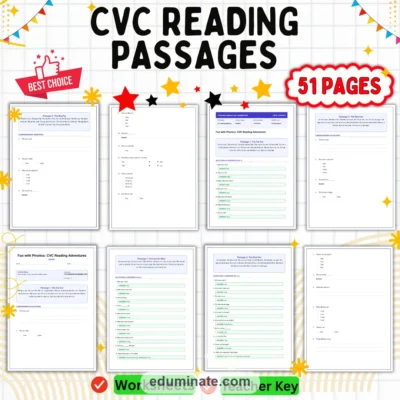
- CVC reading passages for kindergarten and first grade has five short vowel decodable stories, ten questions per section, bubble answer sheets and a ninety minute lesson plan.
- CVC stories reading comprehension has ten decodable stories and forty student worksheet pages with varied text dependent questions.
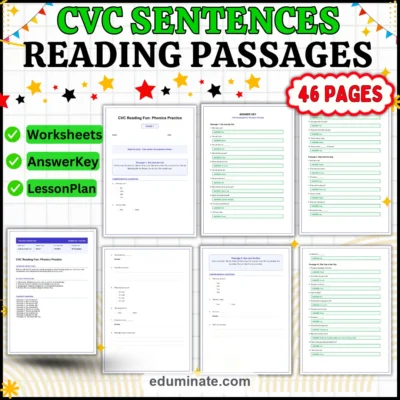
- Reading simple CVC sentences has ten decodable stories and structured comprehension questions across thirty-one worksheet pages.
- CVC sentences reading comprehension has ten decodable stories, thirty-one student worksheet pages and sixteen pages of answer keys.
Each one lists a lesson plan or teacher answer keys. Once children decode well, the focus can shift to comprehension. See our post on reading comprehension strategies for ideas.
Practice material
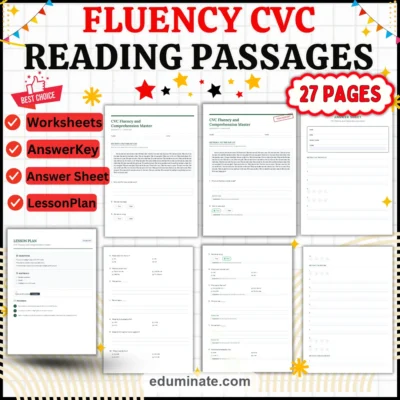
For more short vowel practice, short vowel CVC reading passages has ten decodable phonics stories with comprehension questions across thirty-one worksheet pages and twenty pages of answer keys, for kindergarten to grade 1. A smaller set, the kindergarten CVC reading fluency passages, has five targeted short vowel stories with multiple choice, true or false and fill in the blank questions; it is in the list below.
For the next step, decodable CVC passages are listed for grades 1 to 3 and include ten short vowel adventure stories with 150 comprehension questions.
Frequently asked questions
What comes after CVC words?
Words with blends and digraphs. A blend is two consonant sounds together, like the st in stop. A digraph is two letters that make one sound, like the sh in ship. Both build on the same blending routine.
Are CVC words the same as sight words?
No. CVC words can be sounded out letter by letter. Sight words are words children learn to recognize quickly, and many of them (like the or was) do not follow regular sound patterns. Children need both.
How many words should a child practice at one time?
Keep it small and comfortable. A handful of words with the same vowel is plenty for one short session. Add more when the child reads those words smoothly.
What grade learns CVC words?
Schools differ, so check your curriculum. For reference, our CVC reading packs are listed for kindergarten to grade 1, and the decodable set is listed for grades 1 to 3.
Related resources
- CVC Reading Passages Worksheets for Kindergarten and First Grade Phonics Set
- Kindergarten CVC Worksheets, Reading Passages with Questions and Answer Key
- Short Vowel Worksheets, CVC Words Reading Passages and Questions 1st Grade
- Reading Simple CVC Sentences Worksheets for Kindergarten and 1st Grade Class
- CVC Sentences Kindergarten, Reading Passages, Questions and Answer Key Grade 1
- CVC Stories Reading Comprehension Passages for Kindergarten and Grade 1 Set
- Decodable Passages, Decodable CVC Printable Pages, Questions and Answer Key