Short I Words: CVC Lists, Blends and 2 Syllable Words

Short i words are words in which the letter i makes the vowel sound in “sit”, written /i/. This guide has short i words listed by word family, blends and syllables, with sentences, a comparison with long i and activities to try with a child or a class.
Short i words
The short i sound is the vowel in “sit”, “pin” and “lip”. It is a quick, light sound made with the tongue high in the mouth and the lips relaxed. Many children say it too long at first, so remind them to keep it short and snappy, not the long sound in “ice”.
Like the other short vowels, short i is easiest to read in a CVC word. One vowel sits between two consonants, and the vowel says its short sound. The short a words post introduces all five short vowels in one chart, and the short e words post covers the vowel that sounds closest to this one.
Short i CVC words
CVC stands for consonant, vowel, consonant. Short i CVC words are plentiful, and they fall into tidy families. If the pattern is new to you, the CVC words guide walks through it.
- -ig: pig, big, dig, wig, fig
- -ip: lip, zip, sip, tip, dip, rip, hip
- -it: sit, bit, fit, hit, kit, pit
- -in: pin, bin, fin, win, tin
- -id: kid, lid, did, hid, rid
- -im: him, rim, dim
- -ix: six, fix, mix
To practice a family, say the ending first, then add the starting sound. For the -ip family, children say /ip/ and then add /l/, /z/, /s/ and /t/ to hear “lip”, “zip”, “sip” and “tip”. Seeing that the ending stays still while the first sound moves is what makes word families so useful.
Short i words for kindergarten
For a first lesson, pick one family and a handful of words. These short i words for kindergarten make a good starting set:
- sit, pin, lip, big, dig, kid, zip, bin
- fit, tip, did, lid, win, fin, mix, six
Read them as a list, then mix the order so the child must look at each word and cannot just guess. After that, the same words can go into sentences and short stories. Pre-K and kindergarten readers can use the CVC word lists pack, a six-page set of sixty decodable words in PDF and PowerPoint formats, and a short text from the decodable books guide will give them something real to read once the words are secure.
Short i words with blends and digraphs
A blend keeps each consonant sound audible, like “sl” in “slip”. A digraph is two letters that make one sound, like “sh” in “ship”. In each word below, the vowel is still short i, so these short i words with blends are the natural next step after the CVC lists.
- Beginning blends: skip, slip, trip, drip, flip, grip, grin, skin, spin, twin, swim, trim, slim, skim, twig, split, print, sprint
- Ending blends: list, mist, fist, lift, gift, drift, mint, hint, limp, chimp, milk, film, silk
- Digraphs: ship, chip, chin, thin, thick, this, with, fish, dish, wish, chick, quick, stick, brick, click
- Double-letter endings: hill, mill, fill, bill, will, still, spill, drill, grill, skill, chill, thrill
The ending -ick deserves a note. The letters “ck” make one sound, /k/, so “stick” has four sounds: /s/ /t/ /i/ /k/. Children can read it as the -ick family, the same way they read -ip or -it.
2 syllable short i words
To read a longer word, split it into syllables. In each 2 syllable short i word below, the first syllable is a closed syllable, so its vowel is short. In several words the second syllable is short as well. Try dividing the word between the two consonants in the middle.
- Compound words: zigzag, windmill, hilltop, dishpan, chipmunk, insect
- Everyday words: picnic, kitten, mitten, dinner, sister, visit, limit, ticket, hidden, kitchen, chicken, skillet, lizard
Show the split on paper: pic-nic, kit-ten, mit-ten, din-ner, sis-ter. Then read each part and put the parts together. With “windmill” and “hilltop”, the child already knows both halves, which makes them a gentle place to begin. For a fuller explanation of closed syllables, see the closed syllable section in the short a words post.
Short i sound words
Short i sound words are all the words with the /i/ sound, whatever the spelling. Most use the letter i, but not all:
- y: gym, myth, system
- u: busy
- ui: build, guilt
- e: pretty
These are not simple CVC words, so teach them one at a time after the basic lists.
The reverse problem also happens. Some words have one i and end in a consonant, but the vowel is long: “kind”, “find”, “mind”, “wild” and “child”. They do not belong in a short i list, and children need to meet them as a separate group. The word “wind” is a special case: the wind that blows has a short i, while to wind a ball of yarn has a long i.
The sound is also nudged a little in endings like -ing and -ink, as in “ring”, “king”, “wing”, “pink” and “sink”. These are fine to leave for a later lesson, once the plain CVC words are easy.
A simple order for teaching short i
One way to plan the first lessons is to move from the easiest words to the hardest, adding one new thing at a time:
- Three-letter words from one family, such as -ip or -in.
- Three-letter words from two or three families, mixed together.
- Words with an ending blend or the -ck ending, such as list, mist and lift.
- Words with a beginning blend or a digraph, such as ship, skip and swim.
- Two-syllable words.
- Short sentences and then short stories.
If a child stumbles at any step, go back one step and stay there for a few days. A step that feels easy is the signal to move on. Short, frequent practice with a few words works better than one long session with many.
Spelling short i words
Reading and spelling use the same skill in opposite directions. To spell a short i word, the child says the word slowly, counts the sounds on their fingers and writes one letter for each sound. Dictate three or four words from one family, then a few mixed words, and check each one together. For words like chick, ship and stick, remind the child that two letters can share one sound.
Short i words in sentences
Each sentence below puts short i words to work. The words with the short i sound are in bold, and the remaining words are simple ones that children learn separately.
- Tim did a big skip.
- The kid will fix the lid on the bin.
- The ship is big and quick.
- Bill will fill the jug with milk.
- The kitten hid in the big bin.
- Jill will pick up the list.
- A chick sat on a twig.
Have the child read each sentence aloud, then tell you something about it in their own words. If a word trips them up, tap out the sounds with a finger, one tap for each sound, and blend them together again.
Short i vs long i
Adding a silent e to a short i word often changes the vowel to long i, the sound that says the name of the letter. Pairs make the difference easy to hear:
- hid and hide
- kit and kite
- pin and pine
- bit and bite
- rip and ripe
- fin and fine
- dim and dime
- slid and slide
Read the short word, add the e, and read it again. Ask the child what changed in the sound, and what changed in the word. This short i vs long i comparison also shows why the closed syllable is called closed: the consonant after the vowel shuts it in and keeps it short.
The reverse comparison is short e vs short i, covered in the short e words guide, where pairs like pen and pin and bet and bit are laid out.
Short i activities
Keep each short i activity brief and read every word aloud.
Word family houses
Write an ending like -ip on a sheet of paper. The child adds a first letter or blend to make words and writes them in a list underneath. Check each one by reading it back.
Change one letter
Begin with “sit” and change one sound at a time: “sit”, “sip”, “tip”, “tin”, “pin”, “pit”. The child writes each new word and reads the whole chain at the end.
Sound boxes
Draw a box for each sound in a word, then push a counter into each box as you say the sounds. For “ship”, draw three boxes, because “sh” is one sound: /sh/ /i/ /p/. For “stick” draw four.
Sort by vowel
Mix cards with short i words and short e words. The child sorts them into two piles and reads each pile aloud. The pairs listed above make good cards because they differ by only one letter.
Practice material
For reading practice beyond word lists, these printable sets use decodable stories and short vowel words:
- Short Vowel Worksheets for Kindergarten to 1st grade: ten decodable phonics stories with questions across thirty-one worksheet pages, and twenty pages of teacher answer keys.
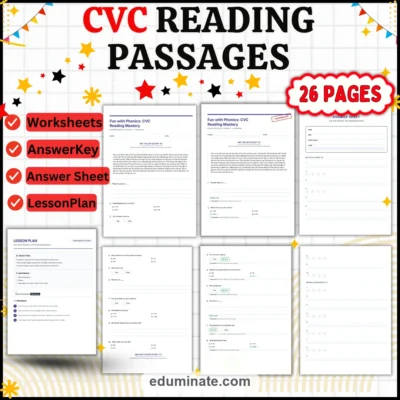
- CVC Reading Passages for Kindergarten to 1st grade: five short vowel decodable stories, ten questions per section, bubble answer sheets, a lesson plan and answer keys.
- CVC Stories for Kindergarten to 1st grade: ten decodable stories, forty student worksheet pages, a lesson plan and seventeen pages of answer keys.
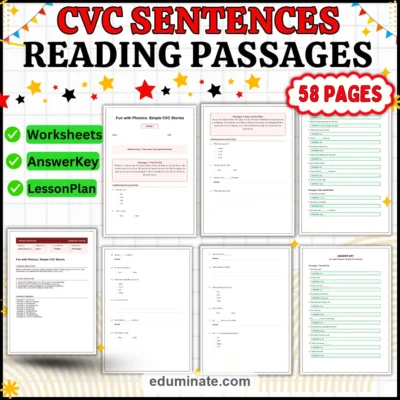
- CVC Sentences for Kindergarten to 1st grade: ten decodable stories, thirty-one student worksheet pages, a lesson plan and sixteen pages of answer keys.
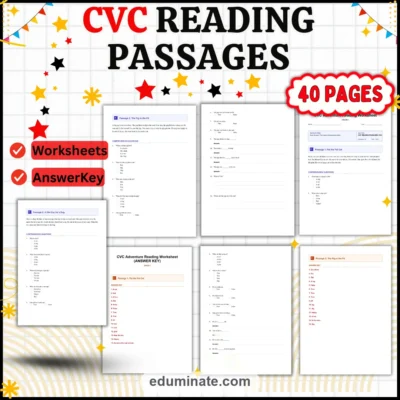
- Decodable CVC Passages for 1st to 3rd grade: ten short vowel adventure stories with 150 comprehension questions across thirty student pages.
The matching lists for the other vowels are here: short a, short e, short o and short u.
Frequently asked questions
What are short i words?
Short i words have the vowel sound in “sit”. Most are spelled with the letter i, like “pin”, “lip” and “stick”, but a few use y, u or ui, as in “gym”, “busy” and “build”.
Is “pig” a short i word?
Yes. “Pig” is a CVC word with the short i sound and belongs to the -ig family with “big”, “dig” and “wig”.
Why is “child” not a short i word?
The i in “child” is long, even though a single i is followed by consonants. A few endings, such as -ild, -ind and -ight, change the vowel, and children learn them as separate patterns.
What grade learns short i words?
The printable sets above are made for Kindergarten to 1st grade, and the decodable passages for 1st to 3rd grade.
Related resources
- Short Vowel Worksheets: CVC Words Reading Passages and Questions
- CVC Reading Passages Worksheets for Kindergarten and First Grade
- CVC Stories Reading Comprehension Passages for Kindergarten and Grade 1
- Decodable Passages: Decodable CVC Printable Pages
- CVC Sentences Kindergarten: Reading Passages and Questions
- CVC Word Lists: Winter Phonics Worksheets