
12 Low-Prep Teaching Ideas for Teachers Using Printables

Most teachers already have a stack of printables. The problem is rarely finding more pages. It is that handing out a worksheet the same way every day gets dull for everyone, and planning something new takes time you do not have.
These are teaching ideas for teachers who have more worksheets than planning time. Each one takes an ordinary worksheet and changes how students use it. None of them need special materials beyond scissors, tape, sticky notes or sheet protectors, and most take less than ten minutes to set up. They work across subjects and grades, with small changes for younger or older students.
Before you start: habits that cut prep time
- Print in batches. Once a week, print everything for the next week and sort it into labeled folders by day.
- Keep a master copy. Store one clean copy of each page in a sheet protector in a binder by subject. When you need it again, it is ready to copy.
- Save answer keys with the page. Put the key behind the master copy so it never goes missing.
12 low-prep teaching ideas using printables
1. Reusable dry-erase pages
Slide a worksheet into a sheet protector and give students dry-erase markers. They solve, you check, they wipe and try the next one. This works well for math facts, spelling patterns, tracing for younger students and any page you want to repeat.
Prep: one copy per student or pair, sheet protectors, markers and a tissue or sock for erasing. After the first time, prep is zero.
2. Cut-and-sort
Cut a worksheet into strips or cards and have students sort them into groups. Sentences can be sorted by verb tense, words by part of speech, numbers by odd and even, animals by habitat. Sorting makes students think about why each item belongs where it does.
Prep: one copy per group, cut into pieces. Older students can do the cutting themselves.
3. Gallery walk
Tape six to eight different problems or short passages around the room. Students move in pairs with a clipboard, solve each one and write their answer. At the end, review the answers together, spending time on the ones most pairs found hard.
Prep: cut one worksheet into separate problems and tape them up. Give each pair a numbered answer sheet.
4. Find the mistakes
Fill in a worksheet yourself and make three or four deliberate errors. Students act as the teacher: they find the mistakes, mark them and explain the fix. Hearing a student explain why an answer is wrong tells you a lot about how well they know the rule.
Prep: five minutes to fill in one copy, then photocopy it.
5. One-problem exit ticket
Instead of assigning the whole page, choose the one problem that best shows whether students understood today’s lesson. Cut the page into slips with only that problem. Students answer it on their way out, and you sort the slips into “got it” and “needs another look” for tomorrow’s groups.
Prep: a few copies cut into slips.
6. Partner check
Students complete the first half of a page alone. Then they swap with a partner and check each other’s work using an answer key. Where they disagree, they talk it out and only then check the key. Having to answer a classmate’s “why?” makes students put their reasoning into words.
Prep: a few copies of the answer key, one per table.
7. Color-by-code review
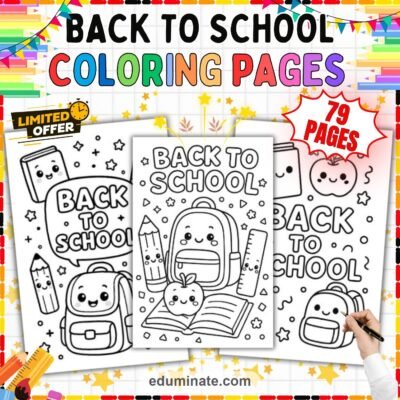
Color-by-code pages turn a set of practice problems into a picture. The answer to each problem tells the student which color to use. A wrong answer shows up as a color in the wrong place, so students can catch their own mistakes. These are a good fit for review days and the last lesson before a break. We wrote more about this in our article on using coloring worksheets in class.
Prep: print, provide crayons or colored pencils.
8. Scavenger hunt
Hide numbered problems around the room, in the hallway or on the playground. Each answer leads to the next location, or students simply find and solve all of them. This works well for review and gets students moving in the afternoon.
Prep: cut one page into problems and place them before class. Five minutes.
9. Station rotation
Set up three or four tables, each with a different short activity on the same topic. Groups rotate every 8 to 10 minutes. One station can be with you for small-group teaching, while the others use worksheets students can complete without help.
Prep: one page per station, copies for each group, and a timer.
10. Students write the questions
After finishing a worksheet, students write one new question in the same style and swap it with a classmate. Writing a good question takes real understanding of the skill. Collect the best ones for the next day’s warm-up.
Prep: none beyond the worksheet itself.
11. Beat your own score
For skills that need fluency, like math facts or sight words, use the same page several days in a row. Students time themselves or count how many they finish correctly in two minutes and try to beat their own number from yesterday. The competition is only with themselves, which keeps it low-stress.
Prep: one page per student per day, or one page in a sheet protector for the whole week.
12. Early finisher folders
Give each student a folder with a few extra pages: a puzzle, a coloring page, a challenge problem and a writing prompt. When they finish early, they work from the folder without asking what to do next. Refresh the folders once a month.
Prep: about 30 minutes once a month for the whole class.
Choosing the right idea for the moment
Each idea fits some situations better than others. A quick guide:
- Introducing a new skill: dry-erase pages or partner check, so students get quick feedback.
- Practice after a lesson: cut-and-sort, find the mistakes, students write the questions.
- Checking understanding: one-problem exit ticket.
- Review before a test: gallery walk, scavenger hunt, color-by-code, station rotation.
- Building fluency: beat your own score.
- Managing different paces: early finisher folders.
Adapting for different grades
Kindergarten and first grade: keep everything shorter and more physical. Sorting with picture cards, dry-erase tracing and coloring work well. Gallery walks work if each stop has one picture and one question.
Second and third grade: almost every idea above works as written. Scavenger hunts and finding mistakes tend to go over well at this age.
Fourth and fifth grade: push the thinking further. Ask students to explain errors in writing, write harder versions of questions and lead a station themselves.
Where to find printables to start with
Any worksheet you already own will work with these ideas. If you are building a set for the year, our shop has printable worksheets, coloring pages and activity packs you can filter by grade, and bundles group related packs together.
Frequently asked questions
What does “low-prep” mean in practice?
Here it means ten minutes or less of preparation on the day, using materials most classrooms already have: a printer, scissors, tape, sticky notes and sheet protectors. Some ideas, like early finisher folders, take a bit longer once but then run for weeks.
Do these ideas work with any worksheet?
Most do. Worksheets with separate, short problems work best for cutting into pieces, gallery walks and scavenger hunts. Pages with one long passage suit partner check and find the mistakes.
How do I stop activities like scavenger hunts from getting too noisy?
Set clear rules before you start: work in pairs, walk, use quiet voices and return to your seat when finished. Give a time limit and a signal for stopping. Practicing the routine once on an easy topic helps the next time go smoothly.
Can I use these ideas at home or in homeschooling?
Yes. Dry-erase pages, find the mistakes, beat your own score and scavenger hunts all work well with one or two children. A scavenger hunt around the house is often a favorite.