
Printable Coloring Worksheets: Ideas for Class and Home
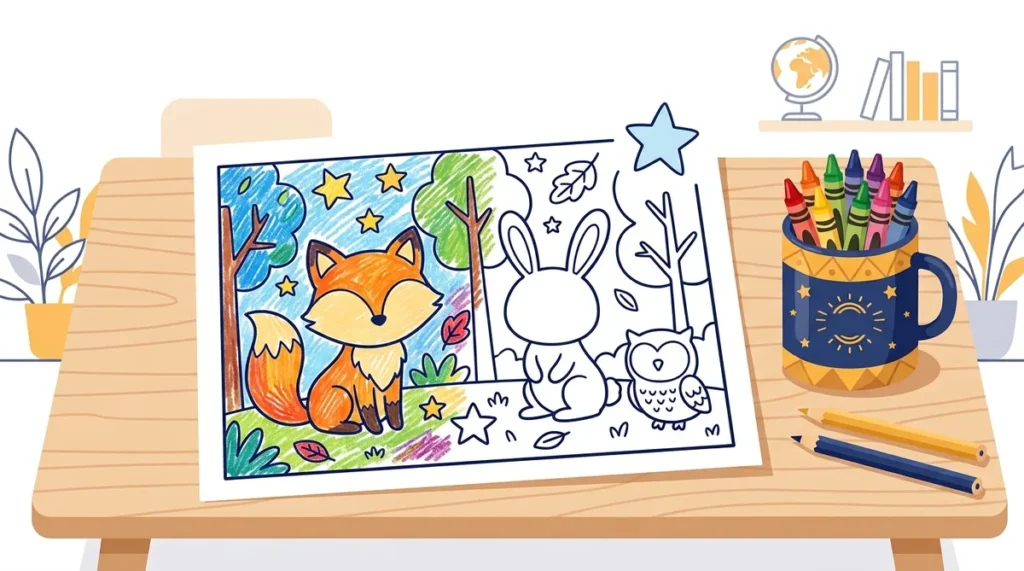
Coloring pages have a reputation as filler, something to hand out when the real lesson is over. In practice, a good coloring sheet does a lot of quiet work. It gives young children practice controlling a crayon, gives older ones a calm task while they listen or think, and can carry real content like vocabulary or math facts.
This guide covers what coloring practices, how teachers and parents use printable coloring worksheets well, and what to look for when you choose free printable coloring pages.
What coloring helps children practice
Coloring is simple, which is part of its value. Here is what a child is actually doing while they color a page.
Hand control and grip
Staying inside a shape asks the small muscles of the hand to make short, controlled movements. Children practice holding a crayon or pencil, adjusting pressure and stopping at a line. Those are the same movements they use when forming letters, which is one reason coloring so often has a place in preschool and kindergarten days.
The size of the spaces matters. Large shapes with thick outlines suit three and four year olds who are still learning to hold a crayon. Smaller spaces and thinner lines suit older children who already have good control and want more detail.
Using both hands together
While one hand colors, the other holds the paper steady. It sounds small, but young children often forget the helper hand, and the paper slides around. Coloring is an easy, low-pressure way to build that habit before handwriting and cutting.
Following directions
Color-by-number and color-by-code pages add a listening and reading step: “Color all the spaces with a 3 blue.” The child has to read the key, find the matching spaces and keep track of what is done. That is a useful practice in following multi-step directions, and it does not feel like a test.
Focus and a calm pace
Many teachers use coloring as a quiet activity because it has a clear start and finish and needs no talking. Children can work at their own pace, and the task is easy to pick up again after an interruption. For some children, having their hands busy also makes it easier to sit and listen.
How to use coloring worksheets in the classroom
The best uses connect the page to something else happening in the room. A few ideas teachers use often:
Morning arrival
Put a coloring page on each desk before students come in. It gives early arrivals something to do, lets you take attendance and talk to parents, and sets a quiet tone for the day. Pick a page connected to the week’s theme or read-aloud book.
Listening while coloring
During a read-aloud or an audiobook, let students color a page about the story’s setting or characters. Afterwards, ask them to add one detail from the story to their picture. The drawing becomes a quick check of what they heard.
Color-by-code for math review
Color-by-code sheets turn a set of math facts into a picture. Each space has a problem, and the answer tells the child which color to use. Mistakes show up as a color in the wrong place, so students can often find and fix their own errors. For ready-made pages that mix math and coloring, see our math coloring pages.
Vocabulary and labeling
After coloring an animal, a plant or a vehicle, students label its parts with words from a word bank. A coloring page about ocean animals becomes a science vocabulary page with almost no extra prep.
Early finishers and transitions
Keep a folder of coloring pages for students who finish early, and for the few minutes before lunch or dismissal. Because coloring has no right answer, it works for every level in the class. For more ways to use printables like this, see our list of low-prep teaching ideas.
Substitute plans
A coloring page tied to the current unit is an easy, reliable activity for a substitute teacher. It needs little explanation and keeps the class settled.
Using coloring pages at home
At home, coloring is useful for quiet time, waiting rooms, car trips and the half hour before dinner. A few ideas parents find helpful:
- Keep a small kit ready: a folder of printed pages and a pencil case of crayons. Ready-to-go means it actually gets used.
- Talk about the picture: ask what is happening, what colors they chose and why. For younger children this builds vocabulary.
- Let siblings share a theme: a simple page for a younger child and a detailed one for an older child, both about animals, means they can work side by side.
- Display the results: a finished page on the fridge tells a child their work matters.
Choosing free printable coloring pages
There are thousands of free printable coloring pages online, and quality varies. Before you print a stack, check a few things.
Line quality
Zoom in on the preview. Lines should be clean and closed, with no gray blur or broken edges. Pages traced from low-quality images often print with fuzzy lines that make coloring frustrating.
Right level of detail
Match the page to the child. Big, simple shapes for preschool. Moderate detail for early elementary. Older children often enjoy patterns, mandalas or detailed scenes.
Paper size
US classrooms print on US Letter paper. Pages made for A4 can lose their edges or shrink when printed. Check the print preview before you print a class set.
What you are allowed to do
Free does not always mean free for any use. Some sites allow personal use only, while others allow classroom copies. Check the terms on the site before printing for a whole class or sharing files with other teachers. For Eduminate files, our license page explains what is allowed.
If you want to try our pages first, the freebies page has free printable coloring pages you can download and print. When you need more, the full coloring pages collection is in the shop.
Printing tips that save time and ink
- Use the printer’s black-only or grayscale setting. Coloring pages are black line art, so color ink is wasted.
- For markers, print on heavier paper or cardstock if you have it. Regular copy paper can let markers bleed through.
- Print a single test page before a class set to check size and line darkness.
- Make a master copy and store it in a sheet protector, so you can photocopy again later without reprinting the PDF.
- For younger children, print one picture per page. Two small pictures on one sheet are harder to color neatly.
Making coloring part of a routine
Coloring works best when it has a regular place in the day, not only as a reward. A few options:
- A daily coloring page during morning arrival in preschool and kindergarten.
- A weekly color-by-code page for math review in first to third grade.
- A coloring page during a weekly read-aloud in upper elementary.
Children know what to expect, materials are ready, and the activity takes almost no instructions. That predictability is a big part of why coloring time tends to be calm.
Frequently asked questions
At what age can children start coloring?
There is no fixed age. Toddlers scribble long before they color inside a shape. Offer chunky crayons and pages with large, simple shapes once a child shows interest in staying near the lines, and let them go at their own pace.
Are coloring pages useful for older kids?
Yes, when the page matches their skills. Older children often enjoy detailed designs, color-by-code math or pages connected to a topic they are studying. Coloring can also be a calm activity while they listen to a read-aloud.
Can I print free coloring pages for my whole class?
It depends on the site’s terms. Some free pages are for personal use only. Check the license or terms of use on the site you downloaded from before making class copies.
Crayons, colored pencils or markers?
Crayons are best for young children because they are sturdy and easy to grip. Colored pencils suit detailed pages and older children. Markers give bright results but can bleed through thin paper, so print on heavier paper if you use them.