Motivational Posters for Classroom: Ideas and Printables
Motivational posters for the classroom are printable pages with short phrases such as “Believe in Yourself,” “Work Hard” and “Never Give Up,” made to hang on a wall or bulletin board. They work best when the words are big enough to read from the back of the room, when you change them often, and when you talk about the phrase with your class. A poster nobody discusses turns into wallpaper.
Phrase ideas that fit most classrooms:
- Believe in yourself.
- Work hard and be kind.
- Never give up.
- Mistakes help us learn.
- Do your best.
- Dream big.
The sections below cover how to choose wording, where to hang posters, ways to use them in lessons, and the printable sets we offer.

In this article (12 sections)
- What makes classroom motivational posters work
- Phrases that suit different moments
- Posters and positive affirmations
- Classroom decor that does a job
- Where to hang motivational posters
- Printable motivational posters
- Using posters in lessons
- Making a bulletin board display
- Using posters with early finishers and subs
- Matching words to behavior
- Frequently asked questions
- Related resources
What makes classroom motivational posters work
Look at the wall from a child’s seat. If you cannot read a poster from there, a child cannot either. A few simple rules help.
- Short phrases. Three to six words are easy to read and remember.
- Big lettering. Thick, clear letters work better than thin, fancy ones.
- Wording you can act on. “Try again” tells a child what to do. “Success” is just a word.
- Few pages up at once. Four or five at a time look tidy. Twenty at once become noise.
- Change them. A new page each week keeps the wall fresh and gives you a reason to talk.
Posters also have limits. A phrase on the wall does not change behavior by itself. It helps when you use the same words in the room, such as, “I see you tried again.” Children notice when the wall and the teacher say the same thing.
Phrases that suit different moments
Effort
Work Hard. Do Your Best. Never Give Up. Try Again. These suit a class working on a hard task, and they give you wording for praise.
Kindness
Be Kind. Help Others. Use Kind Words. Place these near the door or the line-up spot to set the tone at the start of the day.
Confidence
Believe in Yourself. You Can Do It. Stand Tall. These suit test weeks, presentations and the first days of school.
Positive outlook
Stay Positive. Think Positive. Be Happy. Have Fun. Keep them near the board or reading corner, where children spend long stretches.
Big goals
Dream Big. Aim High. Follow Your Dreams. These suit older children who set goals and plan ahead.
Posters and positive affirmations
Posters and positive affirmations go together. An affirmation is a short, kind sentence a child says about themselves, such as “I can try again.” A wall poster is something children read silently. An affirmation is something they say aloud, so the two support each other. Read a poster as a class at morning meeting, then let each child say it back in their own words.
Keep the wording honest and small. “I am learning” is easier to believe than “I am the best,” and children can tell the difference. If you want cards children can hold and read in pairs, the bundle below includes a set of affirmation cards.
Classroom decor that does a job
Decor is only worth the wall space if it earns its place. Bright borders and stars make a room feel cared for, and classroom decor that also carries a message does double duty. Choose a color scheme for the term, print the pages that fit it, and leave some wall empty for children’s own work. A room that looks lived in, with posters beside student writing, feels warmer than one covered edge to edge with print.
Where to hang motivational posters
- Next to the door. Children see the phrase as they come in and go out.
- Above the board. A single line there acts as the class motto.
- On a bulletin board. Group several pages as a display, such as “Our Growth Mindset Wall.”
- By the work area. Put effort phrases where children do hard tasks.
- In the hallway. A rotating line outside your door tells visitors what your class values.
Avoid blocking windows or covering the board space you use for teaching. A clean wall with a few posters beats a full wall.
Printable motivational posters
Two poster sets from Eduminate suit most rooms. Both are PDFs for all grades. The product pages say the files are A4 and print on US Letter with “Fit to page,” and you can use them at home or in one classroom.
- Motivational Posters for Classroom has 62 poster pages (65 pages in the PDF) and costs $7.99. Each page has a headline such as Think Positive, Be Your Best or Believe in Yourself, with five or six boxed phrases underneath. The pages use words, stars and a few small drawings of a sun, a flower, a rainbow and arrows. The product page says there are no photos and no pictures of people.
- Classroom Motivational Posters for Students has 26 poster pages (29 pages) and costs $3.99. It is a shorter run of bulletin board pages with phrases such as Work Hard, Never Give Up and Be Kind. The small drawings include a sun, a smiling flower, a rainbow and a comet, and the product page notes a star with a face.
Both sets put the words first. The larger set gives you a full year of weekly pages. The smaller set is cheaper and suits one classroom wall for a term.
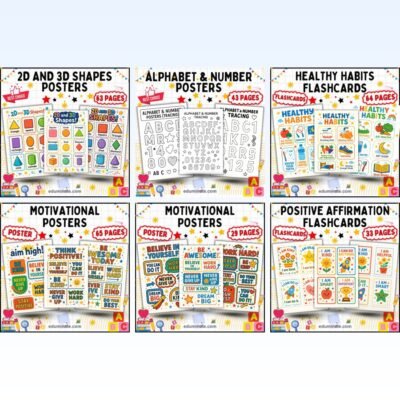
The Classroom Posters Bundle contains six PDFs and 297 pages. It includes both motivational sets, a Positive Affirmation Cards set, Healthy Habits Posters, Shapes Posters and Alphabet and Number Posters. The separate prices add up to $38.94 and the bundle costs $27.26, a saving of 30%. It suits a Pre-K to 3rd grade teacher who is setting up a whole room. Teachers of older grades may want only the first two sets.
For more on picking wording and arranging a display, see our post on growth mindset posters for classroom walls.
Using posters in lessons
A poster becomes useful when you talk about it. Try these quick routines.
- Phrase of the week. Hang a new page each Monday and read it together. Ask what the phrase looks like in the classroom.
- Morning meeting. Let a child choose a phrase and share a time they used it.
- Writing prompt. Ask children to write one sentence about a phrase, such as “I never gave up when I…”
- Journal starter. Use a phrase at the top of a page and let children continue it.
- Partner talk. Pairs choose their favorite phrase and explain why.
- Test week. Move a confidence phrase to the front of the room.
Making a bulletin board display
A bulletin board helps you group posters by theme. Here is a simple plan.
- Choose a title for the board, such as “Our Class Can” or “Try Again.”
- Pick four to six pages that match the theme.
- Pin them in a grid with a small gap between pages.
- Add a blank space for student work, such as a sentence about their favorite phrase.
- Change a page every week and move the older ones to a folder for later.
Keep a folder of used pages. You can bring them back later in the year when a class needs a reminder.
Using posters with early finishers and subs
- Early finishers. Give a child a poster page to read and a blank sheet. The child draws a picture for the phrase and writes a sentence about it.
- Sub plans. Leave a page for the day and a short note: “Please read the poster with the class and ask what it means.”
- Reading practice. The phrases are short and repeat across pages, which helps early readers.
- Home connection. Send one page home with a note asking the family to talk about it.
Matching words to behavior
The best posters match what actually happens in your room. If the wall says “Be Kind” and children push in line, add a short talk about what kindness looks like in line. Use the poster as a shared language. When a child holds the door, point to the phrase and say, “That is what kind looks like.”
Keep the tone gentle. Posters should invite, not scold. A child who is struggling does not need to hear “Never Give Up” as a command. They may need a smaller step and a calm voice.
Frequently asked questions
How many posters should I hang at once?
Four or five is plenty for most rooms. Rotate them so the wall stays interesting.
What grades are these posters for?
Both sets list all grades. The phrases are short and simple, so they suit young readers, and older children can use them as writing prompts.
Can I print just one page?
Yes. Each page is a normal PDF page, so you can print a single page or any set of pages.
Do the posters use pictures of children?
No. The pages use words, borders, stars and small drawings. Both product pages say the pages show no people.